
Archive
Category: Digital Technology
Article
Digital Technology
Subscribers
Object as Portal: Actual-Virtual Multi-Space of Temporary Urban Games Space
by Bramasta Putra Redyantanu, Yandi Andri Yatmo, Paramita Atmodiwirjo
pp. 171–194
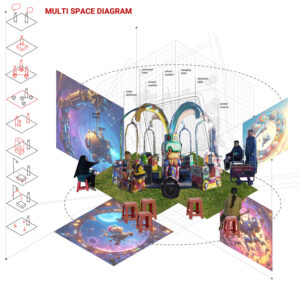
This study proposes utilizing AI text-to-image technology to project virtual multi-space onto the spatial operations of actual objects. The foundation of this research lies in demonstrating multi-space within urban game spatial practices. The interplay between actual and virtual notions of space recalls the multi-space concept. The actual-virtual relationship is infinite, potentially giving rise to virtual entities mirrored through spatial mechanisms and operations. Alun-alun, a public space in Indonesia, undergoes everyday time-based temporal-spatial alterations. Notably, it transforms into an imaginative game space at night. By constructing temporary spaces with simple game objects and mechanisms, we observe the potential for multi-space presence based on spatial operations. Generative AI, particularly text-to-image operations in architecture, can project game objects and their properties, revealing various virtual, imaginative multi-space alterations. The study’s findings contribute to expanding spatial design methods in architecture, envisioning collaboration between multi-non-physical spaces within the actual-virtual framework in a future digital realm.
Buy
Already in your cart -
View cart

Article
Digital Technology
Open Access
Architecture and Soft Kinetics: Scale and Performance
by Vera Parlac
pp. 69–86
Traditionally buildings are not designed to adapt to the dynamics of fluctuating environmental conditions or changing user needs. Even though today’s technical capabilities for kinetics have advanced significantly, the integration of stable and kinetic elements still presents challenges. The project described in this article integrates “soft” and “hard” elements to produce a dynamic material system that is self-supporting, pliable, and kinetic. It explores a kinetic and formal potential of integrating custom-made soft robotic muscles into a component-based surface. The developed prototype is a light modular construct, with components and patterns of aggregation that work in unison with the silicone muscles to produce a dynamic structure. The proposed material system can be used to construct a kinetic and “programmable” architectural skin that can be integrated with existing or new façade systems. The project is informed by
a history of pneumatic structures, the technology of soft robotics, and a kit-of-parts design strategy.
Article
Digital Technology
Subscribers
An Ontology of Robotic Architecture
by Mahesh Daas, Andrew John Wit
pp. 127–139
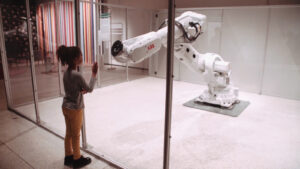
Robotics has recently found themselves more engrained within the ethos of architectural research and production. However, their relationship to architecture still remains to be understood. This article examines the relationship between robotics and architecture from an ontological standpoint. The article offers foundational frameworks and raises key questions to broadly define robotics in architecture.
Buy
Already in your cart -
View cart