
Archive
Tag: accessibility
Essay
Subscribers
Open-Air-Space: Inclusive Involvement within a Public Health Crisis
by Ulysses Sean Vance
pp. 365–384
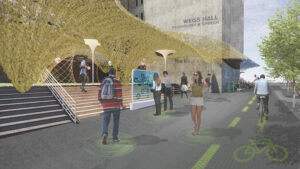
Since the eighteenth century, the healing arts have included open-air treatments, with the field hospital at the Royal Sea Bathing Infirmary near London being one of the earliest medical care facilities on record to successfully treat patients in this manner. Florence Nightingale began applying the principles of open-air treatment to architecture when she proposed an open-ward hospital design as a means to provide pure air to the sick. Her perspective would directly influence nineteenth- and early twentieth-century hospital design, which increasingly had to address the rising incidence of infectious diseases in cities. However, hospital design in the twentieth century began to rely on mechanically conditioned air rather than open-air spaces to provide filtered ventilation and reduce particulate contamination. In the twenty-first century, even as the world faces the public health crisis of the global COVID-19 pandemic, the Open-Air-Space Project conceptually revisits the open-air spaces of hospitals. The project basis is the “open plan,” whose structural origin is in part the Maison Dom-Ino system by Le Corbusier.
Buy
Already in your cart -
View cart
Article
Open Access
Waterscapes in Transformation: The Case of the Belgian Coastal Area
by Sis Pillen, Kris Scheerlinck, Erik Van Daele
pp. 743–766
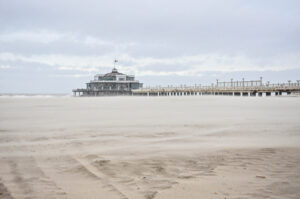
The socio-economic impact of nature in Belgian coastal landscapes on a regional scale is high due to their general attractiveness for visitors, their strongly developed tertiary service economy and other related sectors (tourism, residential, agriculture…). Due to climate changes however, these coastal landscapes and their required accessibility and continuous character are threatened by the unavoidable planned infrastructures (dikes, new connections, floodable areas, etc.) that will generate ruptures, frictions and additional transition spaces within the landscape. Flanders urgently needs to unfold policies and strategies to avoid or reduce the undesirable effects of the expected changes. Influential changes for the coastal zone will be sea level rising, increasing temperature, changing rainfall patterns, floods, fragmented ecological system, salinization, and reduced drainage capabilities to sea. A thoughtful planning policy forms the necessary key to a sustainable development. Policies and plans lead to the formulation of spatial proposals for mitigation and adaptation, to be executed by major infrastructural works planned for the next decades. Most of these infrastructures, conceived at a large scale, generate a different model of accessibility for the Flemish Coastal landscape.