
Archive
Tag: adaptive reuse
Article
Typology
Subscribers
The University and the City. A Project at Pisa’s Former Marzotto Complex
by Sara Stillavato, Francesca Molle
pp. 141–163
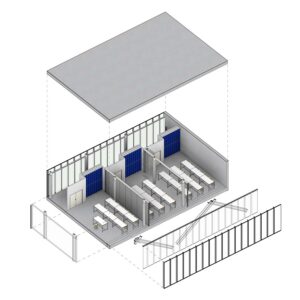
This article frames the expansion of the University of Pisa’s Fibonacci Campus as a threshold project: an interface between university and city operating within a historically stratified urban edge, where the former Marzotto industrial complex meets Pisa’s medieval walls. Building on contextual analysis of the site’s transformations – from twentieth-century rationalist factory to academic campus – this research discusses how new scientific programs can be inserted without compromising the legibility of the existing fabric. The design translates departmental needs for flexible laboratories and study environments into a spatial gradient that combines public accessibility and controlled research conditions. Ground-floor spaces are conceived as independently usable civic rooms, while open areas are reconfigured as shared green infrastructure that reconnects institutional and urban life. A comparative cost appraisal, developed from recent public tenders, frames feasibility from a public-client perspective and links adaptability of use to long-term economic sustainability. Rather than proposing a resolved model, the project advances a critical framework that makes legible the tensions between architectural intent, institutional governance, and civic appropriation inherent in any university expansion within a historic urban context.
Article
Landscape Urbanism
Subscribers
The Adaptive Island: Proving Ground for Temporal Awareness in the Anthropocene
by Dalia Munenzon, Kayci Gallagher
pp. 177–196
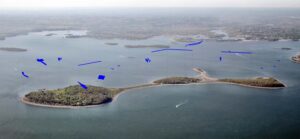
Peddocks Island is a 200-acre [80.9 ha] island which is part of The Boston Harbor Islands National Recreation Area (US). The island has limited public transportation and is rarely visited by humans. Its use and ecology has transformed throughout history and it is now positioned to transform again with climate change and rising sea levels. This article suggests that the island’s history, geology, mythology, and ecology situate it perfectly to experience climate change’s temporal and spatial impacts. Amitav Ghosh points out the need to communicate and narrate the uncertainty of the changing climate and build temporal awareness through narratives. In this work, we suggest the island as a “living lab,” available for both controlled observations and for the public to experience the realities of climate change. This article provides tangible and experiential concepts for Ghosh’s question by exploring mutable and ephemeral infrastructure design strategies
Buy
Already in your cart -
View cart
Essay
Open Access
The SEA Is Coming: The Future of a Marine Research Facility
by Ursula Emery McClure
pp. 415–438
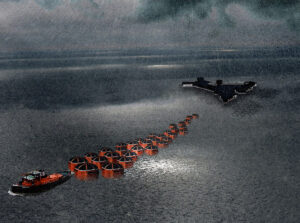
This paper originates from a Louisiana State University School of Architecture Research Studio. Charged by the organization’s Director, the students investigated the Louisiana Universities Marine Consortium (LUMCON) facility and environment, and re-imagined both the building and landscape as a cutting-edge (albeit remote) research and educational destination. “The SEA Is Coming” Integrative-Design Studio proposes adaptation to climate change as a means to investigate the transformative capacity of a site. Going far beyond the boundaries of current (and future) building program, the studio method provoked profound rethinking of current conventions about coastal change and occupancy, design, community, the environment, and land use. LUMCON’s facility sits at the nexus of deltaic land, freshwater, brackish wetland, and salty ocean and provides access to all these systems. It has withstood the volatility of this environment: flooding, hurricanes, oil spills, the Gulf dead zone, salt-water intrusion, etc. Now over thirty-years-old, the building must adapt to changing conditions. The studio investigated LUMCON’s ability to continue functioning in its changing environment and further its indispensable research capabilities of the rapidly changing coastal landscape.