
Archive
Tag: AI

Essay
Theory
Subscribers
Train Yourself: Architectural Recycling Between Digital and Physical Realities
by Andy Bako
pp. 21–43
As generative AI reshapes architectural practice, a critical paradox emerges: while new computational tools offer unprecedented creative possibilities, the physical resources essential to building grow increasingly scarce. This paper investigates how architecture can productively engage this tension through novel approaches to material recycling and digital transformation. Rather than treating physical and virtual domains separately, this research proposes an integrative framework where design emerges through continuous feedback between material manipulation and computational processing. The exhibition Train Yourself demonstrates this methodology, presenting a series of experimental artifacts that evolve through iterative exchanges between physical material, AI-driven formal exploration, and imaging techniques. These hybrid objects gain definition through recursive operations that blur boundaries between physical construction and digital representation. Beyond resource conservation, this approach reveals how architectural practice might cultivate new forms of creative intelligence capable of navigating between material constraints and computational possibilities. The findings of this research suggest a mode of practice where designers orchestrate dynamic interactions between physical matter, algorithmic processes, and human intention, pointing toward a more nuanced understanding of ecological sensitivity in contemporary design practice.
Buy
Already in your cart -
View cart

Essay
Subscribers
To Think a New Thing: AI, Metaphor, and the Fantasies of Knowing
by Karel Klein
pp. 303–315
This essay aims to explore the unexpected intersection of AI-generated images, metaphor, and fantasies of knowledge. Expanding on the notions of metaphor in the philosophy of Jose Ortega y Gasset, we view the AI-generated images (such as those from mis-trained StyleGAN models) as ‘objects’ in possession of an inherent surplus that transcends their perceived qualities and constituent parts. Metaphors reveal latent qualities of ‘objects’ that extend beyond human perception. We consider how these image-objects operate not merely as generators of visual metaphors but as metaphor-like entities themselves, shifting our perception of reality. As a result, these image-objects behave like disembodied expressions of a new kind of knowledge. This feeling, or fantasy of knowledge, is what Steven Connor calls ‘epistemopathy.’ By examining the interplay between human imagination, AI-generated outputs, and the epistemopathic experiences they evoke, we explore how AI becomes a manifestation of the human desire for expanded knowledge and imaginative exploration. In the blurring of the boundaries between our own understanding and AI’s perplexing output, we are confronted with a sort of knowledge boundary that conflates reverie with reasoning.
Buy
Already in your cart -
View cart
Article
Digital Technology
Subscribers
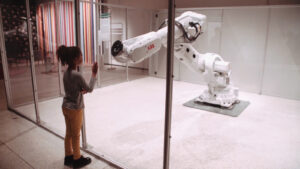
An Ontology of Robotic Architecture
by Mahesh Daas, Andrew John Wit
pp. 127–139
Robotics has recently found themselves more engrained within the ethos of architectural research and production. However, their relationship to architecture still remains to be understood. This article examines the relationship between robotics and architecture from an ontological standpoint. The article offers foundational frameworks and raises key questions to broadly define robotics in architecture.
Buy
Already in your cart -
View cart