
Archive
Tag: archipelago

Essay
Urbanism
Subscribers
A Prairie Archipelago
by Martin Hättasch, Dean Almy
pp. 91–118
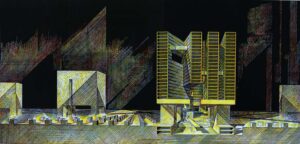
The Green Archipelago, introduced by Oswald Mathias Ungers in 1977 in response to Berlin’s depopulation, amplified a lack of urban coherence by reducing the city to a series of idealized urban islands floating on a green “sea.” This framework established a dialectical relationship between zones of urban intensity – islands – and a diffuse, low-intensity landscape – the sea. Within this duality of formal control and laissez-faire, the island preserves the authority of architectural form and serves as the site of concentrated urbanity. Conversely, the “sea” is the city’s antithesis – defined not by its content but by its emptiness. But how can the dialectic of the archipelago be sustained – or initiated – under conditions of rapid urban expansion, when the starting point is an urban landscape that, in its entirety, resembles the “sea”? Building on research into the periphery of Austin, TX, this essay proposes a conceptual reversal of the archipelago without abandoning its fundamental principles: where Ungers’ dialectical agency resides in the island’s architectural morphology, the Prairie Archipelago shifts this agency to a landscape capable of producing friction, limits, and differentiation from within.
Essay
Theory
Subscribers
The Contemporary City as Archipelago: From O.M. Ungers’ Berlin to the Global Collage City
by Gregorio Froio, Monica Manicone, Matteo Benedetti
pp. 45–65
This essay critically examines the continuing relevance of the archipelago city – as theorized by Oswald Mathias Ungers in the 1970s – as a morphological and conceptual framework for understanding contemporary urban conditions. Originally developed in response to the fragmentation and depopulation of post-war Berlin, the archipelago city posits a model of urban organization based on autonomous, differentiated spatial units or ‘islands’ within a continuous green matrix. The essay situates this model within a broader theoretical lineage, drawing connections with Colin Rowe’s “collage city,” Aldo Rossi’s theories of typology and memory, and Rem Koolhaas’s concept of “junkspace.” Through morphological and compositional analysis, it explores how Ungers’ vision has been reinterpreted in projects from the 1990s to the present, including proposals by Franco Purini and Laura Thermes. These case studies highlight the adaptability of the archipelago paradigm in the contexts of accelerated urbanization, formal heterogeneity, and socio-political complexity. Finally, the essay reflects on the limitations and potentials of the model in an age marked by globalized urban development, the rise of the zone and the increasing marginalization of architectural agency.
Buy
Already in your cart -
View cart