
Archive
Tag: architecture
Essay
Narration
Subscribers
The Evolving Shape of Post-Cold War Space: Architecture, Empire, and Spatial Sovereignty in the Arctic
by Eric Nay
pp. 7–21
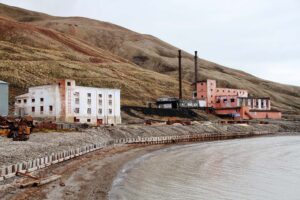
Svalbard is warming faster than anywhere else on Earth. Average temperatures are up, and sea ice is declining. Life there means having to adapt to longer summers and shorter, warmer winters. Svalbard, a Norwegian Arctic Archipelago located midway between mainland Norway and the North Pole, and the spectral presence of abandoned Soviet-era coal mining towns on the peninsula are the subjects of this paper. Shaped by Soviet coal mining, this essay is framed by an analysis of spatial haunting and Cold War/neocolonial aspirations and current anxieties around climate change. Evidence is rendered concrete through abandoned industrial architecture and the combined spectres of war and climate catastrophe in the region. This conceptual framework provides a setting for the analysis of Pyramiden, an abandoned Soviet coal mining town on Svalbard. It serves to explore the Arctic as more than terra nullius; rather, it presents a region of ambiguous spatial sovereignty produced in the interstices of governance. This highlights an evolving spatiality that rests on Arctic fantasies and imaginaries materialized in “haunted” sites like Pyramiden.
Article
Subscribers
Digital Participatory Design as a Tool for Inclusive and Democratic Post-conflict Reconstruction in Damascus, Syria
by Karam Alkatlabe
pp. 429–450
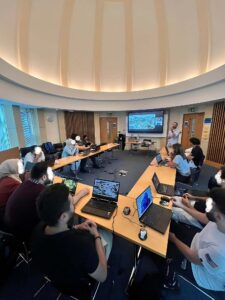
This research investigates the implementation of digital participatory design to include the engagement of externally displaced persons (EDPs) in envisioning the future of their neighborhoods in post-conflict cities. In a world where conflicts cause large-scale displacement, the conventional top-down framework for reconstruction cannot achieve democratic and sustainable recovery as it excludes EDPs. It has become critical to shift toward a digital, bottom-up participatory approach to steer the reconstruction of space. This study is the first to investigate how EDPs can remotely participate in rebuilding their destroyed cities. It offers insights into how architects and urban recovery practitioners can emphasize the critical role of architecture in enhancing democracy in post-conflict cities. The findings show that a participatory approach helps engage EDPs and leads to an inclusive democratic reconstruction process. Digital participatory practice can also increase drivers of democracy, including social cohesion and citizens’ sense of ownership, and legitimize reconstruction planning. Despite its challenges and limitations, this approach assists architects in forming a deeper understanding of the contextual challenges facing destroyed cities to facilitate creating spaces shaped by the input of EDPs.
Buy
Already in your cart -
View cart

Article
Theory
Subscribers
Three Aspects of Nostalgia: Thoughts on the Work of Aldo Rossi
by Edna Langenthal, Hagit Leshem
pp. 153–175
This essay discusses various aspects of the term “nostalgia.” Rather than an individual plight, it will be considered here as a symptom of contemporary society, which does not stand in contrast to modernity but is derived from it. Nostalgia characterizes humans’ connections to the past, to their sense of self, home and community. We reflect on how this affects our longing for home, how we envision our collective home, and how we place ourselves in the world. We distinguish three types of nostalgia: Restorative, longing for the restoration of a lost home; Utopian, transforming our longing into a utopian ideal; and Reflective, which differs by shifting the focus from recovering what is perceived as a loss of absolute truth to pondering questions of history and the passing of time. The essay focuses on nostalgia’s bearing on architecture, as demonstrated in the work of Architect Aldo Rossi. His oeuvre, in which the contemplation of time and memory are inherent, reveals all three forms of nostalgia, highlighting and questioning their centrality to architectural thought and practice.
Buy
Already in your cart -
View cart
Article
Theory
Open Access
The Meta-Project, Eisenman, and Capital: Lessons for Critical Architectural Practice
by Cem S. Kayatekin, Ujal Gorchu, Mikhail Frantsuzov
pp. 133–151
How does Peter Eisenman’s conception of the meta-project relate to capital? Within much of the relevant discourse, the Eisenmanian ideal of achieving autonomy from politico-economic dynamics is underscored, with strict references to the notion of capital remaining absent from the literature. However in studying narratives articulated by Eisenman himself over the course of several lectures spanning several decades, a more integrated connection with capital begins to emerge—wherein Eisenman’s conception of capital not only shapes later stages of the meta-project evolution but even seems to partially shape the anti-phenomenological position, anchoring it in its formative stages. These findings offer a distinct counterpoint to the Eisenmanian meta-project, both in terms of its efficiency at achieving distance from politico-economic dynamics and, more fundamentally, in terms of its presumed apolitical anchoring. However, far from being solely applicable to a scholarly niche, these discursive wrinkles offer contemporary practitioners a proactive theoretical framework for how to structure meta-projects to better resist contemporary capitalistic intricacies, and avoid the paths which led Eisenman’s own meta-project being appropriated by dominant politico-economic dynamics.

Article
Reflective Practice
Subscribers
Why the Energy Transition Needs Designers
by Thomas Auer, Ulrike Andres, Wolfgang Fiel
pp. 69–84
This study is based on the work of Vienna-based architectural firm Delugan Meissl Associated Architects. Together with a group of experts, the office has developed an exemplary approach for the energy transition in the field of architecture and landscape design on the basis of five concrete scenarios. The authors maintain that the energy transition is not only subject to technical solutions but of equal importance to designers, which they underpin by policy frameworks on climate change in the DACH region. Since all five design scenarios are located in Austria, the study focuses on the situation there. The authors view the scenarios as concrete examples and practical guidelines for the implementation of similar projects at a municipal level by providing local decision-makers with concrete planning tools. The design is focused on photovoltaic energy provision since the implementation of such systems currently has the greatest financial incentives and the lowest implementation hurdles in terms of legal frameworks in the DACH region.
Buy
Already in your cart -
View cart
Article
Cross-Disciplinary Studies
Open Access
Design for COVID-19: Rethinking an American Campus and the Dilemma of the Second Wave
by Aneesha Dharwadker
pp. 147–164
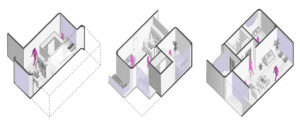
In 2020, the presence of COVID-19 forced, among other serious reflections, a reevaluation of how university spaces are used and how higher education may achieve efficacy while protecting public health. This essay presents work from a Fall 2020 graduate studio at the University of Illinois at Urbana-Champaign that explores how the campus could adapt to the specifics of social distancing and offer new kinds of outdoor and indoor spaces for learning and living. From the materiality of the ground plane to the layout of campus residences, the projects reimagine the campus at the scales of the site, building, and rooms. While the built environment can be viewed as a passive backdrop (or worse, an active culprit) in public health crises, this studio argues that strategic and thoughtful design, anchored by distancing recommendations of the Centers for Disease Control and Prevention, could also be a remedy.
Article
Subscribers
The Engaged Project: Representation, Dissent, and the Architecture of Public Space
by Jennifer Akerman
pp. 341–362
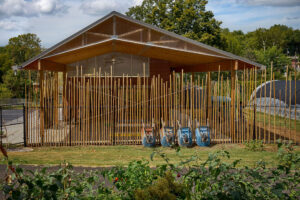
Vandalism is an alternative form of design narrative, a subversive practice of reading architecture and urban systems, and a fundamental way key voices can be heard. Architects, city planners, officials and the public should value such reads as constructive engagement enriching the life of a built work. Architecture usually results from elaborate systems of power, capital, and privilege - though its presence affects everyone in the city. In the periphery of public space, dynamic alternative practices emerge that communicate and critique. Vandalism, especially in areas of contested “ownership” in public space, is an architectural counterpoint, a dissent available to people without conventional means of power. It is intrinsically linked to the pedestrian experience of cities, and therefore opens reconsideration of walking as knowing, especially in an urban terrain vague [empty lot]. Technologies of sharing allow us to broadcast transgressions, track goings on, exploit urban problems for artistic gain, and conduct vandalism in public space. Focusing attention on a public farm building designed collaboratively within an urban park will frame broader discussion of these complex relationships at work, specifically considering vandalism as a form of engagement.
Buy
Already in your cart -
View cart
Article
Housing
Open Access
Project Strategies and Evaluation Methods for Contemporary Social Housing
by Romina Marvaldi, Elisabetta Pani
pp. 45–57
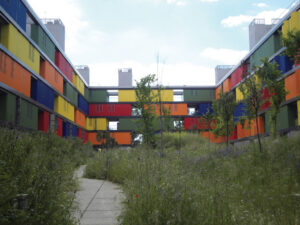
The deep social transformations occurred in the last decades have deeply affected the patterns of urban living. In this sense, experimentation on housing plays the dual role of investigation and validation of our hypothesis that residential space should reflect new life-styles. At the beginning of the 21st century, social housing represents the main field for experimentation.In the current architectural scenario, many interesting experimentations on contemporary housing can be observed.The approach proposed in this article starts with post-occupancy evaluation of some case-studies extracted from extensive research on European case-studies realized projects. It then analyzes the results of such evaluation to abstract issues concerning different aspects of contemporary living that could be coped at the design level. This method combines spatial and typological research, issues about housing and planning approaches developed by the promoters of the case-studies discussed. Providing quality social housing involves the coordination of multiple actors and synergies..
Essay
Theory
Open Access
The Absurd Alibi
by Joseph Godlewski
pp. 7–14
Published: 2016-01-28
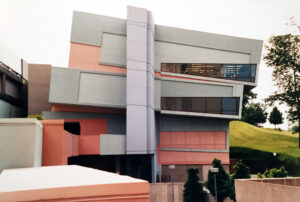
Generated from a discussion at the Fall 2015 ACSA Conference in Syracuse, New York, this article tackles the very topic of the conference (“Between Autonomous and Contingent Objects of Architecture”). It reflects on projects of autonomy (new and old) asking what they contribute to architecture as a discipline and profession. What, if anything, is at stake in such projects? It discusses some contemporary examples of autonomous and object-oriented theories of architecture. While autonomy originally posed a radical challenge to ways architecture was made and reasoned, this article contends that the critical energy generated with that challenge has been exhausted and replaced with disengaged copies of earlier experiments. It is unclear what insights these newer versions provide to architectural discourse. This article further conjectures that the socio-economic context in which autonomy re-emerges today is fundamentally altered leaving its advocates in a much more precarious position than the exponents of previous iterations of architectural autonomy. It concludes that notions of architectural autonomy are an absurd alibi, incommensurate with a discipline so constrained by social and economic expectations as architecture.
Article
Theory
Open Access
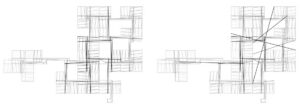
Designed and Emergent Tectonics: Resituating Architectural Knowledge
by Sophia Psarra, Fani Kostourou, Kimon Krenz
pp. 15–32
Architecture is usually defined through intent while cities come into being out of multiple human actions over a long period of time. This seems to trap us between a view of architecture as authored object, and a view of the city as authorless, evolutionary process. The debate about the autonomous and the contingent object thus, goes back to the separation of architecture from its skill base in craft and building practice that took place in the Renaissance. This separation also includes the operations through which buildings and cities are produced by designers, clients, users, regulatory codes, markets and infrastructures. The resurgence in the debate on the competing claims of autonomy and contingency testifies that since the Renaissance we have failed to develop theories and techniques that address the relationship between authored architecture and authorless contexts. As a result, coupled with commercial forces, recent advancements in digital technology and complexity theory claim architecture and the city as self-organization, dismantling architecture and depriving it from relevance in shaping social capital. If in the Renaissance, architecture was separated from the city, which was the relationship between the ways in which a city was built and the urban fabric? How can we better understand the relationship between the architectural project and the processes that configure the urban structure in which it is situated? This paper argues that for architecture to reclaim its scope as a social discipline it needs to theorise its relationship with the social, the political and the economic processes of its context.