
Archive
Tag: artificial intelligence
Article
Digital Technology
Subscribers
Object as Portal: Actual-Virtual Multi-Space of Temporary Urban Games Space
by Bramasta Putra Redyantanu, Yandi Andri Yatmo, Paramita Atmodiwirjo
pp. 171–194
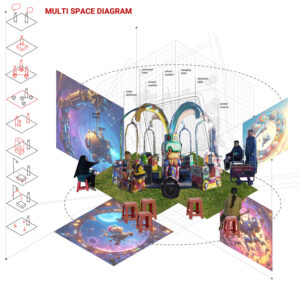
This study proposes utilizing AI text-to-image technology to project virtual multi-space onto the spatial operations of actual objects. The foundation of this research lies in demonstrating multi-space within urban game spatial practices. The interplay between actual and virtual notions of space recalls the multi-space concept. The actual-virtual relationship is infinite, potentially giving rise to virtual entities mirrored through spatial mechanisms and operations. Alun-alun, a public space in Indonesia, undergoes everyday time-based temporal-spatial alterations. Notably, it transforms into an imaginative game space at night. By constructing temporary spaces with simple game objects and mechanisms, we observe the potential for multi-space presence based on spatial operations. Generative AI, particularly text-to-image operations in architecture, can project game objects and their properties, revealing various virtual, imaginative multi-space alterations. The study’s findings contribute to expanding spatial design methods in architecture, envisioning collaboration between multi-non-physical spaces within the actual-virtual framework in a future digital realm.
Buy
Already in your cart -
View cart
Essay
Subscribers
AI and Design Synthesis: Hybridity and Hybrid Form
by Karim W. F. Youssef
pp. 335–348
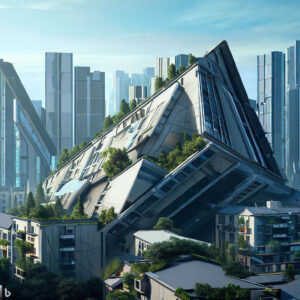
AI, as a gamechanger, is revolutionizing the architectural and urban scenes so drastically that the way our buildings and cities will look like and be experienced will fundamentally change. The overarching purpose of the paper is to take a modest step towards understanding the paradigmatic role of AI in changing the form of our built environments. The paper conceptualizes AI’s role in the design process as essentially the suggestion of hybrid solutions, transforming the nature of the built environment to a hybrid between its static and non-static, real and virtual forms. The basic question to pose is the role of AI technology in assisting the design process, gearing it towards the creation of hybrid forms that redefine the relationship between humans and their built environment in a meaningful way and that also address the complex problems of our contemporary society which hinge upon the resilience of the architecture and urban form of the space we inhabit. AI technology is being increasingly embedded into our inhabited environment affecting the built expression of architecture as well as the process and practice of designing architecture.
Buy
Already in your cart -
View cart

Essay
Subscribers
Site and AI: A Paradigm Shift
by Genevieve Baudoin, Bruce A. Johnson
pp. 319–333
AI’s potential is in its ability to sift through vast amounts of contextual data that can drive design decisions. It offers the opportunity to process information about a virtually limitless number of subjects, at a conscious or unconscious level. This has created what Thom Mayne describes as a “paradigm shift” in our perception of site. The architect can now curate, directing results based on AI to restore specificity to projects that, through the distance created between the real site and the computer model, we have lost along the way. We rely on technological workarounds to fix many designable issues in our buildings – an over-reliance on climate control, a willingness to place buildings directly in harm’s way (i.e., building on flood plains), and an ignorance of the context of a site (from archeology to gentrification). This paper offers a provocation: AI can create a return to site and construction sensibilities by harnessing layered data sets such as orientation, topography, climate, or even social fabric. Can AI chart a course towards less reliance on technological band-aids in the production of building?
Buy
Already in your cart -
View cart
Opinion
Cross-Disciplinary Studies
Open Access
Baukultur in a Cybernetic Age: A Conversation
by Michael A. Arbib, Meredith Banasiak, Robert Condia, Colin Ellard, Jonathan Enns, Melissa Farling, Robert Lamb Hart, Richard Hassell, Eduardo Macagno, Harry Mallgrave, Fred Marks, Juhani Pallasmaa, Sarah Robinson
pp. 7–28
We received and we gladly publish this conversation among distinguished theorists and scholars on an important topic, also aligned with the cross-disciplinary mission of our journal. [MS]
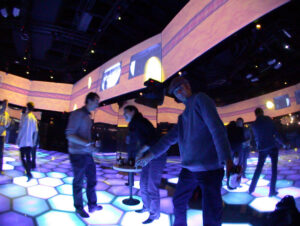
ABSTRACT - The article offers a multi-author conversation charting the future of architecture in light of the apparent tension between Baukultur, which combines the culture of building and the building of this culture, and the rapid changes brought about by digital technology, embracing cybernetics and artificial intelligence. The article builds on a discussion of Baukultur to debate in what sense buildings are “machines for living in,” then examines neuromorphic architecture wherein cybernetic mechanisms help buildings sense the needs of their occupants. It closes with an example of a building complex, Kampung Admiralty, that combines cybernetic opportunities with a pioneering approach to building “community and biophilia” into our cities. This article interleaves an abridged version of Michael Arbib’s (2019) article “Baukultur in a Cybernetic Age,” 1 with extensive comments by the co-authors.