
Archive
Tag: Critical Call
Exhibition Review
Criticism
Open Access
Make New Critical Stories. A View on the 2017 Chicago Architecture Biennial
by Maurizio Sabini
pp. 219–231
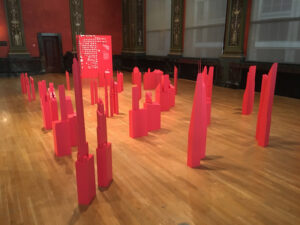
The 2017 edition of the Chicago Architecture Biennial, Make New History, like any other similar event, has caused debate and controversy. Beyond inevitable flaws and shortcomings, the CAB though deserves to be appreciated for the quality of most of the exhibited projects, works or installations, some of which managed also to offer what was missing in this CAB’s main theme: a critical perspective. The theme itself of the CAB is challenged, but the good works of many international architects and artists, well selected by the Artistic Directors Sharon Johnston and Mark Lee, is appreciated for their contributions to a critical discourse in our field, for their “critical stories.” Through a discussion of the curators’ hypothesis and of some of the most interesting works, as well as of some critical contributions included in the exhibition catalog, this review tries to offer a critical assessment for an event that, fortunately, has already acquired an outstanding position within the architecture cultural landscape of our time.
Essay
Theory
Open Access
The Act and Art of Architectural Critique: A Drawing, a House, and a Sign
by Andreea Mihalache
pp. 25–38
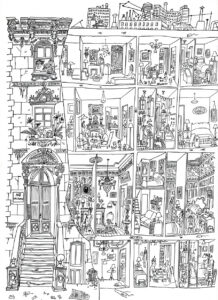
The role of criticism is not to split, but rather to bring matters together in an assembly. Philosopher Bruno Latour makes the argument that the responsibility of the critic, (and, implicitly, critique), is not to divide, but instead to “offer the participants arenas in which to gather.” In light of Latour’s proposition, I will examine the generative and creative role of architectural criticism and some of the many guises under which it might take shape. I propose that the critical call of architecture is often hidden in plain sight in works that camouflage themselves under seemingly disengaged positions, and which, upon closer inspection, act as resources of architectural imagination. Specifically, I examine Saul Steinberg’s drawing “Doubling Up” (1946), the Splitnik (the American model-house showcased at the American Exhibition in Moscow, 1959), and Robert Venturi’s sign for the Grand’s Restaurant (Philadelphia, 1961-1962)
Article
Theory
Open Access
Planning Criticism: Operative Contingencies in the Project of the Italian Tendenza
by Pasquale De Paola
pp. 31–44
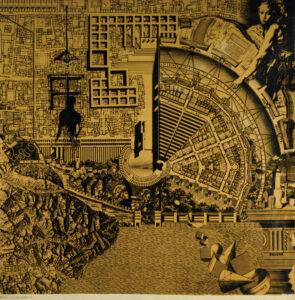
In order to re-assess architecture’s critical role and redefine the disciplinary domain of its production, this essay looks beyond forms of technocratic utopias, while it historically analyzes operative theoretical contingencies relative to the “project” of the Italian Tendenza, which is examined as an historical form of ideological criticism of the discipline of architecture and its contentious relationship between intellectual and capitalistic production. Particularly, this essay explores the ideological and historiographical production of the 1960s and 1970s. This was when the term Rationalism and its theoretical body of work acquired renewed prestige replacing the ephemeral aesthetic of the Modern Movement with a grounded and critical discourse based on Aldo Rossi’s and Massimo Scolari’s position relative to the need for architecture to re-affirm its own statute, in order to free itself from any form of technocratic utopia. While questions of interdisciplinarity remain essential toward an understanding of future architectural contingencies, it is only by questioning the status quo of architecture and re-examining its past that a new sense of criticality can be generated.
Essay
Theory
Open Access
Towards an Ethical Technique: Reframing Architecture’s “Critical Call” through Hannah Arendt
by Paul Holmquist
pp. 17–29
This paper examines how the critical vocation of architecture might be reclaimed through reconsidering the interrelationship of technique and politics in light of the political philosophy of Hannah Arendt. I argue that Arendt’s conception of a fabricated common world that is essential to establishing a properly human sense of reality opens up ways to rethink the constitutive political role of architecture. As a discipline, architecture comprises an "ethical technique" by which to guide the fabrication of the condition of "the common," and to constructively embody the recognition of a primary political reality arising out of human plurality. In so doing, architecture can projectively envisage and prepare for the emergence of a potential politics alternative to the apparatus of capital.