
Archive
Tag: democratic space

Essay
Subscribers
At Scale: Democracy in the Balance
by Edgar G. Adams
pp. 351–373
Democracies are in decline. Some blame the erosion of the public realm and proliferation of digital media for a decline in the means of authentic discourse and our capacity for building meaningful consensus. American democracy was uniquely shaped by the struggle against the tyranny of the Crown, and tenaciously clings to individual liberty and land ownership. Most European democracies evolved more gradually alongside hereditary monarchies maintaining stronger communal values. Consequently, many of our prized urban models and most vibrant public spaces, were created under aristocratic regimes or in republican city states with powerful religious influences. What can these examples teach us about the current potential for “democratic space” and what can we learn from its present impediments? This essay surveys the evolution of urban settlements in response to a range of influences, culminating with an examination of a potential combination and transformation of two paradigms, one historic and one contemporary, to create an urban framework that is reflective of democratic principles at various scales for our reflection and debate.
Buy
Already in your cart -
View cart
Essay
Open Access
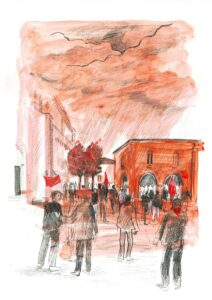
Exploring Expressed Democratic Attempts in Space: Architecture and Landscape in Pier Paolo Pasolini
by Riccardo Maria Balzarotti, Luca Maria Francesco Fabris
pp. 389–403
This article explores the works of Pier Paolo Pasolini, focusing on the interplay between his artistic output and spatial themes like architecture and landscape, particularly as they reflect democratic values. Pasolini viewed space as a physical entity and a site for political, social, and cultural interaction. By examining locations such as Friuli and Casarsa della Delizia, Pasolini’s youth environment, the paper delves into how these landscapes shaped his vision of democratic spaces. It also connects Pasolini’s perspective to contemporary public spaces, which, like his poetics, emphasize the role of dissent in democracy. The article further investigates how modern urban developments may limit this potential for democratic engagement by prioritizing aesthetic and commercial objectives over historical and social memory. Additionally, Pasolini’s involvement in education and local politics illustrates how spaces like schools and civic centers become arenas for resistance and public discourse. Ultimately, the essay argues that spaces become truly democratic when they foster active engagement and dissent, as reflected in Pasolini’s works and the symbolic power of place.