
Archive
Tag: density

Essay
Theory
Subscribers
The Contemporary City as Archipelago: From O.M. Ungers’ Berlin to the Global Collage City
by Gregorio Froio, Monica Manicone, Matteo Benedetti
pp. 45–65
This essay critically examines the continuing relevance of the archipelago city – as theorized by Oswald Mathias Ungers in the 1970s – as a morphological and conceptual framework for understanding contemporary urban conditions. Originally developed in response to the fragmentation and depopulation of post-war Berlin, the archipelago city posits a model of urban organization based on autonomous, differentiated spatial units or ‘islands’ within a continuous green matrix. The essay situates this model within a broader theoretical lineage, drawing connections with Colin Rowe’s “collage city,” Aldo Rossi’s theories of typology and memory, and Rem Koolhaas’s concept of “junkspace.” Through morphological and compositional analysis, it explores how Ungers’ vision has been reinterpreted in projects from the 1990s to the present, including proposals by Franco Purini and Laura Thermes. These case studies highlight the adaptability of the archipelago paradigm in the contexts of accelerated urbanization, formal heterogeneity, and socio-political complexity. Finally, the essay reflects on the limitations and potentials of the model in an age marked by globalized urban development, the rise of the zone and the increasing marginalization of architectural agency.
Buy
Already in your cart -
View cart
Article
Subscribers
Central State Infill: Middle Housing Solutions in Oklahoma City, USA
by Francesco Cianfarani
pp. 423–444
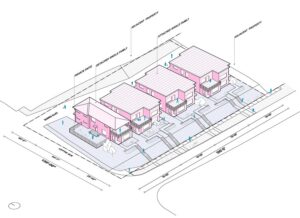
The essay discusses the urban form problem in contemporary American mid-size cities, and the relationships between urban growth and residential models, in the light of ongoing demographic, economic, and environmental phenomena. Rediscussing typical urban growth models in American cities is key for the sustainable future of these communities. In a time of significant climatic transformation, traditional city models must be updated to generate renewed climate-resilient urban forms. That means reducing waste heat and greenhouse gas emissions through compact neighborhoods that integrate energy efficiency with transit and walkability. The first part of the essay introduces the topic of urban growth in the United States. Ongoing urbanization is considered in relationship to emerging climate phenomena, change in demographics, and housing market trends. The second part discusses the current planning debate in Oklahoma City (OKC), one of the largest and most populated cities in Central United States. In addition, the essay presents a selection of recent infill housing developments for OKC’s urban core, discussing how they are contributing to the debate on sustainable urban growth in the city.
Buy
Already in your cart -
View cart
Essay
Urbanism
Subscribers
Reconfronting Sprawl: Still Paved with Good Intentions as Well as Asphalt
by Doug Kelbaugh
pp. 187–199
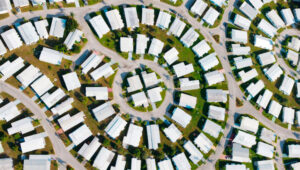
This paper, based on the author’s new book The Urban Fix: Resilient Cities in the War against Climate Change, Heat Islands and Overpopulation (2019), culminates over three decades of researching, teaching, and writing on American sprawl. One of the country’s biggest and most familiar problems, it could be described as a conspiracy of good intentions: short-sighted desires to live in nature; traffic safety engineers’ preference for wide thoroughfares; fire marshals’ desire to turn around hook-and-ladder trucks at the end of every cul-de-sac, etc. Over half of American homes are single-family dwellings – 69 million out of a total of 132 million. The fatal flaw is that these positive intentions quickly led to very high energy/carbon/ecological footprints per suburbanite – a challenge that is difficult because of extensive, indelible infrastructure. Densifying arterial strips, inserting transit, redeveloping a walkable, bikeable, mixed-use, and human-scaled urbanity is as urgent as it is essential in the nation’s effort to combat climate change.
Buy
Already in your cart -
View cart