
Archive
Tag: displacement
Article
Subscribers
Digital Participatory Design as a Tool for Inclusive and Democratic Post-conflict Reconstruction in Damascus, Syria
by Karam Alkatlabe
pp. 429–450
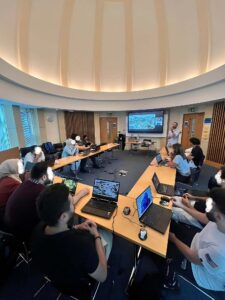
This research investigates the implementation of digital participatory design to include the engagement of externally displaced persons (EDPs) in envisioning the future of their neighborhoods in post-conflict cities. In a world where conflicts cause large-scale displacement, the conventional top-down framework for reconstruction cannot achieve democratic and sustainable recovery as it excludes EDPs. It has become critical to shift toward a digital, bottom-up participatory approach to steer the reconstruction of space. This study is the first to investigate how EDPs can remotely participate in rebuilding their destroyed cities. It offers insights into how architects and urban recovery practitioners can emphasize the critical role of architecture in enhancing democracy in post-conflict cities. The findings show that a participatory approach helps engage EDPs and leads to an inclusive democratic reconstruction process. Digital participatory practice can also increase drivers of democracy, including social cohesion and citizens’ sense of ownership, and legitimize reconstruction planning. Despite its challenges and limitations, this approach assists architects in forming a deeper understanding of the contextual challenges facing destroyed cities to facilitate creating spaces shaped by the input of EDPs.
Buy
Already in your cart -
View cart
Essay
Criticism
Subscribers
Vernacular Architecture on Display: From Exhibited Artifact to Operative Discourse
by Stamatina Kousidi
pp. 35–56
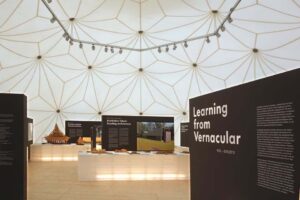
This article sets out to interrogate the exhibition as an essential form of critical discourse in architecture, looking at how it has engendered new conceptual and operative approaches to the vernacular notion. Focusing on the late 20th century, it explores how the exhibition space contributed to the praise of the vernacular as a valid design reference, by creating a platform for its renewed, consistent, and systematic reinterpretation. This praise did not entail the recovery of history but the redefinition of the relation between tradition and concepts of modernity, building and pre-existent context. The exhibition space thus served as a catalyst to the return of the vernacular model; it enabled new connections between project, travel, and theoretical discourse, engaging ever more international audiences. In recent exhibitions such a model manifests itself again through full-scale models, mock-ups, and pavilions that prioritize issues of materiality, construction, and experience. The article, ultimately, explores the vernacular as a cogent theme which may hold the key for a more inclusive, culturally-rooted, and holistic approach to the design of the built environment and its interpretation.
Buy
Already in your cart -
View cart