
Archive
Tag: ecology
Essay
Urbanism
Subscribers
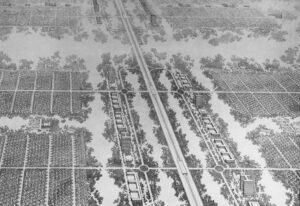
From Totality to Relationality: Ludwig Hilberseimer’s Superblock and the Relational Urban Form
by Liang Wang
pp. 63–89
This essay examines two interrelated concepts – the superblock and the relational urban form – through the urban studies of Ludwig Hilberseimer. It advances three arguments. First, it situates Hilberseimer’s superblock within his broader project to reform the city and its architecture through a socio-ecological framework – an effort largely overlooked in twentieth-century architectural history. Second, it repositions the superblock within the lineage of modern urban formations, emphasizing its transitional role from the implementation of the master plan toward the instrumentalization of relational form. Third, it demonstrates his superblock proposition enables relational urban formations across scales and geographies and, therefore, remains relevant to contemporary urbanism. The essay argues that Hilberseimer’s superblock is not a fixed compositional entity but a proto-relational form: a spatial system structured by interdependence, hierarchy, and part-to-whole relations. Through close analysis of texts, drawings, and diagrams, it reveals a multi-scalar framework operating across building, settlement, and regional levels. Relational urban form thus emerges as an operational principle – one that mediates scales, accommodates changes, and organizes urban transformations incrementally.
Article
Landscape Urbanism
Open Access
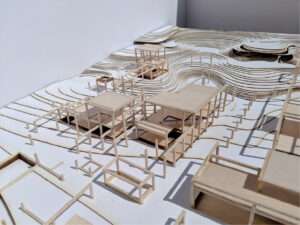
Ecologies of Leisure: Reimagined Architectures and Landscapes of Leisure and Infrastructure
by Carla Aramouny
pp. 197–218
The research detailed in this paper revolves around an ecological and spatial exploration for a derelict coastal area in Lebanon. It frames the possibility for an agile ecological approach to design, one that builds upon the latent derelict aspects and persisting disconnections in this specific area and that reimagines a potential new reality intermeshing the natural with the human and the infrastructural with the architectural. Within the format of a research undergraduate studio, the approach and work discussed here present possible synthetic scenarios for coastal developments in Lebanon, and suggest alternative production, programmatic, and ecological strategies.
Article
Subscribers
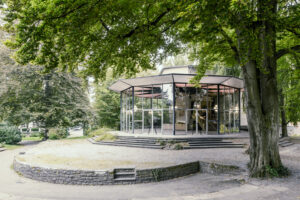
On the Work of Lisbeth Sachs: From the Aesthetic to the Environmental Impact of Architecture
by Stamatina Kousidi
pp. 481–501
Characterized by continuity, inventiveness, and a fervent exploration of the relationship between architecture and the environment at large, the work of Lisbeth Sachs was included in the 1979 issue of the Aktuelles Bauen magazine on women and architecture. This contribution proposes an in-depth review of Sachs’ underexplored work, suggesting a better understanding of her role as a practicing woman architect at a time when this task was not a matter of course. It places an emphasis on the dialogue Sachs established with her contemporaries, on the dense network of experiences that shaped her design approach, and on the ways it intersected with the late twentieth-century discourse on the relationship between architecture, ecology, and nature. It is not coincidental that the work of Frei Otto would have a long-lasting influence on Sachs’ design experimentation, informing her theoretical and applied design projects. Her design exploration, too, was influenced by the technological advances, the societal changes and the shifts in the cultural agency of architecture, proposing each time a solution that addressed, rather than excluded, its surrounding context, cultural, physical, or environmental.
Buy
Already in your cart -
View cart
Essay
Open Access
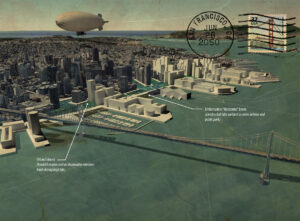
Between Land and Sea: An Approach for Resilient Waterfront Development along the San Francisco Bay
by Gabriel Kaprielian
pp. 273–294
The waterfront along the San Francisco Bay is facing a growing threat from sea-level rise. By the end of the century, a projected sea-level rise of 55 in. [140 cm] will affect an estimated 128 sq. mi. [331 km2] of urban development valued at $62 billion. In addition, 2.1 million people and 660,000 homes are estimated to arrive by 2040, adding to the 7 million current Bay Area residents. Furthermore, sea-level rise will affect the ecology of the San Francisco Bay, threatening to submerge the majority of existing tidal wetlands by mid-century. To combat sea-level rise, many are calling for increased shoreline protection, while others suggest the removal of urban development in areas at risk of inundation, allowing tidal wetlands to migrate to higher elevations. In this proposal, I demonstrate that both may be accomplished by a managed retreat of existing development, enabling wetland migration, while introducing a resilient new typology of development built on levees that is designed to co-exist with a tidal ecosystem, enabling new relationships between urban life and bay ecology that redefine the coastal boundary.
Article
Cross-Disciplinary Studies
Open Access
Landscape as a Conceptual Space for Architecture: Shifting Theories and Critical Practices
by Michelle Laboy
pp. 77–96
Architecture constantly negotiates the ideal and the real. These two conditions, being a reflection of cultural values and practices, change over time. I suggest that what remains constant to architecture are the lasting spatial and formal qualities that engage in constructing the physical and cultural landscape: how it channels natural light and air, how its permanent structures organize space, frame and supports life, shelter, protect and comfort. There are the qualities that make architecture endure and adapt to a changing cultural and natural environment. The placement of architecture in the real world often seems contaminated by a multiplicity of socio-economic structures and processes, but its situation in the world is also what provides an opportunity to engage in the making of a landscape where over time architecture finds a critical autonomy and relevance. The role of architecture in making or responding to the landscape is one of the critical questions in current debates about autonomy and contingency. In this paper, I expand on the work I presented at the ACSA conference at Syracuse University in the Fall of 2015, where I explored how the discipline of architecture has absorbed the landscape as a conceptual space, to “theorize critical means of engagement with the formal, spatial and performance qualities of its territory, to define critical contingencies that are meaningful through space and time, and to refuse those that can keep it tied to the trivialities of a temporary situation.” More specifically, my work examines how the notion of the ecological permeates the architecture discipline from the field of landscape, providing a framework for architectural discourse to theorize the relationship of the idealized and the real, to create new singular form within a situation of multiplicity.