
Archive
Tag: exhibitions
Essay
Criticism
Subscribers
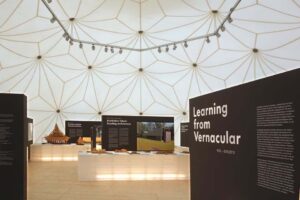
Vernacular Architecture on Display: From Exhibited Artifact to Operative Discourse
by Stamatina Kousidi
pp. 35–56
This article sets out to interrogate the exhibition as an essential form of critical discourse in architecture, looking at how it has engendered new conceptual and operative approaches to the vernacular notion. Focusing on the late 20th century, it explores how the exhibition space contributed to the praise of the vernacular as a valid design reference, by creating a platform for its renewed, consistent, and systematic reinterpretation. This praise did not entail the recovery of history but the redefinition of the relation between tradition and concepts of modernity, building and pre-existent context. The exhibition space thus served as a catalyst to the return of the vernacular model; it enabled new connections between project, travel, and theoretical discourse, engaging ever more international audiences. In recent exhibitions such a model manifests itself again through full-scale models, mock-ups, and pavilions that prioritize issues of materiality, construction, and experience. The article, ultimately, explores the vernacular as a cogent theme which may hold the key for a more inclusive, culturally-rooted, and holistic approach to the design of the built environment and its interpretation.
Buy
Already in your cart -
View cart
Article
Open Access
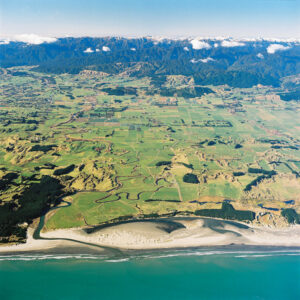
Climate Change Adaptations for Coastal Farms: Bridging Science and Mātauranga Māori with Art and Design
by Martin Bryant, Penny Allan, Huhana Smith
pp. 497–518
Indigenous coastal farming communities need to address future climate change impacts, yet many communities are slow to respond, due to lack of adequate information, economic pressures, the abstract nature of climate change science and poor communication between what science knows and what indigenous farming communities need to know. Art and design can address these issues by synthesizing broad scientific principles with local place-specific culture and their visual language can effectively communicate short and long-term benefits to local communities. Art and design are thus both generative research methods and media for representation. This research uses art and design to provide a bridge between the Māori culture of a local farming community in coastal New Zealand and climate change science. It provides a framework of strategies for new farm practices. Underpinned by the qualitative awareness of thresholds and an open-ended toolbox of land-based strategies, the role of the framework is to catalyze adaptation. The framework is responsive to both the Māori worldview and scientific knowledge, and has the potential to provide a model for other coastal communities.