
Archive
Tag: form
Essay
Subscribers
Tracing Democratic Space of a Public Square: The Case of Square Victoria in Montreal
by Karim W. F. Youssef
pp. 499–516
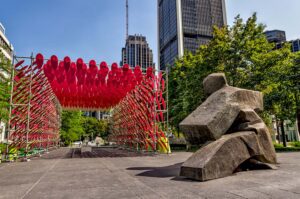
The question of design for democratic space may be formulated through the lens of effect on subjectivity. Under that lens, the paper borrows Norberg-Schulz’s spatial notion of domain to denote the spatial openness of place for gathering things within it, revealing and making their presence tangible through its spatiality. Thus, it follows that good design of a democratic space is a synthesis of form and image in its embodiment of difference and multiplicity. A democratic space is an architectural image of the city as a whole, an image that reflects the psyche as a spatial mode of being. To advance our understanding of the socio-political dimension of space and to take an initial step toward the design of democratic space, the paper revisits the tracing of the morphological development of a public square in downtown Montreal, Square Victoria, as a leitmotif of urban change since its inception in 1810 as a hay market and subsequent effect on subjectivity that its successive redesign promoted.
Buy
Already in your cart -
View cart
Essay
Urbanism
Open Access
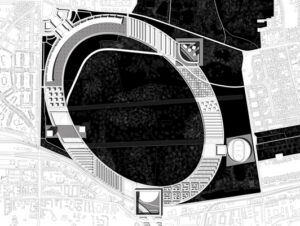
Form after Urbanism: The Potential of Grossform
by Martin Hättasch
pp. 59–76
Published: 2016-01-28
Grossformen im Wohnungsbau is the title of an unassuming pamphlet that German architect O.M. Ungers published in 1966 as part of the Veröffentlichungen zur Architektur series (VzA #5) during his tenure at the TU Berlin in the 1960’s. In it Ungers reimagines the singular architectural intervention at a scale between architecture and urbanism as a counter measure to the rapid urbanization brought about by Europe’s postwar boom. The formal coherence of Grossform (literally meaning “large form” in German) could provide a framework within which the unplannable processes of the contemporary city played out, while acting as stable markers of identity in an expanding urban field of increasing formlessness. Many of the ideas introduced in Grossformen would resurface throughout Ungers’ career, and eventually find their way into the better known Green Archipelago project. But where the morphologically pure islands in the Green Archipelago form a “dialectic city” only as a federation of ideal fragments, the scaleless concept of Grossform equally suggests the possibility of the island itself becoming a “dialectic object,” containing the exacerbated differences of the archipelago within. Faced with an urban environment in which traditional tools of urbanism have come to be swept away irrevocably by a limitless proliferation of building production, this reconsideration of the urban agency at the architectural scale appears highly pertinent today. Reconstituting the conceptual underpinnings of Grossform and outlining the trajectories of the “dialectic city” and “dialectic object” in reference to Ungers’ work, this paper aims to contribute to the (re)emergent debate on the conditions and constitutions of the architectural object: Through the combination of programmatic neutrality and formal specificity, Grossform may serve as the starting point for a contemporary paradigm in which the architectural object carries renewed urban relevance beyond its bounded form.