
Archive
Tag: history

Article
Theory
Subscribers
Three Aspects of Nostalgia: Thoughts on the Work of Aldo Rossi
by Edna Langenthal, Hagit Leshem
pp. 153–175
This essay discusses various aspects of the term “nostalgia.” Rather than an individual plight, it will be considered here as a symptom of contemporary society, which does not stand in contrast to modernity but is derived from it. Nostalgia characterizes humans’ connections to the past, to their sense of self, home and community. We reflect on how this affects our longing for home, how we envision our collective home, and how we place ourselves in the world. We distinguish three types of nostalgia: Restorative, longing for the restoration of a lost home; Utopian, transforming our longing into a utopian ideal; and Reflective, which differs by shifting the focus from recovering what is perceived as a loss of absolute truth to pondering questions of history and the passing of time. The essay focuses on nostalgia’s bearing on architecture, as demonstrated in the work of Architect Aldo Rossi. His oeuvre, in which the contemplation of time and memory are inherent, reveals all three forms of nostalgia, highlighting and questioning their centrality to architectural thought and practice.
Buy
Already in your cart -
View cart

Article
Open Access
Salt as a Building Material: Current Status and Future Opportunities
by Vesna Pungercar, Florian Musso
pp. 393–413
Identifying materials that can substitute rare natural resources is one of the key challenges for improving resource efficiency in the building sector. With a growing world population and rising living standards, the amount of salt (sodium chloride) produced as waste through seawater desalination and potash mining processes is increasing. Unfortunately, most of it is disposed of into nature where it causes environmental pollution. On the other hand, salt is affordable and can be used therapeutically in various respiratory treatments and to store humidity and heat. It was, therefore, necessary to determine salt materials already in use in building construction. The aim of this research was to identify those that have been used in history and analyzed in scientific studies, to investigate their physical and mechanical properties, and to identify the most promising applications in the construction field. This was accomplished via literature review, classifying the salt materials into three groups (raw salt, composite salt, and processed salt). It was found that salt has been used as a building material for centuries and has potential for future applications.
Article
Open Access
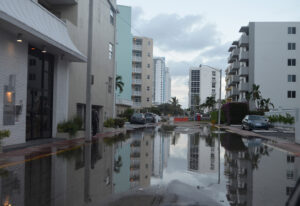
Miami Rising: Historical Perspectives on Sea Level Rise as a View into the Future
by Eric Firley, Victor Deupi
pp. 367–387
Miami is a city whose diversity and vibrant growth has made it an ideal destination for international travel, business, and leisure. However, South Florida is a hurricane prone region, and the threat of sea level rise and erosion poses an immediate and long-term risk to the stability of the city and its region. The city and the scientific community have been studying the phenomenon for some time now, proposing solutions to the management of such threatening uncertainty. Yet the quest for coastal resilience is not a new phenomenon. Since ancient times human settlements have entertained a complex relationship to the water. This paper will explore how several cities throughout history have dealt with flood resilience challenges and consider how historical attempts to adapt and address such problems can provide new spatial strategies for Miami’s future. Aware of the fact that such a study cannot reveal technical solutions for the twenty-first century, the emphasis will be given to an understanding of the correlation between socio-economic identity, attitude towards defensive action, and the type of organization needed for concerted action.