
Archive
Tag: informality
Article
Cross-Disciplinary Studies
Subscribers
Research by Drawing: Imagining the Otherwise in Rio de Janeiro’s Metropolitan Peripheries
by Rodrigo d’Avila, Irene Luque Martín
pp. 41–61
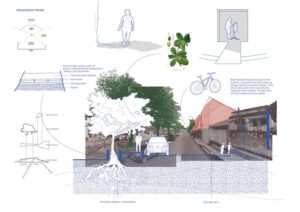
This article explores the use of drawing as a research method to reimagine ecological, social and spatial changes in urban areas undergoing global urbanization. Focusing on the rapidly transformation of the landscape of Seropédica on the outskirts of Rio de Janeiro, the article frames urbanization as a contested process in which multiple histories and temporalities coexist. Rather than treating informality and nature as issues to be resolved, the article proposes a pluriversal urban ecology that centers the “otherwise”: informal, marginalized and non-human forms of life. The article introduces “research by drawing” as an alternative where drawing makes visible what is excluded from conventional planning. Three visual methods reveal Seropédica’s overlooked dynamics. We trace the shifting relationships between rural life, logistics and symbolic erasures, translate a transect into a performative score, documenting rhythms and human–non-human encounters and overlay narratives to expose the multiplicity of urbanization. The findings depict this metropolitan periphery as a fragmented yet interconnected mosaic, challenging binaries such as formal/informal and city/nature and emphasizes the importance of the otherwise for achieving just and ecological urban futures.
Essay
Open Access
Resilient Edges: Exploring a Socio-Ecological Urban Design Approach in Metro Manila
by Stephen Gray, Mary Anne Ocampo
pp. 519–561
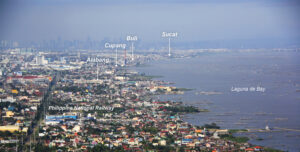
With the notable uptick of natural disasters impacting densely-populated areas, attention to the subject of urban resilience has increased among ecologists, economists, engineers, social scientists, and designers. But despite an extraordinary cross-disciplinary interest in a single subject, the urban resilience discourse has remained largely siloed by discipline. This essay builds on concepts of resilience from ecology and social science and positions urban design (in itself at the intersection of architecture, planning, and landscape architecture) as uniquely situated for integrating and operationalizing various concepts of urban resilience. The authors propose a socio-ecological urban design approach that bridges natural, human, and spatial systems and is empirically grounded in historical research, field observations, and interviews with informal settler families (ISFs) living along the shoreline of Laguna de Bay in Metro Manila. The findings revealed that while many were affected by regular flooding and issues of housing security, these were not necessarily deciding factors when determining where to live. In response to programs which emphasize out-of-city relocation, authors developed three principles of urban resilience that instead spatially integrate formal and informal communities.