
Archive
Tag: innovation
Article
Landscape Urbanism
Subscribers
Knowledge Infrastructure for Coastal Infrastructure: The Y02A Patent Initiative and Site-Based Climate Adaption Strategies
by Richard L. Hindle
pp. 131–155
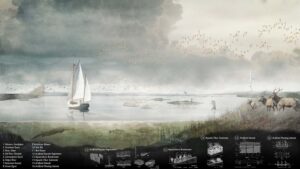
Innovation in climate adaptation and resilience practices is among the most critical issues in architecture, design, and planning. This essay explores how coastal adaptation and resilience planning processes may be informed by the Y02A patent classification scheme to design advanced forms of site-specific coastal infrastructure. The Y02A scheme covers the “technologies for adaptation to climate change,” organizing coastal, riverine, and urban climate adaptation innovations into distinct sub-classes, with the aim of building technical capacity and coordinating discovery in related sectors. The mechanisms and processes through which these novel technologies are invented, tested, translated, and implemented within environmental design and planning praxis remain largely unknown, creating opportunities for new methods of knowledge exchange to be developed. To address the unique, and potentially transformative relationship, important aspects of the Y02A classification scheme are introduced in conjunction with a case study analysis from 2017/18 Resilience by Design Bay Area Challenge in California, during which the Common Ground Team utilized patent innovation studies to conceptualize site-based adaptation and resilience strategies for the San Pablo Baylands.
Buy
Already in your cart -
View cart
Article
Open Access
Territory and Technology: a Case Study and Strategy from the California Delta
by Richard L. Hindle, Neeraj Bhatia
pp. 243–271
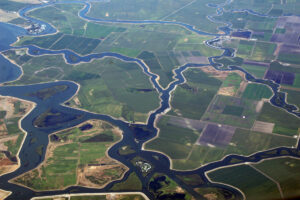
The notion of the resilient edge is perhaps most emblematic in deltaic landscapes, which are a landscape form par excellence of edge conditions - both for their fluctuating natural boundaries and complicated relationship with anthropogenic forces. Given this juxtaposition, it is worthwhile to revisit the early history of deltaic transformation and urbanization — from surfaces to edges — to gain insights into the future resilience of these landscapes and strategies for their redesign. In this essay, we investigate the early history of the California Delta, starting with the Swamp Lands Act of 1850, to gain insights into how policy and technology territorialized this vast inland estuary. We then reformulate this history as a contemporary strategy for the design of deltaic landscapes and introduce a pedagogical experiment to test our observations.