
Archive
Tag: landscape urbanism
Essay
Urbanism
Subscribers
A Prairie Archipelago
by Martin Hättasch, Dean Almy
pp. 91–118
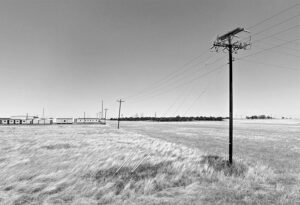
The Green Archipelago, introduced by Oswald Mathias Ungers in 1977 in response to Berlin’s depopulation, amplified a lack of urban coherence by reducing the city to a series of idealized urban islands floating on a green “sea.” This framework established a dialectical relationship between zones of urban intensity – islands – and a diffuse, low-intensity landscape – the sea. Within this duality of formal control and laissez-faire, the island preserves the authority of architectural form and serves as the site of concentrated urbanity. Conversely, the “sea” is the city’s antithesis – defined not by its content but by its emptiness. But how can the dialectic of the archipelago be sustained – or initiated – under conditions of rapid urban expansion, when the starting point is an urban landscape that, in its entirety, resembles the “sea”? Building on research into the periphery of Austin, TX, this essay proposes a conceptual reversal of the archipelago without abandoning its fundamental principles: where Ungers’ dialectical agency resides in the island’s architectural morphology, the Prairie Archipelago shifts this agency to a landscape capable of producing friction, limits, and differentiation from within.
Article
Landscape Urbanism
Subscribers
The Adaptive Island: Proving Ground for Temporal Awareness in the Anthropocene
by Dalia Munenzon, Kayci Gallagher
pp. 177–196
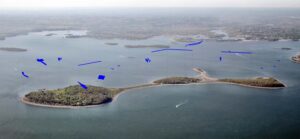
Peddocks Island is a 200-acre [80.9 ha] island which is part of The Boston Harbor Islands National Recreation Area (US). The island has limited public transportation and is rarely visited by humans. Its use and ecology has transformed throughout history and it is now positioned to transform again with climate change and rising sea levels. This article suggests that the island’s history, geology, mythology, and ecology situate it perfectly to experience climate change’s temporal and spatial impacts. Amitav Ghosh points out the need to communicate and narrate the uncertainty of the changing climate and build temporal awareness through narratives. In this work, we suggest the island as a “living lab,” available for both controlled observations and for the public to experience the realities of climate change. This article provides tangible and experiential concepts for Ghosh’s question by exploring mutable and ephemeral infrastructure design strategies
Buy
Already in your cart -
View cart
Essay
Cross-Disciplinary Studies
Open Access
An Urban/Landscape Project for the Venice Lagoon
by Claudio Aldegheri
pp. 191–207
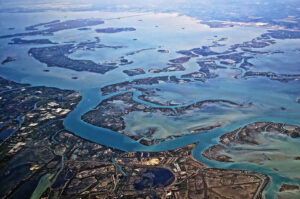
In recent years, in the Venice lagoon we have seen an increasing number of urban planning projects with a low level of flexibility, which have not seized the opportunities offered by such a rich and complex context. This study is therefore about how to approach the project in this area, aiming to give value to its many different landscape aspects and attempting to reconsider in general the attitude to urban planning.
Article
Open Access
Between Land and Sea: Reshaping the Belgian Coastline A Case Study between Ostend and Blankenberge
by Wim Wambecq, Bruno De Meulder
pp. 721–741
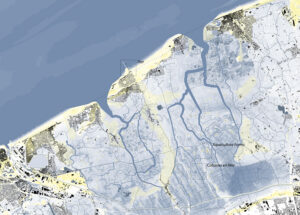
Over time, the Belgian coast has developed into a hard-engineered straight defence line - from the sea inwards - of flat beaches, dykes and a storm wall that is reaching its capacity limits. New plans are being developed in some parts of the coast aiming to raise the storm walls up to “acceptable” levels, based on climate change and sea level rise predictions. This follows the trends of raising river protection walls, but continuously insists on the linear urban structure of the coastline: beaches, dyke, urbanization wall on the dunes and housing proliferation into the back polders. These are often low-quality holiday houses built for the summer season rush. This essay investigates an alternative future for the Belgian coast through research-by-design. The design exploration proposes to seize the opportunity of the increased peril, predicted from climate change and subsequent sea level rise. Furthermore, it proposes a shift from hard to soft engineering and a dynamic tidal landscape within which the tourism economy is reinvented.