
Archive
Tag: Le Corbusier
Essay
Theory
Subscribers
In Search of the New Eden. From Le Corbusier’s Boîte to Sejima’s Curtain
by Javier Pérez-Herreras
pp. 115–132
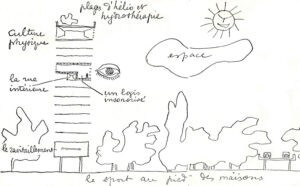
Le Corbusier’s Unité d’Habitation in Marseille established the relationship between an old man and a new world that arrived. This old self found in the interior of a long rectangle a domestic Eden that was once lost. The exterior was still a place for waiting, a place to be seen, writes Beatriz Colomina. But this modern Eden could not last forever: his indoor paradise had to move. In 1999 Terence Riley inaugurated at the Museum of Modern Art of New York the Un-private House. In it, he discovers a new dweller that does not occupy the interior of that domestic laboratory, but its own limits. Contemporary man is a social being, Jose Pardo asserts. His public self is moved to a liminal threshold, writes Victor Turner, that Kazuyo Sejima turns into the new house. Architecture is no longer the air volume contained within its limits, but that which prowls said limits. The new domestic home of contemporaneity becomes a porosity line: a curtain that publicizes domestic life. The house is converted into a habitat of borders, where man discovers his new domestic Eden.
Buy
Already in your cart -
View cart
Essay
Theory
Open Access
On the CIAM 7 Grid: From an Ideological to a Critical Tool
by Pierre-Alain Croset, Andrea Canclini
pp. 89–117
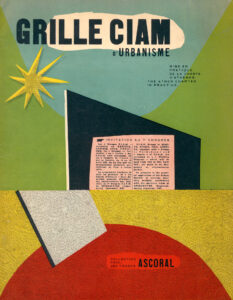
Much historiographical research has been produced on the post-war CIAMs, demonstrating the importance of the CIAM Grid, proposed as a “thinking tool” for representing the town planning projects at the CIAM 7 in Bergamo (1949). This essay proposes a new critical and epistemological examination of the CIAM Grid based on new archival documents and on a rereading of the exact words used by Le Corbusier, who proposed to consider the Grid as an “interlocutor.” Seventy years later, we propose to go beyond the failure of CIAM 7 and to elaborate a “new Grid,” with the name of “Second Life Grid,” as a critical tool for discussing exclusively projects related to the new paradigm of recycling and reusing buildings and urban spaces. Beginning with the question of the critical legacy of the CIAM Grid, our intention was to think of a Grid conceived no longer as an instrument of dogmatic and normative thought, but as an instrument of dialogical criticism which has been tested through an open call for projects and an international conference held in Bergamo in October, 2019.
Conference Report
Theory
Open Access
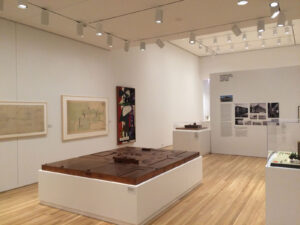
“Ando and Le Corbusier: Masters of Architecture” Symposium
by Eric Mumford
pp. 233–236