
Archive
Tag: Ludwig Hilberseimer
Essay
Urbanism
Subscribers
From Totality to Relationality: Ludwig Hilberseimer’s Superblock and the Relational Urban Form
by Liang Wang
pp. 63–89
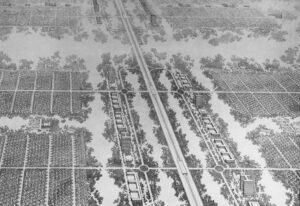
This essay examines two interrelated concepts – the superblock and the relational urban form – through the urban studies of Ludwig Hilberseimer. It advances three arguments. First, it situates Hilberseimer’s superblock within his broader project to reform the city and its architecture through a socio-ecological framework – an effort largely overlooked in twentieth-century architectural history. Second, it repositions the superblock within the lineage of modern urban formations, emphasizing its transitional role from the implementation of the master plan toward the instrumentalization of relational form. Third, it demonstrates his superblock proposition enables relational urban formations across scales and geographies and, therefore, remains relevant to contemporary urbanism. The essay argues that Hilberseimer’s superblock is not a fixed compositional entity but a proto-relational form: a spatial system structured by interdependence, hierarchy, and part-to-whole relations. Through close analysis of texts, drawings, and diagrams, it reveals a multi-scalar framework operating across building, settlement, and regional levels. Relational urban form thus emerges as an operational principle – one that mediates scales, accommodates changes, and organizes urban transformations incrementally.
Essay
Subscribers
At Home with the Collective: Hilberseimer, Labor Unions, and the Women’s Movement
by Alexander Eisenschmidt
pp. 299–323
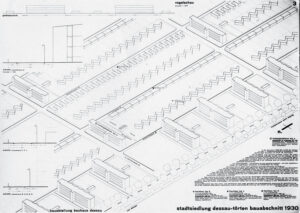
While housing could be described as one of the basic forms of architecture and one of its main responsibilities, if not today’s most crucial task, architecture has largely ceased to rethink established forms of living and the politics and economies that surround it. Escaping the pervasive models of profit-based home ownership in the West seems increasingly difficult when housing is dominated by neoliberal market values. Already at the beginning of the twentieth century, however, some architects struggled with similar conditions within the metropolis. Ludwig Hilberseimer’s proposals for new types of living for a new kind of liberated individual are particularly instructive today as they rethought housing as a right, allied with unions in order to rethink its financial models, and learned from activists in the Women’s Movement to question the dominant narratives around heteronormative family structures and domestic labor. In our time of ballooning housing costs, stagnant wages, failed trickle-down economics, and shortages of affordable housing, these urgencies have not lost but only gained momentum.
Buy
Already in your cart -
View cart

Article
Criticism
Subscribers
Bauhäusler and the Second Chicago School of Architecture: Enduring Student Exercises
by Kristin Jones, Zaida Garcia-Requejo
pp. 219–241
On March 28, 2019, on the occasion of Ludwig Mies van der Rohe’s 133rd birthday, the Illinois Institute of Technology’s Mies van der Rohe Society displayed an exhibition at S. R. Crown Hall entitled “Stories from the Archives” as part of the larger event theme of “Bauhaus Descendants” in the year of its centenary. The exhibition proposed connections between the Bauhaus and IIT’s school of architecture through a display of archival materials related to the work of the former Bauhäusler Ludwig Mies van der Rohe, Ludwig Hilberseimer, and Walter Peterhans who founded the modernist school at IIT. This paper provides a deeper investigation of the exhibit’s proposed connections and the relationship between the Bauhaus and IIT’s architecture school through the lens of three enduring student exercises: the court house problem, the planning sequence, and visual training exercises. Considering these three exercises in relation to the curriculum that was developed at IIT shines light on a philosophy of architectural education which started in Europe, matured in Chicago and continues to evolve into the future.
Buy
Already in your cart -
View cart