
Archive
Tag: modernism
Article
Cross-Disciplinary Studies
Open Access
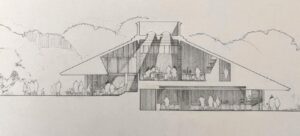
The Wisdom of Cultural Mapping in Reparative Planning — City in the Woods: Mapping of Cherokee Village, Arkansas
by Stephen Luoni
pp. 239–269
As communities and design professionals confront complex cultural issues in planning, new tools are needed to introduce interdisciplinary cultural inquiry into urban design/planning. Reparative planning is premised on a reckoning with socio-economic and environmental decline through design of the built environment. Cultural mapping is necessary to both visibilize suppressed narratives behind decline and inequity, as well as underwrite new policy and development approaches. City in the Woods is a cultural mapping project that supports planning for Cherokee Village. Moving beyond the map as object to mapping as a process, we employed the deep map to sketch a memoir of place different from the disciplinary linearity found in conventional cartography. Cultural mapping animates diverse data sets through various visual literacies ranging from serial filmstrip narratives, to collages, thick description drawings that reconstruct lost local heritage landscapes, and geospatial mapping of the built environment. Change requires storytelling. This descriptive agency in planning, entailing collaboration between design professionals and community, models an equity-based approach beginning with stories that enable community self-advocacy, motivate institutional redesign, and construct new urban forms.
Article
Housing
Open Access
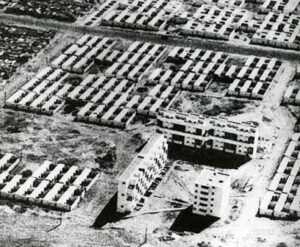
Beyond Modernist Housing: Can the Mass Housing Model Accommodate Human Agency?
by Nadia Shah
pp. 23–43
The lack of attention paid to the disempowerment of the residents has been a shortcoming of the modern mass housing model. Even today, no policies promote and support the residents’ efforts to continue improving their quality of life through actions involving changing the physical environment. Following a brief history of the origins of mass housing in the West through the discourse in the modern movement, the paper expands on implementing these modern ideas in the post-War non-Western region and how they were received and appropriated there. The article presents the case study from the author’s work on Korangi Town in Karachi, Pakistan, to show that the residents’ changes reflect their active agency. However, it was an unintentional outcome of modernist design and planning. This paper is more than just a critique of the cultural apathy of modernism. It questions what happens to a modernist project after the expert leaves the arena. How do residents adapt to or cope with their physical environment? Moreover, is there a way to include human agency in mass housing?
Exhibition Review
Criticism
Open Access
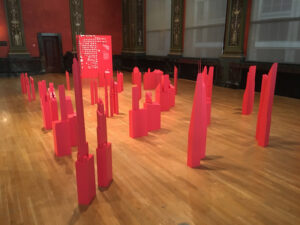
Make New Critical Stories. A View on the 2017 Chicago Architecture Biennial
by Maurizio Sabini
pp. 219–231
The 2017 edition of the Chicago Architecture Biennial, Make New History, like any other similar event, has caused debate and controversy. Beyond inevitable flaws and shortcomings, the CAB though deserves to be appreciated for the quality of most of the exhibited projects, works or installations, some of which managed also to offer what was missing in this CAB’s main theme: a critical perspective. The theme itself of the CAB is challenged, but the good works of many international architects and artists, well selected by the Artistic Directors Sharon Johnston and Mark Lee, is appreciated for their contributions to a critical discourse in our field, for their “critical stories.” Through a discussion of the curators’ hypothesis and of some of the most interesting works, as well as of some critical contributions included in the exhibition catalog, this review tries to offer a critical assessment for an event that, fortunately, has already acquired an outstanding position within the architecture cultural landscape of our time.