
Archive
Tag: post occupancy evaluation
Subscribers
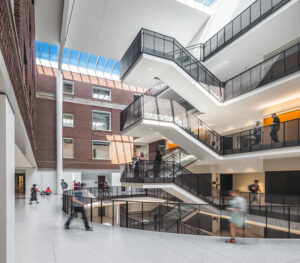
Democratic Light: Daylighting Design and the Tate Hall Building Restoration
pp. 473–495
Published: 2025-01-23
Article
Subscribers
Democratic Light: Daylighting Design and the Tate Hall Building Restoration
by Mary Guzowski, Abimbola Asojo, Anna Pravinata
pp. 473–495
A case study of a recent project at Tate Hall on the University of Minnesota campus illustrates how the architectural firm Alliiance employed the concept of “daylight democracy” as a primary design driver for renovations and an addition to the building that is located in the Northrop Mall Historic District. This article identifies strategies used in the project to foster more democratic, equitable, and accessible approaches to daylighting that support program tasks and activities, visual comfort, and health and well-being for all building occupants regardless of the types of space and program activities. The discussion includes: (1) an overview of daylight strategies at the site, building, and room scales, (2) whole building daylighting analyses using DIVA, ElumTools, and Licaso software to evaluate illuminance levels and visual comfort, and (3) a Post Occupancy Evaluation (POE) of the indoor environmental quality (IEQ) to document user satisfaction, comfort, and well-being. Daylighting design conclusions summarize the strategies that are most effective in supporting the design goal of “daylight democracy.”
Buy
Already in your cart -
View cart
Article
Housing
Open Access
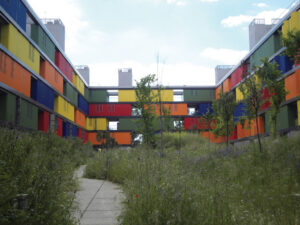
Project Strategies and Evaluation Methods for Contemporary Social Housing
by Romina Marvaldi, Elisabetta Pani
pp. 45–57
The deep social transformations occurred in the last decades have deeply affected the patterns of urban living. In this sense, experimentation on housing plays the dual role of investigation and validation of our hypothesis that residential space should reflect new life-styles. At the beginning of the 21st century, social housing represents the main field for experimentation.In the current architectural scenario, many interesting experimentations on contemporary housing can be observed.The approach proposed in this article starts with post-occupancy evaluation of some case-studies extracted from extensive research on European case-studies realized projects. It then analyzes the results of such evaluation to abstract issues concerning different aspects of contemporary living that could be coped at the design level. This method combines spatial and typological research, issues about housing and planning approaches developed by the promoters of the case-studies discussed. Providing quality social housing involves the coordination of multiple actors and synergies..