
Archive
Tag: public architecture
Article
Criticism
Subscribers
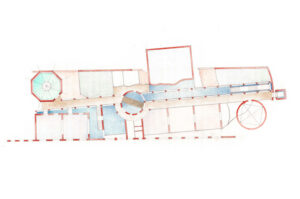
Massimo Carmassi, the Civic Architect of Pisa. Five School Projects
by Cecilia Marcheschi
pp. 119–139
This article examines the work of Massimo Carmassi, a civil servant architect and head of the architecture department of the Municipality of Pisa between 1974 and 1990, focusing on school architecture as a field of civic and urban design experimentation, both in terms of public commitment and authorial research. Developed within the framework of the progressive policies promoted by Pisan administrations during the 1970s and 1980s, Carmassi’s schools are interpreted as urban devices that introduce spatial quality, recognizability, and identity into the city’s peripheral neighborhoods, often marked by anonymity and a lack of collective spaces. The article explores the architect’s language, grounded in the deliberate use of a limited set of recurring devices – such as the wall, elementary formal structures, and the gallery building – alongside a restrained palette of materials, including brick, iron, and glass. What emerges is an understanding of public architecture not as a functional container, but as an active instrument in the construction of the city. This perspective frames Carmassi’s work as a form of architectural practice in which civic responsibility and authorial research are inseparably intertwined.
Essay
Open Access
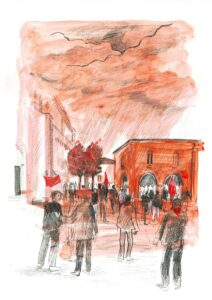
Exploring Expressed Democratic Attempts in Space: Architecture and Landscape in Pier Paolo Pasolini
by Riccardo Maria Balzarotti, Luca Maria Francesco Fabris
pp. 389–403
This article explores the works of Pier Paolo Pasolini, focusing on the interplay between his artistic output and spatial themes like architecture and landscape, particularly as they reflect democratic values. Pasolini viewed space as a physical entity and a site for political, social, and cultural interaction. By examining locations such as Friuli and Casarsa della Delizia, Pasolini’s youth environment, the paper delves into how these landscapes shaped his vision of democratic spaces. It also connects Pasolini’s perspective to contemporary public spaces, which, like his poetics, emphasize the role of dissent in democracy. The article further investigates how modern urban developments may limit this potential for democratic engagement by prioritizing aesthetic and commercial objectives over historical and social memory. Additionally, Pasolini’s involvement in education and local politics illustrates how spaces like schools and civic centers become arenas for resistance and public discourse. Ultimately, the essay argues that spaces become truly democratic when they foster active engagement and dissent, as reflected in Pasolini’s works and the symbolic power of place.
Essay
Open Access
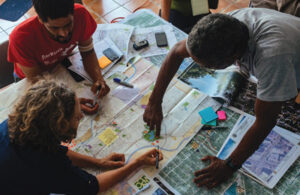
Dotte Agency: A Participatory Design Model for Community Health
by Shannon Criss, Matt Kleinmann
pp. 213–237
As community activists resist racial injustice, food insecurity, and infrastructural delinquency, many groups are attempting to articulate the voice of the citizen. It is within this landscape that architects have historically struggled to find common ground to afford democratic access for citizens to engage in discussions about the future of their city. Based upon surrogate models of other professions, there has emerged a proactive movement towards Social Impact Design. Like many urban core areas, our community faces a health epidemic compounded by poverty. In response to requests for collaboration, and through cross-disciplinary academic partnerships in both public health and social welfare, we have begun to leverage design advocacy to improve health outcomes. This has evolved into an alternative model of practice that advances public design through interdisciplinary, adaptive and incremental spatial agency. It is a sustainable practice that fosters conversations and supports events originating from within the community. Our approach seeks to scaffold an infrastructure of public health through methods of participatory design and advocacy. Through new forms of design intelligence and collaborative design tools, our critical spatial practice demonstrates new ways for how architectural design can be relevant to society.