
Archive
Tag: resilient design
Article
Sustainability
Subscribers
Sea-Level Rise and South Florida: Envisioning Public Space as a Function of a Changing Natural Environment
by John Sandell
pp. 143–162
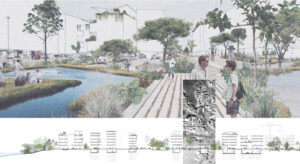
Sea-level rise and its effects on low-lying territory posit a rethinking of urban environments. Drawing on green infrastructure concepts and resiliency principles in urban design, this study examines how these urban environments could evolve. The study describes the challenges that coastal cities face and advances a cross-disciplinary research approach to a specific coastal site. The site location is Fort Lauderdale, Florida. The study adopts a transformational strategy that directs the development of an urban design inclusive of hydro-patterns, vegetation, building mass, and its orientation. The strategy foregrounds nature’s role in the conceptualization of changing conditions and the built morphologies at the scale of territory and neighborhood. By exploring these relationships, the project highlights the dynamics of the natural environment as a frame for reconfiguring public space as permeable and adaptive networks, enabling an open and indeterminant understanding of urban commons.
Buy
Already in your cart -
View cart
Essay
Open Access
Salty Urbanism: Towards an Adaptive Coastal Design Framework to Address Sea Level Rise
by Jeffrey E. Huber, Keith Van de Riet, John Sandell, Lawrence Scarpa
pp. 105–130
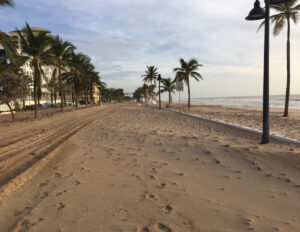
Utilizing the North Beach Village neighborhood in Fort Lauderdale, Florida, as case study, “Salty Urbanism” establishes an interdisciplinary team to develop a coupled research methodology and pedagogical approach that envisions and quantifies the experiential and ecological outcomes of alternative ways forward for the neighborhood in response to climate instability, disruption and rising sea levels. These outcomes consider an inevitable future of saturated landscapes and, as a result, integrate research models that accommodate a variety of best management practices (BMP), low impact development (LID), green infrastructure (GI) and other alternative concepts to be implemented over time in the neighborhood adaptation plan.