
Archive
Tag: Robert Venturi
Essay
Theory
Open Access
Musings on Boredom, Midcentury Architecture, and Public Spaces
by Andreea Mihalache
pp. 119–138
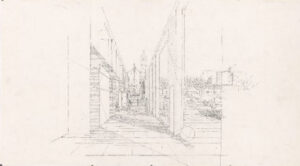
The rejection of “boredom” fueled the midcentury reaction against modernism, but little is known about the complicated presence of this mood in the architectural discourse. Far from being a mere rhetorical tool, the quip “Less is a bore” is part of Robert Venturi’s larger interest in boredom and was influenced by his reading of a book referenced repeatedly in Complexity and Contradiction in Architecture (1966): August Heckscher’s The Public Happiness (1962). A liberal writer and political activist, Heckscher situated boredom at the core of modern humanity’s alienation. While the concern with boredom was explicitly addressed in the humanities, I suggest that it was taking shape in midcentury architectural polemics under the influence of writings from other disciplines, as well as the emerging artistic practices that were deliberately embracing the “aesthetics of boredom.” Specifically, I will examine Venturi’s reading of Heckscher through two of his (unbuilt) civic projects that directly engage the issue of boredom: Three Buildings for a Town in Ohio (1965) and the entry for the Copley Square Competition (1966).
Essay
Theory
Open Access
The Act and Art of Architectural Critique: A Drawing, a House, and a Sign
by Andreea Mihalache
pp. 25–38
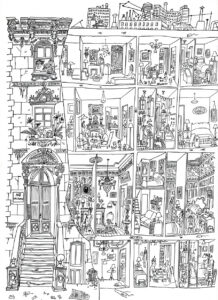
The role of criticism is not to split, but rather to bring matters together in an assembly. Philosopher Bruno Latour makes the argument that the responsibility of the critic, (and, implicitly, critique), is not to divide, but instead to “offer the participants arenas in which to gather.” In light of Latour’s proposition, I will examine the generative and creative role of architectural criticism and some of the many guises under which it might take shape. I propose that the critical call of architecture is often hidden in plain sight in works that camouflage themselves under seemingly disengaged positions, and which, upon closer inspection, act as resources of architectural imagination. Specifically, I examine Saul Steinberg’s drawing “Doubling Up” (1946), the Splitnik (the American model-house showcased at the American Exhibition in Moscow, 1959), and Robert Venturi’s sign for the Grand’s Restaurant (Philadelphia, 1961-1962)