
Archive
Tag: sea level rise
Article
Sustainability
Subscribers
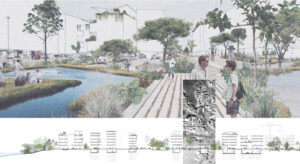
Sea-Level Rise and South Florida: Envisioning Public Space as a Function of a Changing Natural Environment
by John Sandell
pp. 143–162
Sea-level rise and its effects on low-lying territory posit a rethinking of urban environments. Drawing on green infrastructure concepts and resiliency principles in urban design, this study examines how these urban environments could evolve. The study describes the challenges that coastal cities face and advances a cross-disciplinary research approach to a specific coastal site. The site location is Fort Lauderdale, Florida. The study adopts a transformational strategy that directs the development of an urban design inclusive of hydro-patterns, vegetation, building mass, and its orientation. The strategy foregrounds nature’s role in the conceptualization of changing conditions and the built morphologies at the scale of territory and neighborhood. By exploring these relationships, the project highlights the dynamics of the natural environment as a frame for reconfiguring public space as permeable and adaptive networks, enabling an open and indeterminant understanding of urban commons.
Buy
Already in your cart -
View cart
Essay
Open Access
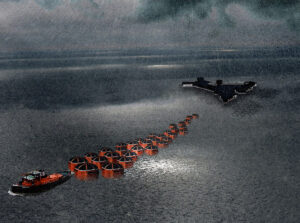
The SEA Is Coming: The Future of a Marine Research Facility
by Ursula Emery McClure
pp. 415–438
This paper originates from a Louisiana State University School of Architecture Research Studio. Charged by the organization’s Director, the students investigated the Louisiana Universities Marine Consortium (LUMCON) facility and environment, and re-imagined both the building and landscape as a cutting-edge (albeit remote) research and educational destination. “The SEA Is Coming” Integrative-Design Studio proposes adaptation to climate change as a means to investigate the transformative capacity of a site. Going far beyond the boundaries of current (and future) building program, the studio method provoked profound rethinking of current conventions about coastal change and occupancy, design, community, the environment, and land use. LUMCON’s facility sits at the nexus of deltaic land, freshwater, brackish wetland, and salty ocean and provides access to all these systems. It has withstood the volatility of this environment: flooding, hurricanes, oil spills, the Gulf dead zone, salt-water intrusion, etc. Now over thirty-years-old, the building must adapt to changing conditions. The studio investigated LUMCON’s ability to continue functioning in its changing environment and further its indispensable research capabilities of the rapidly changing coastal landscape.
Article
Open Access
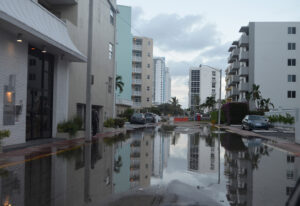
Miami Rising: Historical Perspectives on Sea Level Rise as a View into the Future
by Eric Firley, Victor Deupi
pp. 367–387
Miami is a city whose diversity and vibrant growth has made it an ideal destination for international travel, business, and leisure. However, South Florida is a hurricane prone region, and the threat of sea level rise and erosion poses an immediate and long-term risk to the stability of the city and its region. The city and the scientific community have been studying the phenomenon for some time now, proposing solutions to the management of such threatening uncertainty. Yet the quest for coastal resilience is not a new phenomenon. Since ancient times human settlements have entertained a complex relationship to the water. This paper will explore how several cities throughout history have dealt with flood resilience challenges and consider how historical attempts to adapt and address such problems can provide new spatial strategies for Miami’s future. Aware of the fact that such a study cannot reveal technical solutions for the twenty-first century, the emphasis will be given to an understanding of the correlation between socio-economic identity, attitude towards defensive action, and the type of organization needed for concerted action.
Essay
Open Access
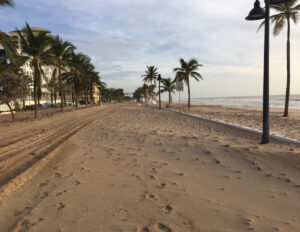
Salty Urbanism: Towards an Adaptive Coastal Design Framework to Address Sea Level Rise
by Jeffrey E. Huber, Keith Van de Riet, John Sandell, Lawrence Scarpa
pp. 105–130
Utilizing the North Beach Village neighborhood in Fort Lauderdale, Florida, as case study, “Salty Urbanism” establishes an interdisciplinary team to develop a coupled research methodology and pedagogical approach that envisions and quantifies the experiential and ecological outcomes of alternative ways forward for the neighborhood in response to climate instability, disruption and rising sea levels. These outcomes consider an inevitable future of saturated landscapes and, as a result, integrate research models that accommodate a variety of best management practices (BMP), low impact development (LID), green infrastructure (GI) and other alternative concepts to be implemented over time in the neighborhood adaptation plan.
Essay
Open Access
Between Land and Sea: An Approach for Resilient Waterfront Development along the San Francisco Bay
by Gabriel Kaprielian
pp. 273–294
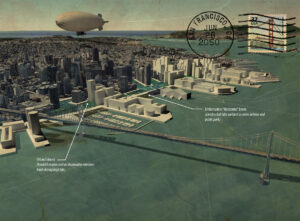
The waterfront along the San Francisco Bay is facing a growing threat from sea-level rise. By the end of the century, a projected sea-level rise of 55 in. [140 cm] will affect an estimated 128 sq. mi. [331 km2] of urban development valued at $62 billion. In addition, 2.1 million people and 660,000 homes are estimated to arrive by 2040, adding to the 7 million current Bay Area residents. Furthermore, sea-level rise will affect the ecology of the San Francisco Bay, threatening to submerge the majority of existing tidal wetlands by mid-century. To combat sea-level rise, many are calling for increased shoreline protection, while others suggest the removal of urban development in areas at risk of inundation, allowing tidal wetlands to migrate to higher elevations. In this proposal, I demonstrate that both may be accomplished by a managed retreat of existing development, enabling wetland migration, while introducing a resilient new typology of development built on levees that is designed to co-exist with a tidal ecosystem, enabling new relationships between urban life and bay ecology that redefine the coastal boundary.