
Archive
Tag: sharing economy

Essay
Subscribers
The Future of Urban Living in the Sharing Economy
by Wendy Wei-Yue Fok
pp. 301–314
This is the continued research and development that derived from the original doctoral research “Whose Digital Property,” probing into the ramifications brought about by the new business model of the “sharing economy,” and the concerns raised behind the issues of access, ownership and distributed rights among policy, economy, design and architecture, of digital and physical property law research. The doctoral research was defended in 2017 at the Harvard University Graduate School of Design with the Harvard School of Law as a partnering department. The discussion developed in this essay tries to show how several examples and trends suggest architecture and architecture-related software programming will likely become even more collaborative in the future and will necessitate a more strategic, articulated and multi-pronged cooperation between designers, companies and users.
Buy
Already in your cart -
View cart
Project
Subscribers
Un-Cramming – A New Shared Economy
by Winka Dubbeldam
pp. 427–434
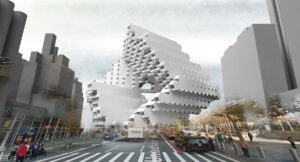
To mark the hundredth anniversary of the New York City’s zoning code, we propose the next dimension of zoning, a four-dimensional hypercube that “un-crams” Manhattan’s second- and third-dimensional congestion into a fourth-dimensional model of sharing (space). By projecting the grid’s coordinates into a large hypercube - the fourth dimension in mathematics -, we developed a typology that falls between the scale of a city block and a building. A city in a city. Located at the water-edge of the East River, this becomes a new terminal building, a domestic/commercial hybrid that takes the notion of sharing to a new level. This waterfront site gives not only access to the new Second Avenue Subway, but also to the new water ferry and the airport water taxi. Sharing economy - this four-dimensional framework - will re-activate Manhattan’s forgotten East Side. Sixty percent of the Hypercube is a public and shared program (park, pool, terraces), while 40% percent is occupied with mixed-use space. Inhabitants are encouraged to share domestic appliances and tools, creating a new social network. This new social economy distributes the allowable 10 Floor Area Ratio (FAR) into the Hypercube, and with elevated parks it creates a new way of shared city living.
Buy
Already in your cart -
View cart