
Archive
Tag: site analysis
Article
Open Access
Exploring the Role of AI in Urban Design Research: A Comparative Analysis of Analogical and Machine Learning Approaches
by Carla Brisotto, Jeff Carney, Forough Foroutan, Karla Saldana Ochoa, Whittaker Schroder
pp. 237–264
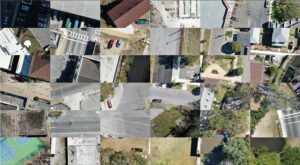
We conducted an experiment to explore how Machine Learning (ML) can be utilized as a tool in urban studies research. The current study aims to compare two methodologies to identify urban indicators of the residents’ well-being focusing on three transects across two local watersheds in Jacksonville. The study is framed within the theory of transect analysis. The goal of this experiment was to compare an analogical transect analysis method (AT) to Machine Learning one (MLT) to understand (1) what kind of contribution the latter approach can provide to the development of transect analysis methodologies, and (2) if and how it can connect digitally generated site analysis to local knowledge.The experiment’s findings highlight the ability of the ML algorithms to find noticeable patterns of built environment from aerial imagery. However, local knowledge is indispensable to interpret results in a meaningful way. The combination of the two approaches emphasizes the complementary nature of them and shows how ML methods can be a tool at the service of communities.

Essay
Subscribers
Site and AI: A Paradigm Shift
by Genevieve Baudoin, Bruce A. Johnson
pp. 319–333
AI’s potential is in its ability to sift through vast amounts of contextual data that can drive design decisions. It offers the opportunity to process information about a virtually limitless number of subjects, at a conscious or unconscious level. This has created what Thom Mayne describes as a “paradigm shift” in our perception of site. The architect can now curate, directing results based on AI to restore specificity to projects that, through the distance created between the real site and the computer model, we have lost along the way. We rely on technological workarounds to fix many designable issues in our buildings – an over-reliance on climate control, a willingness to place buildings directly in harm’s way (i.e., building on flood plains), and an ignorance of the context of a site (from archeology to gentrification). This paper offers a provocation: AI can create a return to site and construction sensibilities by harnessing layered data sets such as orientation, topography, climate, or even social fabric. Can AI chart a course towards less reliance on technological band-aids in the production of building?
Buy
Already in your cart -
View cart