
Archive
Tag: social housing
Article
Subscribers
Hybrid Mass Timber + Additive Construction: Projecting an Urbanistic Building System for Social Housing
by Yong Huang, Jack Collins
pp. 399–421
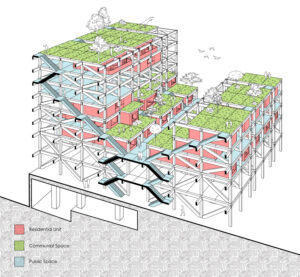
Mass timber construction has been cultivated as an environmentally sustainable and cost effective approach for housing typology. However, repetitive and regularly shaped timber structural systems for larger scale affordable housing applications tend to be homogeneous, lacking unique and personalized spaces for both individuals and the collective, hindering the progress of more diversified and inclusive living communities. Concurrently, rapid additive (3D-printed) building construction has begun to emerge in the single-family housing market due to its benefits of mass customization, reduced onsite labor costs, and time efficiency. However, present production and building typology at a single-unit-scale are still limited for complex social housing projects. This research aims to integrate mass timber and rapid additive construction into a hybrid system. Hybrid affordable housing, through mass timber construction and additive manufacturing processes, is intended to evolve into environmentally conscious architecture as an extension of nature. It not only provides healthy and adaptable physical spaces but also supports everyday urbanism as a response to diversified personal needs and desires for a more sustainable future.
Buy
Already in your cart -
View cart
Position Paper
Open Access
A Right to Housing: A Compelling Idea and an Elusive Reality
by Rachel G. Bratt
pp. 287–297
Article
Criticism
Subscribers
Housing the Multitude: Struggling with Impermanence and Singularities
by Xavier Van Rooyen, Michaël Bianchi
pp. 67–92
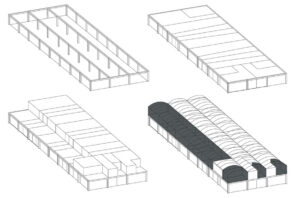
This article seeks to trace a history of Team X’s experimentations on the issue of housing for the great number and more specifically around the theoretical background leading to the question of impermanence and indeterminacy in the architectural process. Through the writings of the Smithsons, Oskar Hansen, or John Voelcker, a theoretical framework will be defined and then put into perspective in a contemporary context. Two case studies will be discussed: Lacaton & Vassal, and Elemental. Connections will be made on the issue of indeterminacy and the concepts of “open structure” and “open aesthetics” will be promoted. These concepts presented here offer an alternative for some other possible formal developments around the question of indeterminacy. We will assess whether the pragmatism of these two contemporary architectural offices allow their proposals, beyond responding to specific situations, to claim the status of a reproducible model, such as one imagined during the 1960s.
Buy
Already in your cart -
View cart
Article
Housing
Subscribers
Housing by People and Work: Design Principles for Favelas Residents in Economies of Commerce and Service
by Ana Rosa Chagas Cavalcanti, Tiziano Li Piani
pp. 113–136
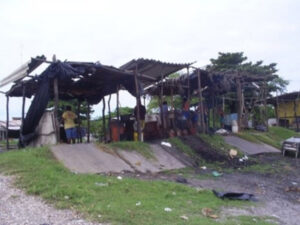
This article proposes a new approach towards the design and planning of social housing destined to residents living in informal settlements of Brazil. It is aimed at restoring the proximity between the labor and domestic functions within the spatial domain of the house. This need emerges from a field research aimed at addressing the spatial logics emplaced by residents in Brazilian favelas. The integration proposed in the article is meant to be achieved with the combined goal of improving the living conditions of the residents, sustaining also their socio-economic development, while promoting also the economy of the city. Graphic guidelines are shown to the reader after a critical analysis of the main systems of housing currently emplaced for unprivileged people.
Buy
Already in your cart -
View cart
Article
Housing
Open Access
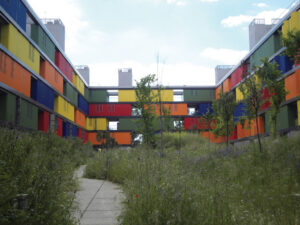
Project Strategies and Evaluation Methods for Contemporary Social Housing
by Romina Marvaldi, Elisabetta Pani
pp. 45–57
The deep social transformations occurred in the last decades have deeply affected the patterns of urban living. In this sense, experimentation on housing plays the dual role of investigation and validation of our hypothesis that residential space should reflect new life-styles. At the beginning of the 21st century, social housing represents the main field for experimentation.In the current architectural scenario, many interesting experimentations on contemporary housing can be observed.The approach proposed in this article starts with post-occupancy evaluation of some case-studies extracted from extensive research on European case-studies realized projects. It then analyzes the results of such evaluation to abstract issues concerning different aspects of contemporary living that could be coped at the design level. This method combines spatial and typological research, issues about housing and planning approaches developed by the promoters of the case-studies discussed. Providing quality social housing involves the coordination of multiple actors and synergies..