
Archive
Tag: social impact design
Essay
Open Access
Dotte Agency: A Participatory Design Model for Community Health
by Shannon Criss, Matt Kleinmann
pp. 213–237
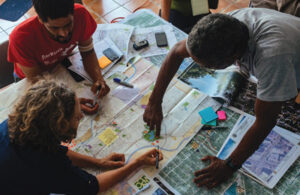
As community activists resist racial injustice, food insecurity, and infrastructural delinquency, many groups are attempting to articulate the voice of the citizen. It is within this landscape that architects have historically struggled to find common ground to afford democratic access for citizens to engage in discussions about the future of their city. Based upon surrogate models of other professions, there has emerged a proactive movement towards Social Impact Design. Like many urban core areas, our community faces a health epidemic compounded by poverty. In response to requests for collaboration, and through cross-disciplinary academic partnerships in both public health and social welfare, we have begun to leverage design advocacy to improve health outcomes. This has evolved into an alternative model of practice that advances public design through interdisciplinary, adaptive and incremental spatial agency. It is a sustainable practice that fosters conversations and supports events originating from within the community. Our approach seeks to scaffold an infrastructure of public health through methods of participatory design and advocacy. Through new forms of design intelligence and collaborative design tools, our critical spatial practice demonstrates new ways for how architectural design can be relevant to society.
Polemic
Open Access
Challenging the White-Savior Industrial Complex
by Thomas Fisher
pp. 139–151
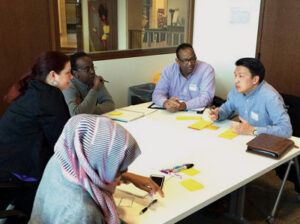
Social-impact design challenges many of the assumptions that guide architectural practice such as: What should we design? What program should we design to? What site should we design on? Who should be involved in the design? And what else needs designing beyond what we have been commissioned to do? In raising these questions, social-impact design essentially inverts the expertise model that has guided both architectural education and practice and leads to a more open and responsive mode of practice that looks for the underlying reasons why a problem or need has occurred and the larger systemic issues that surround the project and that may require redesigning themselves. Through a series of social-impact design projects conducted by the Minnesota Design Center at the University of Minnesota, this essay explores what this means in specific ways, through actual projects with diverse communities of people.