
Archive
Tag: social sustainability
Article
Subscribers
Play for Democracy: Facilitating a Space for Children’s Involvement in Urban Development
by Per-Johan Dahl, Pernilla Theselius
pp. 407–428
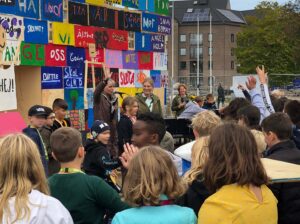
Drawing on the quest to improve inclusion and social sustainability in urban planning process, a holistic approach on citizen participation in urban development is becoming increasingly important. One sector of society whose democratic rights remain overlooked in participatory action is children. It is therefore imperative to develop methods for processing the children’s rights to express their opinions when government is vested in the general population. This article analyzes the transdisciplinary project Play for Democracy (PfD), which was established in 2020. Building upon the five-stage design thinking model of the Hasso Plattner Institute of Design at Stanford, its primary objective is to develop a new method for children to exercise their democratic rights in urban development process. The article traces the purpose of PfD and its expected impact on the broader socio-cultural context of urban development; it reviews the different phases of the four-week workshop; and it deduces a new method in which children can exercise their democratic rights through design. The method is extrapolated through text and diagram to be applicable to similar initiatives.
Buy
Already in your cart -
View cart
Article
Housing
Subscribers
Politicized Gentrification: The New Urban Renewal Movement in Beijing
by Wei (Windy) Zhao
pp. 93–112
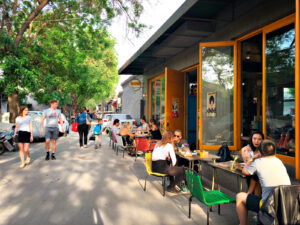
In April 2017, the Beijing municipal government enacted a new, three-year urban renewal policy that is aimed to restore and improve the built environment of the 2,435 alleyways located in the historic center of the city. The local implementation, however, has focused on the sealing of doors and windows that led to homes and small businesses for decades. As a result, thousands of businesses that had provided daily services to local residents have shut down, forcing many people to move to other cities. Drawing on archival research and interviews, this article argues that the Beijing municipal government is merely using urban renewal as camouflage for a politically-oriented gentrification project which not only eliminates non-permanent residents, but also deconstructs, as well as reconstructs, “place” at the local level as a means to control social activities and relationships. The result is the creation of a new image of the capital of China, which exhibits the ideas of regularity, singularity, segregation, and authoritarianism.
Buy
Already in your cart -
View cart