
Archive
Tag: urban ecology
Article
Subscribers
Modelling Urban Nature: Pedagogies and Tooling for Communicating Landscape Futures
by Susanne Trumpf, How Yu Chung
pp. 359–380
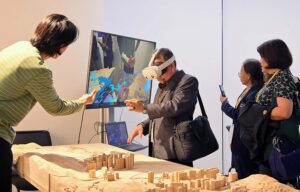
When Ian McHarg published his seminal book Design with Nature in 1967, he emphasized “process as value” urging planners to integrate natural land resources into urban design. Yet today, amid climate change and urban land degradation, the built environment disciplines struggle to act upon this call. Set in Hong Kong, a subtropical city facing climate pressure, the teaching-research project outlined in this paper addresses the necessity to negotiate complexities of urban ecological processes. Developed in concurrence with a Year Three undergraduate landscape architecture studio, the project proposes an extended reality (XR) workflow and representation methodology that allows students and practitioners to both dynamically discuss and co-create urban-ecological processes and designs. Students were tasked to design a large urban park on a site in Hong Kong profoundly transformed by urban development. Following this studio brief, this project employs two case studies – one focused on hydrological dynamics, the other on plant succession – to experiment with XR-based methods that address both site-specific conditions and the temporal dimensions of design proposals.
Buy
Already in your cart -
View cart
Article
Subscribers
Streetscape Ecologies in Southern Europe: Design for Culturally Rooted Nature-Based Regeneration
by Alessandro Raffa, Marilena Baggio
pp. 443–469
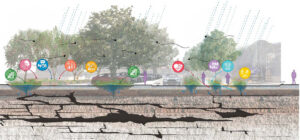
Urban streets are increasingly acknowledged as more than infrastructural corridors, serving as accessible and pervasive spaces where ecological processes and collective life unfold. In the context of climate change and ecological transition, cities worldwide are experimenting with nature-based street regeneration. Yet current research and practice often prioritize ecological performance metrics, overlooking the nuanced, spatially embedded, and culturally grounded processes through which urban nature evolves. This risk of homogenized solutions is particularly evident in Southern European cities, where layered urban fabrics and historically situated conceptions of nature have long shaped the interface between built form and ecology. This article argues that regenerating streetscapes in such contexts requires more than standardized interventions. Building on a three-year academic research project, it introduces a framework of ten cultural dimensions for culturally rooted nature-based solutions, tested across speculative and practice-based projects. Five operational lines of work are distilled, positioning streets as palimpsestic urban ecologies where ecological performance and cultural narratives converge. By aligning nature-based adaptation strategies with cultural sensitivity and spatial quality, the article advances pathways for resilient streetscape regeneration.
Buy
Already in your cart -
View cart