
Archive
Tag: urban farming
Article
Landscape Urbanism
Subscribers
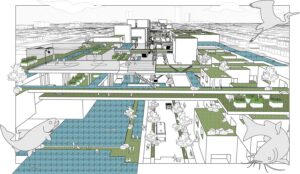
Beyond Eco-City: Re-Envisioning the Impossible Dream of Dorr Street, Toledo, Ohio
by Yong Huang
pp. 206–222
Throughout history, cities have always been extended towards the countryside without contemplating the other direction. While current urban farming practice tends to play a remedial role in our urban design processes and strategies, it is time for a paradigm shift between cities and the organic worlds that sustain them. Meanwhile, emerging eco-cities, such as the Masdar City project, were devised with ecological mechanisms almost exclusively driven by economic imperatives of the dominating political power. As posited by Federico Cugurullo, this kind of ecological modernization “does not change the traditional capitalistic patterns of production and consumption, and thus replicates the same environmental issues intrinsic to capitalism” (2016). This design research experiments ethnographic method in Toledo, Ohio, to generate urban farming prototypes as localized cultural practice. In response to the “Impossible Dream,” a new urban design initiative of the African American Legacy Project of Northwest Ohio, visual narratives of urban farming urbanism are created to address ecological urbanism and social-economic impacts, as well as building programming and cultural events initiatives, with a focus on public and interactive communal spaces.
Buy
Already in your cart -
View cart
Article
Open Access
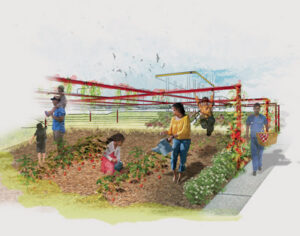
Social Impact through Design: Experiments in Urban Agriculture
by Sallie Hambright-Belue, Martin J. Holland
pp. 287–302
This paper describes the work of students at the School of Architecture and the Department of Landscape Architecture at Clemson University with a local, non-profit organization - the Feed & Seed - in creating alternatives to the current threads that affect the urban area of West Greenville, South Carolina. Starting on the definition of Food Desert as an area without access to fresh and whole foods, students address issues of economic equity, community building and social justice by developing urban agriculture solutions that focus on food hub and food cycle, promote education and foster social cohesion. With the gaps between the haves and have-nots apparently widening each and every year students perceive, challenge, and test the role that designers have in the decision making processes that constitute possible solutions of fractured neighborhoods, cities and regions.