
Archive
Tag: urban regeneration
Article
Subscribers
Streetscape Ecologies in Southern Europe: Design for Culturally Rooted Nature-Based Regeneration
by Alessandro Raffa, Marilena Baggio
pp. 443–469
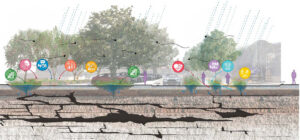
Urban streets are increasingly acknowledged as more than infrastructural corridors, serving as accessible and pervasive spaces where ecological processes and collective life unfold. In the context of climate change and ecological transition, cities worldwide are experimenting with nature-based street regeneration. Yet current research and practice often prioritize ecological performance metrics, overlooking the nuanced, spatially embedded, and culturally grounded processes through which urban nature evolves. This risk of homogenized solutions is particularly evident in Southern European cities, where layered urban fabrics and historically situated conceptions of nature have long shaped the interface between built form and ecology. This article argues that regenerating streetscapes in such contexts requires more than standardized interventions. Building on a three-year academic research project, it introduces a framework of ten cultural dimensions for culturally rooted nature-based solutions, tested across speculative and practice-based projects. Five operational lines of work are distilled, positioning streets as palimpsestic urban ecologies where ecological performance and cultural narratives converge. By aligning nature-based adaptation strategies with cultural sensitivity and spatial quality, the article advances pathways for resilient streetscape regeneration.
Buy
Already in your cart -
View cart
Article
Subscribers
Facing the Backside of Garibaldi: Democracy, Socio-Spatial Justice and Regeneration in Brescia, Italy
by Marco Alioni, Barbara Badiani
pp. 541–563
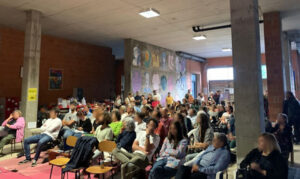
This paper examines planning logic and practices of a large-scale urban regeneration project targeting the artery Via Milano and surrounding district (Brescia, Northern Italy). The project aims to revitalize and gentrify historically industrial and working-class neighborhoods, now also home to a conspicuous migrant population. The paper argues that, while intended to improve the “urban quality” of the area, the municipality’s approach is leading to the stigmatization of the residents and disrupting the diverse community practices that have developed over time. Drawing on six years of ethnographic research and by discussing two significant examples, the paper questions whether these regenerative efforts are genuinely democratic and inclusive or if they are neglecting both residents’ needs, as well as undermining local community practices. The contribution also discusses how these interventions are affecting the neighborhood’s inherent vitality and whether they fulfill their goals of pursuing urban revitalization while promoting social integration.
Buy
Already in your cart -
View cart
Article
Landscape Urbanism
Subscribers
Beyond Eco-City: Re-Envisioning the Impossible Dream of Dorr Street, Toledo, Ohio
by Yong Huang
pp. 206–222
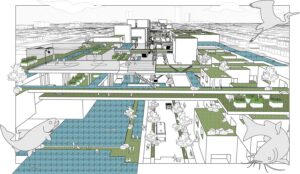
Throughout history, cities have always been extended towards the countryside without contemplating the other direction. While current urban farming practice tends to play a remedial role in our urban design processes and strategies, it is time for a paradigm shift between cities and the organic worlds that sustain them. Meanwhile, emerging eco-cities, such as the Masdar City project, were devised with ecological mechanisms almost exclusively driven by economic imperatives of the dominating political power. As posited by Federico Cugurullo, this kind of ecological modernization “does not change the traditional capitalistic patterns of production and consumption, and thus replicates the same environmental issues intrinsic to capitalism” (2016). This design research experiments ethnographic method in Toledo, Ohio, to generate urban farming prototypes as localized cultural practice. In response to the “Impossible Dream,” a new urban design initiative of the African American Legacy Project of Northwest Ohio, visual narratives of urban farming urbanism are created to address ecological urbanism and social-economic impacts, as well as building programming and cultural events initiatives, with a focus on public and interactive communal spaces.
Buy
Already in your cart -
View cart