
Outgrowing Mannerism. On Lina Malfona’s The Mannerist Phase in Architecture
ABSTRACT - The Mannerist Phase in Architecture. On Early StyleBy Lina MalfonaRoutledge, 20255.74 × 0.54 x 8.74 in. [17 x 1.4 x 22 cm]15 b&w illustrations154 pages (hardcover)US$55.49 (hardback)US$25.59 (eBook)ISBN 9781041014911 (hardback)ISBN 9781003615071 (eBook)
Starting from an assessment of the current state of the architectural profession and its contemporary cultural and theoretical implications, Lina Malfona introduces the book’s main fields of inquiry: manner as authorship, language, and style.1 Through these categories, the central argument emerges: Mannerism is framed as an inevitable phase – almost endowed with a quasi-magical aura – that permeates all forms of artistic expression, finding particularly strong expression in architecture. Mannerism is thus interpreted as both “originary” and “original”: a fertile, ambiguous, and tension-filled formative phase in which the relationship to the past is critically reworked, while the future remains open and indeterminate. As Malfona suggests, it may appear either as a limited episode or a prolonged condition, ultimately becoming a chronic state of theoretical and projective elaboration that operates across both the private and public trajectories of architects.
The book’s significance lies in its timely and urgent contribution, which can be attributed to a logical shift in focus. Mannerism, in this sense, could be considered a misaligned or anachronistic topic with respect to contemporary problematics; yet it is mobilized here as a critical dispositif capable of engaging them obliquely and in depth. Malfona’s research operates along a dual trajectory. On the one hand, the volume constitutes the object of an autonomous, vertically oriented inquiry, enabling a finely grained analysis of authors, works, and historical periods with remarkable analytical precision, extending to the scale of the architectural project itself. Conversely, it is deployed horizontally as an interpretative instrument, capable of traversing heterogeneous epochs and contexts, re-emerging as an unpredictable and intermittent phenomenon. Within this expanded register, Mannerism assumes the role of a seismograph of our relationship to both past and future, registering the tensions that traverse architectural language at moments of social transformation.
The vertical and horizontal trajectories constructed by the author compel the reader to continuously recalibrate their standpoint with respect to the object of inquiry. The following relationship is established between the text and the space it represents, which is apprehended through multiple non-stabilized perspectives. This strategy is consistent with the core of the research and ultimately results in the configuration of a theoretical construction that is Mannerist in nature. This critical device organizes the complexity, stratification, and tensions that define its object within the form of an editorial artifact. The book is structured in an evolutionary manner across three parts:
I.Maniera, Mannerism, and Other Manias,
II.Adolescent Architecture,
III.Mannerism as a Method.
Each section situates, and re-situates, the phenomenon under investigation from distinct angles, theoretical postures, and historical temporalities.
The first part interrogates the notion of maniera and its operative transformation into Mannerism, examining modes of production, disciplinary attitudes, projective strategies, and the deviations. The second part, adopting a phenomenological perspective, frames Mannerism as an “attitudinal” condition associated with an adolescent phase, analyzing authors and projects in which such a disposition emerges through the previously outlined strategies. The third part adopts a design-oriented perspective, actualizing the legacy of Mannerism. It outlines a methodological approach to design through signs, built works, scenographic constructions, and discrete architectural elements from types of openings to formal devices such as gigantism. Through this lens, it reflects on the compositional use of architectural elements within the interpretative framework of the movement. The conclusions return to the research’s primary objective: to examine the cultural positioning of an architect-author who, perhaps nearing the end of her own Mannerist phase, recognizes its tensions, pathologies, and seductive force, while turning toward a new phase in her work.
Malfona deploys the chapter entitled “Manner vs Agency” to elucidate the ambiguities that are pervasive in the discourse on “manner” and “Mannerism,” particularly as they pertain to the figure of the author. The latter’s assertion, she argues, is intrinsically bound to the consolidation of inquiries into language. In this context, language is understood not merely as stylistic expression, but as a critical and operative field of research within architectural and design theory. The author argues that, in the contemporary context, only a small minority of architects maintain a sustained engagement with questions of language. This stands in contrast to the growing prevalence of hybrid and associative practices, in which projects are shaped by adaptive, often opportunistic logics. As she observes, this reflects a “chameleon-like attitude” adopted by many firms, which are compelled to adjust their work to diverse and demanding commissions within an increasingly oppressive market.2
The fundamental question pertains to the evolution of the architect’s role, transitioning from a position that is predominantly concerned with the creation of forms, as “formgiver,” or the cultivation of a distinct personal style toward a more intricate and less distinctly delineated subjectivity. This transformation positions the architect as a pivotal agent: “one of many agents co-founding and co-responsible for the entire ideational, compositional and constructive process.” 3 Following the paired structure established in earlier chapters, “Enigma and Ambiguity” juxtaposes the elusive disclosures of Mannerist architecture with the historiographical consolidation of “Mannerism” in architectural discourse, beginning with Rudolf Wittkower’s studies of the Biblioteca Laurenziana. The origins of Mannerism are examined as marked by an internal tension concealed beneath sprezzatura, which the author investigates through a rigorous historical and projective inquiry.4
The chapter further highlights a contemporary critical shift from the appearance of the work to its mechanisms of production, a move that has influenced design practice by privileging the exposure of architecture’s underlying “script” over formal completion, thereby challenging the traditional role of the architect as formgiver. These ambiguities – operating across both process and artifact – are reframed as operative categories. Such a paradoxical equilibrium is evident in the work of Christian Kerez, as well as in projects by Fala Atelier, while envelopment and contortion emerge in the practices of PARA and Johnston Marklee. Finally, the ambiguous deployment of vernacular elements, through curvature, aggregation, and displacement, is explored in the work of Sean Canty. The chapter “Variation and Haecceity” concludes the first part of the study, revealing the transformative variation strategy adopted by Serlio. This paves the way for the manipulation of the theme as the true object of Mannerist enquiry, a kind of “obsession with possibilities.” 5
Starting with the fifty “rustic” doors in Sebastiano Serlio’s Extraordinario Libro (1551), Malfona emphasizes the pedagogical and editorial use of the diagrammatic tool or variation of the “type” in architecture, recognizing this applied research as a revelation of “Mannerist connotations.” The author then expands on this serial investigation by linking it to Peter Eisenman, particularly in his early theoretical explorations of signs detached from their meanings. Building on the reflections of the 2016 volume Palladio Virtuel, the author highlights Eisenman’s unveiling of the underlying principles in Andrea Palladio’s architecture. This is thus revealed to contain a multitude of variations, uncertainties, and ambiguities, partially rewriting its design trajectory. The author understands this trajectory as “evolutionary,” as it is inscribed in an “obsession with possibilities” which is characteristic of Mannerism.6 Moreover, within the context of Eisenman’s Carlo Erba Residences project in Milan (2019), the theme of gigantism and the protrusion manifests as an evident formal characteristic. However, this does not concomitantly determine a corresponding spatial significance, thereby engendering an “enigmatic and impractical presence.” 7
The second part of the book, entitled “Adolescent Architecture,” draws a strategic parallel between the construction of a personal framework of thought within a design project and the stages of life, thereby identifying a one-to-one connection between the exploration of Mannerist conditions and adolescence.
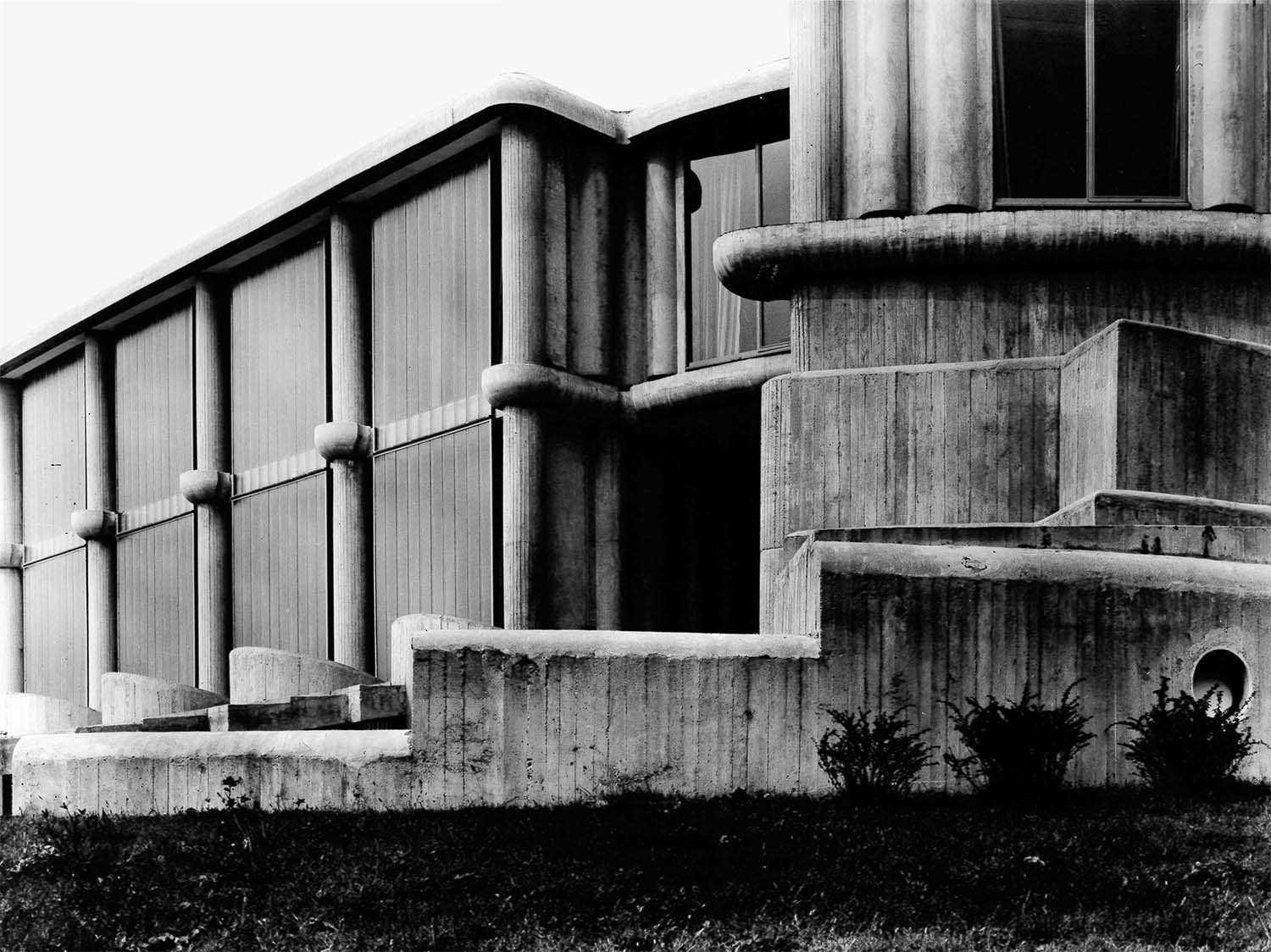
The author identifies “Mannerist adolescence” through diverse elements that converge on a central idea: a reworked relationship with the canon – distorted, expanded, and destabilized – encompassing norms, the past, and engagement with masters, as reflected in figures, studies, research, and individual projects. The following architects will be grouped together on the basis of their need to redefine or update the proportional relationships in certain architectural works: Michelangelo, Leon Battista Alberti, Guido Canella, and Giuseppe Terragni. The dizzying effect of the portico inside the Biblioteca Laurenziana (1571) – the result of a prolific early period – is achieved in part by accentuating the off-scale pilasters with pietra serena, or the “bold” treatment of the joints in Guido Canella’s Segrate Civic Center (1963-66, Fig. 1), or the paradigmatic case of the angular variation in Terragni’s Novocomum (1929), where the tripartite texture of the “rounded” façade is concluded by a final, seemingly contradictory level that confirms the right angle.
A separate chapter is devoted to the work of Denise Scott-Brown and Robert Venturi, who, in contrast to previous studies, “inhabit” the subject by traversing and transcending a Mannerist condition that can be traced, in particular, in their positions aimed at re-evaluating Mannerism as a “sign and system.” 8 As with the Vanna Venturi House (1964), the ambiguity in the construction of the façade’s “text” allows one to ponder the question – also applicable to the palazzina Il Girasole (1950) by Luigi Moretti – of the duality or singularity of the building caused by the cut in the façade. Malfona’s reflections do not pertain to figurative issues, but rather to VSB’s “analytical-figurative method,” which can be characterized as Mannerist.9 The chapter entitled “The Mannerist Phase” is predicated on the notion that the principle operates on the fringes of tradition. Malfona, paraphrasing Colin Rowe, situates Le Corbusier’s Villa Schwob (1912) within his wider body of work: the Mannerist “phase” in which this “early” project is steeped lies in the “pending” treatment of the façade and the seemingly unresolved dual entrance arrangement.
The author identifies the same unsettling ambiguity in Palladio’s Casa Cogollo in Vicenza (1559), where the tension between the domestic and the colossal is evident, or where certain elements or parts are extracted and adapted for unexpected uses. The sense of vertigo evoked, for example, by the contrast between the “tiny” dimensions of Leon Battista Alberti’s Rucellai Chapel inside the Church of San Pancrazio in Florence (1467) and the tall, capital letters of the inscription that throw the spatial scale into confusion.
The “conspiratorial” phase of Giuseppe Terragni’s work, a term coined by Bruno Zevi to describe Mannerism, is exemplified by the Novocomum project.10 The construction in horizontal bands is in contrast to the hollowing out of the corner, which, had it followed “conventional” principles, would have required formal reinforcement or accentuation. The same exploratory movements “on the fringes of tradition” can be identified in Casa Rustici (1936) or Casa del Fascio (1936), considered by Giuseppe Pagano to be hasty or ill-considered inventions.11
The other leading architect in whom a Mannerist phase can be identified – Guido Canella – is evident in the expressive and out-of-scale manifestations of an “anti-graceful” style.12 The Segrate Civic Center (see Fig. 1) best embodies these Mannerist variations, from its base to the roof, to the excessive expressiveness of the vertical and horizontal joints, to the raw, unadorned expressiveness of the material.
In the chapter “Chunky, Bizarre and Sophisticated,” the author develops the notion of “deviations” as a defining condition of the contemporary era, drawing on Sianne Ngai’s critique of late capitalism and translating it into the field of architectural design. Within this framework, Mannerism is reframed as a recurring phase of artistic life, characterized by eccentric, excessive, and oppositional “formative” ruptures. Read through a “syndromic” lens – evoking the Peter Pan metaphor of arrested development – the author identifies contemporary architectural practices that resist maturation, expressed through the categories of the bizarre, the massive, and the sophisticated.13
In this context, the work of Mario Ridolfi is reinterpreted as an “early” manifestation of such resistance, particularly in his typological experimentation with floor plan variation and his “animistic” approach to residential architecture, notably the Palazzina Rea in Rome (1936), where a deliberate pursuit of playful and expressive formal variation emerges. Mario Botta engages with Mannerism through both the theoretical and practical form of self-referentiality, with reference to the house in Breganzona (Switzerland, 1984), where, for Francesco Dal Co as well, the “dangers of manner” conceal the conflicting difficulty of renewing a linguistic-formal system in which one is reflected.14 This principle of rebellion, or “settling,” constitutes a fundamental aspect of the “Peter Pan Syndrome.” When viewed through this lens, the contemporary work of MOS Architects can be considered Mannerist in relation to “non-compositional” forms of composition that employ assembly – a form of settling and self-construction, according to the author.
The third and final section of the book, titled “Mannerism as a Method,” sees Malfona survey a series of design strategies in order to formulate a manifesto for an “applied” Mannerist method. Among these strategies, the author identifies elasticity – most explicitly in relation to the Serlian window – as a key operative principle. This principle of elasticity manifests in two distinct ways. First, it resolves the continuity of a four-sided façade conceived as a sculptural object in the round, where the archivolted element “absorbs” variation. Second, the Serlian motif is extruded along a privileged direction. It is evident that, from these uses, Malfona associates elasticity with an intrinsic principle of adaptability within Mannerist thought. This capacity to deploy architectural elements across heterogeneous bodies is achieved through processes of adjustment and transformation. In this manner, she extends what might be understood as a strategy internal to a historical movement into a broader operative principle aligned with a more expansive conception of sustainability. Another strategy that has been identified is the construction of the “mute” façade, which is grounded in Gilles Deleuze’s significant observation on the Baroque façade as one that “only tends to thrust itself forward,” thereby immediately translating philosophical thought into an operative architectural register.15
The third and final strategy is derived from the multiple reflections on the relationship between interior and exterior developed in Complexity and Contradiction in Architecture (1966), which the author reinterprets through spatial configurations filtered via the lenses of filmmaker David Lynch, architect Michelangelo, and art historian Werner Hager.16 In the chapter “Mute Façades or Theatrical Backdrops,” Malfona further clarifies the enigmatic role of the façade as it is deployed in Mannerism, identifying a set of “anti-normative” rules. These include the use of “protrusions, recesses, niches, or blind elements,” in conjunction with the incorporation of symbols and allegories.17 The author meticulously interweaves established readings by Bruno Zevi and Kurt Forster on Giulio Romano, particularly in relation to the façade of the Palazzo Te in Mantua (1534), while concurrently updating their interpretations in light of recent discoveries concerning the building’s construction.
The deployment of façade elements, which at first appears to be sometimes irrational or contradictory, is revealed to be a series of adaptations to a pre-existing structure, the Gonzaga stables. This includes reflections on the use of the Serlian motif as an “elastic” compositional device, capable of adjustment through the extension or compression of the arched element and the modulation of columnar proportions.18 The chapter “Parallel and Continuous Interior” explores the design of the interior as the thread that articulates a Mannerist tension toward spatiality, through readings of Michelangelo’s interior projects, David Lynch’ Black Lodge (in the TV series Twin Peaks, 1990-91), and Werner Hager’s art-historical considerations. Michelangelo’s Biblioteca Laurenziana, described by Pevsner as a “world forever trapped within an interior,” is compared by Malfona to another spatial construct, the Black Lodge: an interior without exit, subterranean, and accessed in a non-linear way through a forest.19
The interior of the Black Lodge 20 is structured around the allegory of doubleness through discordant and juxtaposed elements.21 It is conceived as a corridor that opens onto an infinite sequence of rooms separated by red velvet curtains. In the paradoxical coexistence of these two spatial strategies – the continuous enfilade of rooms and the parallel plan – Malfona identifies a distinctly Mannerist manifestation.22 In her analysis of the interior of the Black Lodge, Malfona identifies “apparatuses of unreality” in the manner of Mannerism.23 These are adopted in the construction of space, and are achieved through the use of intermediary design elements such as screens, backdrops, diaphragms, arcades, and, ultimately, double façades. This identification is made by Malfona through paraphrasing Arnold Hauser. In certain cases, these devices are known to extend to the scale of the urban strip: Las Vegas provides a prime example of this phenomenon. The first fundamental observation at the conclusion of Malfona’s journey through Mannerism is the conception of architectural design as both an object and a research project.
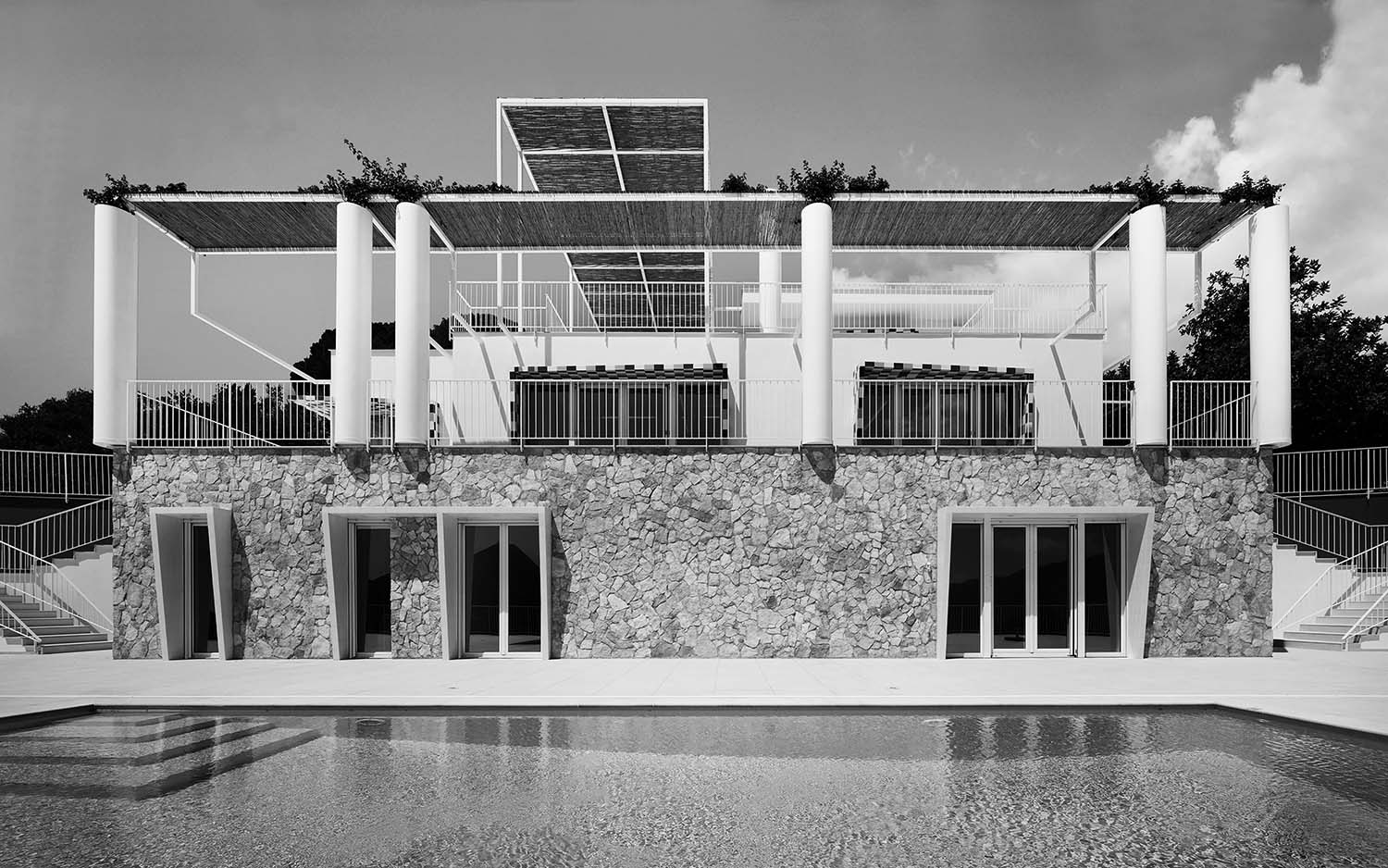
In particular, it allows each project to be extracted from historical time and examined within the eternal present of its signs, thereby reactivating any author and tracing the underlying logics of every fold, every angle, and every relational configuration between parts. The second outcome of this research is undoubtedly the redefinition of the field within which what is not Mannerism may be situated, thereby also allowing Mannerism itself to be considered as an autonomous current, ambiguous, contradictory, and at times hyperbolic in its modes of representation. The third consequence, perhaps a synthesis of the first two anchoring propositions, is the repositioning of Mannerism within the contemporary condition as an inescapable youthful phase of any authorial trajectory. This phase translates into architectural work through the strategies previously identified (gigantism, muteness, eccentricity, deviation, elasticity), expressing the tensions inherent in these beginnings – strategies that must be adopted precisely in order to be eventually relinquished along a more mature path. As Malfona writes: “Throughout the study of mannerism, we can finally understand the author’s role with respect to his or her own work. An author who lets his or her work go gracefully, thus indulging its intrinsic bond with life.” 24 (Fig. 2.)
At the end of the volume, an unpublished contribution by Paolo Portoghesi sheds light on several aspects that had remained in the background throughout the book, and enables – through a retrospective journey – a rereading and recontextualization of Lina Malfona’s observations.
In the first instance, this concerns the relationship between rule and transgression, which Portoghesi identifies with reference to Mannerist perspectival construction: a mode of spatial representation that generates its image by multiplying centers, vanishing points, expansions, and contractions – much as this book itself operates.
Secondly, the exceptions adopted by Mannerism are nothing other than signs of disobedience to established rules and of syntactic innovation, primarily oriented toward expressive freedom and sprezzatura. In a comparable manner, this research – situated within a personal trajectory and mediated by a certain “scientific” rigor of restitution – reveals how both the adherence to and subsequent distancing from Mannerism become pretexts for investigating one among the many possible ways of making architecture, explored here first and foremost through the author’s own practice and intellectual inquiry.
Credits
-
Figure 1: courtesy © Gentucca Canella.
-
Figure 2: courtesy © Gambardella Architetti.
Notes
-
Lina Malfona, The Mannerist Phase in Architecture. On Early Style (Routledge, 2025), 1.
-
Ibid., 15.
-
Ibid.
-
Ibid., 20.
-
Ibid., 32.
-
Ibid., 35.
-
Ibid., 34.
-
See Robert Venturi and Denise Scott-Brown, Architecture as Sign and System. For a Mannerist Time (The Belknap Press of Harvard, 2004). As cited in Malfona, The Mannerist Phase, 79.
-
Malfona, The Mannerist Phase, 78.
-
Ibid., 65.
-
Ibid., 66.
-
Manfredo Tafuri, Storia dell’architettura italiana 1944–1985 (Einaudi, 1986), 163–64.
-
Malfona, The Mannerist Phase, 81.
-
Mario Botta and Francesco Dal Co, “Una conversazione intorno all’architettura,” in Una casa, ed. M. Botta (Electa, 1989), 83–84. As cited in Malfona, The Mannerist Phase, 83.
-
Gilles Deleuze, The Fold Leibniz and the Baroque (Minnesota University Press, 1993), 29. As cited in Malfona, The Mannerist Phase, 98.
-
Robert Venturi, Complexity and Contradiction in Architecture (Museum of Modern Art Papers, 1966).
-
Malfona, The Mannerist Phase, 100.
-
Ibid., 99.
-
Ibid., 109.
-
The setting of the Twin Peaks series (1990–91), which is both metaphysical and imaginary, is what this refers to.
-
See Colin Rowe, “Mannerism and Modern Architecture,” in Architectural Review, no. 107 (1950), 289–300. As cited in Malfona, The Mannerist Phase, 110.
-
See Robin Evans, “Figures, Doors and Passages,” Architectural Design no. 4 (1978), 267–78. As cited in Malfona, The Mannerist Phase, 110.
-
Malfona, The Mannerist Phase, 111.
-
Ibid., 120.