
Archive
Category: Theory
Book Review
Theory
Open Access
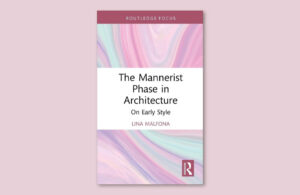
Outgrowing Mannerism. On Lina Malfona’s The Mannerist Phase in Architecture
by Laura Mucciolo
pp. 231–240
The Mannerist Phase in Architecture. On Early StyleBy Lina MalfonaRoutledge, 20255.74 × 0.54 x 8.74 in. [17 x 1.4 x 22 cm]15 b&w illustrations154 pages (hardcover)US$55.49 (hardback)US$25.59 (eBook)ISBN 9781041014911 (hardback)ISBN 9781003615071 (eBook)
Essay
Theory
Open Access
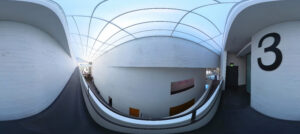
Aesthetics and Epistemological Decentralization: Toward an Embodied Framework for Museum Space
by Majed Awadh Alghaemdi, Abdulrahman Bin Burayk
pp. 189–209
Museum architecture shapes how knowledge is encountered. This article develops the concept of epistemological decentralization to describe spatial configurations that resist privileging a single interpretive route, enabling multiple encounters with content through movement and perception. Two questions drive the argument: first, under what conditions can museum space redistribute epistemic agency without reducing that shift to apparent freedom within a scripted order; second, what spatial conditions support distributed meaning-making rather than staging participation while preserving institutional authority. Drawing on Merleau-Ponty’s phenomenology, the study develops an interpretive reading of Steven Holl’s Kiasma Museum of Contemporary Art in Helsinki (1998), structured around four registers: The Solicited Body, The Lived Body, Bodily Attunement, and The Chiasm. The reading shows that route optionality, navigational oscillation, proprioceptive orientation, and sectional layering can shift interpretive positions from an institutional center toward a more distributed field. The argument connects spatial configuration to the embodied dynamics through which meaning is assembled in museum experience.
Book Review
Theory
Open Access
Boredom and the Architectural Imagination. Rudofsky, Venturi, Scott Brown, and Steinberg in Andreea Mihalache’s Research
pp. 189–197
Boredom and the Architectural Imagination.
Rudofsky, Venturi, Scott Brown, and Steinberg
By Andreea Mihalache
University of Virginia Press, 2024
7 x 1.25 x 8 in. [17.8 cm x 3.2 x 20.3 cm]
45 illustrations (35 b/w, 10 color)
238 pages (hardback & paperback)
288 pages (eBook)
US$115.00 (hardback)
US$34.50 (paperback)
US$34.50 (eBook)
August 5, 2024
ISBN: 978-0-813-95156-0 (hbk)
ISBN: 978-0-813-95157-7 (pbk)
ISBN: 978-0-813-95158-4 (ebk)
Book Review
Theory
Open Access
Representation Restricted Reality (RRR). Marianna Charitonidou on Architectural Drawings
by Pablo Lorenzo-Eiroa
pp. 183–188
Architectural Drawings as Investigating Devices.
Architecture’s Changing Scope in the 20th Century
By Marianna Charitonidou
Foreword by Gevork Hartoonian
Routledge, 2023
6 x 0.75 x 9.25 in. [15.2 x 2 x 23.5 cm]
39 B/W illustrations
298 pages
US$133.00 (hardback)
US$54.99 (paperback)
US$49.49 (eBook)
November 28, 2023
ISBN: 978-1-032-43110-9 (hbk)
ISBN: 978-1-032-44418-5 (pbk)
ISBN: 978-1-003-37208-0 (ebk)

Essay
Theory
Subscribers
Train Yourself: Architectural Recycling Between Digital and Physical Realities
by Andy Bako
pp. 21–43
As generative AI reshapes architectural practice, a critical paradox emerges: while new computational tools offer unprecedented creative possibilities, the physical resources essential to building grow increasingly scarce. This paper investigates how architecture can productively engage this tension through novel approaches to material recycling and digital transformation. Rather than treating physical and virtual domains separately, this research proposes an integrative framework where design emerges through continuous feedback between material manipulation and computational processing. The exhibition Train Yourself demonstrates this methodology, presenting a series of experimental artifacts that evolve through iterative exchanges between physical material, AI-driven formal exploration, and imaging techniques. These hybrid objects gain definition through recursive operations that blur boundaries between physical construction and digital representation. Beyond resource conservation, this approach reveals how architectural practice might cultivate new forms of creative intelligence capable of navigating between material constraints and computational possibilities. The findings of this research suggest a mode of practice where designers orchestrate dynamic interactions between physical matter, algorithmic processes, and human intention, pointing toward a more nuanced understanding of ecological sensitivity in contemporary design practice.
Buy
Already in your cart -
View cart
Essay
Theory
Subscribers
The Contemporary City as Archipelago: From O.M. Ungers’ Berlin to the Global Collage City
by Gregorio Froio, Monica Manicone, Matteo Benedetti
pp. 45–65
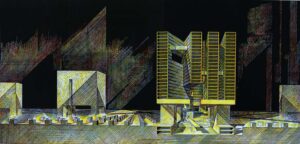
This essay critically examines the continuing relevance of the archipelago city – as theorized by Oswald Mathias Ungers in the 1970s – as a morphological and conceptual framework for understanding contemporary urban conditions. Originally developed in response to the fragmentation and depopulation of post-war Berlin, the archipelago city posits a model of urban organization based on autonomous, differentiated spatial units or ‘islands’ within a continuous green matrix. The essay situates this model within a broader theoretical lineage, drawing connections with Colin Rowe’s “collage city,” Aldo Rossi’s theories of typology and memory, and Rem Koolhaas’s concept of “junkspace.” Through morphological and compositional analysis, it explores how Ungers’ vision has been reinterpreted in projects from the 1990s to the present, including proposals by Franco Purini and Laura Thermes. These case studies highlight the adaptability of the archipelago paradigm in the contexts of accelerated urbanization, formal heterogeneity, and socio-political complexity. Finally, the essay reflects on the limitations and potentials of the model in an age marked by globalized urban development, the rise of the zone and the increasing marginalization of architectural agency.
Buy
Already in your cart -
View cart
Essay
Theory
Open Access
Claude Parent’s Oblique Travels: From Architectural Form to Social Participation
by Igor Siddiqui
pp. 79–101
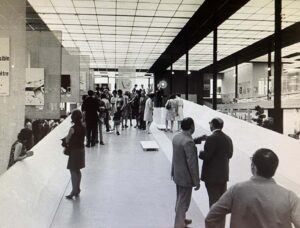
This article focuses on the French architect Claude Parent’s exploration of oblique architecture during a series of traveling programs pursued between 1969 and 1975. Based on a theory of the inclined plane developed in the 1960s with Paul Virilio as part of the group Architecture Principe, Parent conducted this exploration through temporary installations and staged public events hosted by cultural centers throughout France. This article examines the institutional context within which Parent’s traveling repertoire took place as well as the government policies, social movements, and cultural forces that shaped it. Through such an approach, the article develops a perspective on the relationship between Parent’s practice and the cultural centers’ objectives as mutually beneficial, and of his interventions as site specific, both architecturally and socially. The article furthermore provides evidence that these participatory experiences had a lasting effect on the architect’s attitude toward experimental architecture, shifting his priorities from form to subject.
Article
Theory
Subscribers
Three Aspects of Nostalgia: Thoughts on the Work of Aldo Rossi
by Edna Langenthal, Hagit Leshem
pp. 153–175
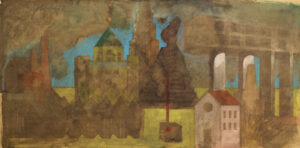
This essay discusses various aspects of the term “nostalgia.” Rather than an individual plight, it will be considered here as a symptom of contemporary society, which does not stand in contrast to modernity but is derived from it. Nostalgia characterizes humans’ connections to the past, to their sense of self, home and community. We reflect on how this affects our longing for home, how we envision our collective home, and how we place ourselves in the world. We distinguish three types of nostalgia: Restorative, longing for the restoration of a lost home; Utopian, transforming our longing into a utopian ideal; and Reflective, which differs by shifting the focus from recovering what is perceived as a loss of absolute truth to pondering questions of history and the passing of time. The essay focuses on nostalgia’s bearing on architecture, as demonstrated in the work of Architect Aldo Rossi. His oeuvre, in which the contemplation of time and memory are inherent, reveals all three forms of nostalgia, highlighting and questioning their centrality to architectural thought and practice.
Buy
Already in your cart -
View cart
Article
Theory
Open Access
The Meta-Project, Eisenman, and Capital: Lessons for Critical Architectural Practice
by Cem S. Kayatekin, Ujal Gorchu, Mikhail Frantsuzov
pp. 133–151
How does Peter Eisenman’s conception of the meta-project relate to capital? Within much of the relevant discourse, the Eisenmanian ideal of achieving autonomy from politico-economic dynamics is underscored, with strict references to the notion of capital remaining absent from the literature. However in studying narratives articulated by Eisenman himself over the course of several lectures spanning several decades, a more integrated connection with capital begins to emerge—wherein Eisenman’s conception of capital not only shapes later stages of the meta-project evolution but even seems to partially shape the anti-phenomenological position, anchoring it in its formative stages. These findings offer a distinct counterpoint to the Eisenmanian meta-project, both in terms of its efficiency at achieving distance from politico-economic dynamics and, more fundamentally, in terms of its presumed apolitical anchoring. However, far from being solely applicable to a scholarly niche, these discursive wrinkles offer contemporary practitioners a proactive theoretical framework for how to structure meta-projects to better resist contemporary capitalistic intricacies, and avoid the paths which led Eisenman’s own meta-project being appropriated by dominant politico-economic dynamics.
Essay
Theory
Subscribers
In Search of the New Eden. From Le Corbusier’s Boîte to Sejima’s Curtain
by Javier Pérez-Herreras
pp. 115–132
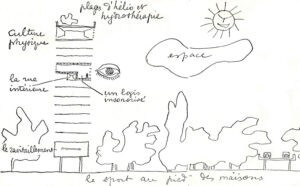
Le Corbusier’s Unité d’Habitation in Marseille established the relationship between an old man and a new world that arrived. This old self found in the interior of a long rectangle a domestic Eden that was once lost. The exterior was still a place for waiting, a place to be seen, writes Beatriz Colomina. But this modern Eden could not last forever: his indoor paradise had to move. In 1999 Terence Riley inaugurated at the Museum of Modern Art of New York the Un-private House. In it, he discovers a new dweller that does not occupy the interior of that domestic laboratory, but its own limits. Contemporary man is a social being, Jose Pardo asserts. His public self is moved to a liminal threshold, writes Victor Turner, that Kazuyo Sejima turns into the new house. Architecture is no longer the air volume contained within its limits, but that which prowls said limits. The new domestic home of contemporaneity becomes a porosity line: a curtain that publicizes domestic life. The house is converted into a habitat of borders, where man discovers his new domestic Eden.
Buy
Already in your cart -
View cart