
Archive
Category: Cross-Disciplinary Studies
Opinion
Cross-Disciplinary Studies
Open Access
Baukultur in a Cybernetic Age: A Conversation
by Michael A. Arbib, Meredith Banasiak, Robert Condia, Colin Ellard, Jonathan Enns, Melissa Farling, Robert Lamb Hart, Richard Hassell, Eduardo Macagno, Harry Mallgrave, Fred Marks, Juhani Pallasmaa, Sarah Robinson
pp. 7–28
We received and we gladly publish this conversation among distinguished theorists and scholars on an important topic, also aligned with the cross-disciplinary mission of our journal. [MS]
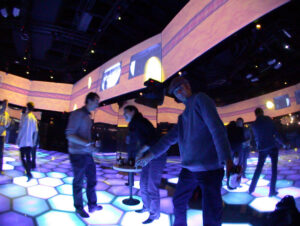
ABSTRACT - The article offers a multi-author conversation charting the future of architecture in light of the apparent tension between Baukultur, which combines the culture of building and the building of this culture, and the rapid changes brought about by digital technology, embracing cybernetics and artificial intelligence. The article builds on a discussion of Baukultur to debate in what sense buildings are “machines for living in,” then examines neuromorphic architecture wherein cybernetic mechanisms help buildings sense the needs of their occupants. It closes with an example of a building complex, Kampung Admiralty, that combines cybernetic opportunities with a pioneering approach to building “community and biophilia” into our cities. This article interleaves an abridged version of Michael Arbib’s (2019) article “Baukultur in a Cybernetic Age,” 1 with extensive comments by the co-authors.

Essay
Cross-Disciplinary Studies
Subscribers
Wellbeing in the Built Environment: Designing Discontinuities Between Function and Semantic
by Nicoletta Brancaccio, Davide Giacomo Maria Gattoni, Federico Niola, Stefano Rozzi
pp. 31–52
Space is relational. How many relationships can occupy a space? How do they work? These are both interesting questions that we would like to answer. We know that we interact with space and that its configuration affects us: we can be aggregative while experiencing it, rather than competitive. Space has considerable power in influencing our brain. Essentially, our actions are somehow manipulated by what we see and what we touch. How does our space (peripersonal space) interfere with another’s? The idea of interaction within space (or social space) and space of selfhood thus becomes an essential subject for architecture and cannot be simply parameterized in a geometric manner. Physical space must, therefore, allow solitary or cooperative movement without alienating the individual. We base our judgments on movement, culture, personal psychical characteristics, memory, and personal experience. Taking these elements as our base, we gave a new perspective for designers to draw from the semantic, which can be rhetorical and disconnected by the function.
Buy
Already in your cart -
View cart
Article
Cross-Disciplinary Studies
Subscribers
Architectural Portraits: ῾The MIES Project’
by Arina Dähnick
pp. 9–30
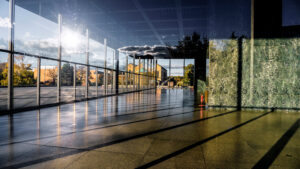
This article wants to offer a brief overview of my experience as an architectural photographer and of “The Mies Project” in particular, on which I have been working on for the past few years. My approach to photography, based on the latest digital technology but also on the Leica M-System, is briefly outlined. In the past, the question was how to obtain information. Nowadays, the proper structuring of information is what really matters. Architectural Portraits, a small selection of which from “The Mies Project” are here presented, are “intimate gazes,” prioritizing the relationship of the detail of a building with its surrounding, the interaction between construction details, lighting and weather conditions. In this sense, Mies’ works not only have sparked my interest in architectural photography, but have been also the perfect poetic partner for my research.
Buy
Already in your cart -
View cart
Essay
Cross-Disciplinary Studies
Open Access
An Urban/Landscape Project for the Venice Lagoon
by Claudio Aldegheri
pp. 191–207
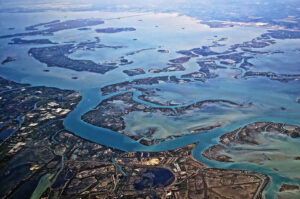
In recent years, in the Venice lagoon we have seen an increasing number of urban planning projects with a low level of flexibility, which have not seized the opportunities offered by such a rich and complex context. This study is therefore about how to approach the project in this area, aiming to give value to its many different landscape aspects and attempting to reconsider in general the attitude to urban planning.
Project
Cross-Disciplinary Studies
Open Access
Architectural Insertions in a Remote Landscape: Projecting Landscape Architecture for an Extreme Territory
by Elisa Izquierdo Garcés
pp. 111–144
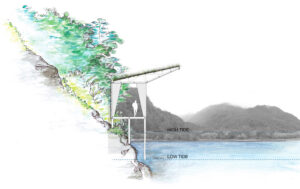
The development of a landscape architecture project that contains a scientific research and tourism station is being considered in an extreme territory – dynamic, isolated, hard to access - in Exploradores, western Aysén, southern Chile. The territorial characteristics, lack of infrastructure, and limited information about the place to be intervened into mean that its landscape – the subject of this work- is hard to define. This situation leads the research into the development of a first part – analytical, descriptive, and speculative - which will define the remote landscapes of Exploradores, which are not observed physiologically in the territory.
The first part will be complemented by the landscape architecture project, which proposes, by architectural insertions, to interpret and express the situation that has been recognized. Supported by a methodology that studies the territory with a four-scale approach, representative aspects of the local landscape will be determined that seek to function as an operative tool guiding decisions for the project.
Article
Cross-Disciplinary Studies
Open Access
Landscape as a Conceptual Space for Architecture: Shifting Theories and Critical Practices
by Michelle Laboy
pp. 77–96
Architecture constantly negotiates the ideal and the real. These two conditions, being a reflection of cultural values and practices, change over time. I suggest that what remains constant to architecture are the lasting spatial and formal qualities that engage in constructing the physical and cultural landscape: how it channels natural light and air, how its permanent structures organize space, frame and supports life, shelter, protect and comfort. There are the qualities that make architecture endure and adapt to a changing cultural and natural environment. The placement of architecture in the real world often seems contaminated by a multiplicity of socio-economic structures and processes, but its situation in the world is also what provides an opportunity to engage in the making of a landscape where over time architecture finds a critical autonomy and relevance. The role of architecture in making or responding to the landscape is one of the critical questions in current debates about autonomy and contingency. In this paper, I expand on the work I presented at the ACSA conference at Syracuse University in the Fall of 2015, where I explored how the discipline of architecture has absorbed the landscape as a conceptual space, to “theorize critical means of engagement with the formal, spatial and performance qualities of its territory, to define critical contingencies that are meaningful through space and time, and to refuse those that can keep it tied to the trivialities of a temporary situation.” More specifically, my work examines how the notion of the ecological permeates the architecture discipline from the field of landscape, providing a framework for architectural discourse to theorize the relationship of the idealized and the real, to create new singular form within a situation of multiplicity.
Essay
Cross-Disciplinary Studies
Open Access
Casting Call: Spatial Impressions in the Work of Rachel Whiteread
by Peter L. Wong
pp. 97–110
Published: 2016-05-01
For more than 20 years, Rachel Whiteread has situated her sculpture inside the realm of architecture. Her constructions elicit a connection between: things and space, matter and memory, assemblage and wholeness by drawing us toward a reciprocal relationship between objects and their settings. Her chosen means of casting solids from “ready-made” objects reflect a process of visual estrangement that is dependent on the original artifact. The space beneath a table, the volume of a water tank, or the hollow undersides of a porcelain sink serve as examples of a technique that aligns objet-trouvé with a reverence for the everyday. The products of this method, now rendered as space, acquire their own autonomous presence as the formwork of things is replaced by space as it solidifies and congeals. The effect is both reliant and independent, familiar yet strange. Much of the writing about Whiteread’s work occurs in the form of art criticism and exhibition reviews. Her work is frequently under scrutiny, fueled by the popular press and those holding strict values and expectations of public art. Little is mentioned of the architectural relevance of her process, though her more controversial pieces are derived from buildings themselves – e,g, the casting of surfaces (Floor, 1995), rooms (Ghost, 1990 and The Nameless Library, 2000), or entire buildings (House, 1993). From an architect’s perspective, Whiteread offers an unsettling interpretation of architectural space, one that is dependent on filling space to the brim, barring life from entering or holding it in suspended animation from within. This paper argues that architectural form, whether fashioned from contingencies or autonomous acts, has reached a saturation point in architectural criticism. The work of Whiteread helps forge an alternative reading that embraces the object-oriented methods inherent in design by turning the tables on our fascination of figural form and the obsession of substance. The essay analyzes several of Whiteread’s projects in order to explain the meaning and techniques of her work, and places them within the context of Luigi Moretti’s 1953 essay on the “Structures and Sequences of Spaces.” It concludes with research work that attempts to use Whiteread’s method to better understand the figural and material attributes of architectural space.