
Archive
Category: Narration
Essay
Narration
Subscribers
The Evolving Shape of Post-Cold War Space: Architecture, Empire, and Spatial Sovereignty in the Arctic
by Eric Nay
pp. 7–21
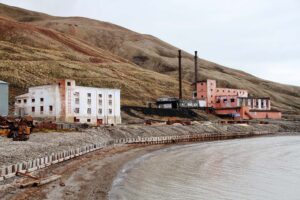
Svalbard is warming faster than anywhere else on Earth. Average temperatures are up, and sea ice is declining. Life there means having to adapt to longer summers and shorter, warmer winters. Svalbard, a Norwegian Arctic Archipelago located midway between mainland Norway and the North Pole, and the spectral presence of abandoned Soviet-era coal mining towns on the peninsula are the subjects of this paper. Shaped by Soviet coal mining, this essay is framed by an analysis of spatial haunting and Cold War/neocolonial aspirations and current anxieties around climate change. Evidence is rendered concrete through abandoned industrial architecture and the combined spectres of war and climate catastrophe in the region. This conceptual framework provides a setting for the analysis of Pyramiden, an abandoned Soviet coal mining town on Svalbard. It serves to explore the Arctic as more than terra nullius; rather, it presents a region of ambiguous spatial sovereignty produced in the interstices of governance. This highlights an evolving spatiality that rests on Arctic fantasies and imaginaries materialized in “haunted” sites like Pyramiden.
Article
Narration
Subscribers
The City and the Myth: Narrating Heritage through a Travelogue
by Giuseppe Resta, Berna Göl
pp. 271–293
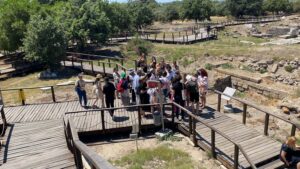
This article explores the use of travelogues as a tool for narrating the vitality of cultural heritage sites in the contemporary city. To strengthen the existing understanding of narration in architecture and spaces, this study discusses the role of travelogues in capturing the multiple layers of a heritage site, the intersection of imaginary narratives with tangible portrayals, and the importance of the bodily experience in shaping the perception of a place. It also examines the influence of prior knowledge and cultural frameworks on the visitor’s experience and the potential for travelogues to challenge stereotypical constructs and create new narratives. As an ideal extension of the traveler’s body, the travelogue offers a unique perspective on heritage sites by incorporating personal experiences, local facts, and new issues that arise in contemporary society. The authors conducted a workshop in Çanakkale, Turkey, organized for the EU COST action “Writing Urban Places,” where participants created travelogues to document their experiences and reflections on the mythological city of Troy.
Buy
Already in your cart -
View cart
Article
Narration
Open Access
Las Heras: An Imagined Future. Stories of an Emerging World
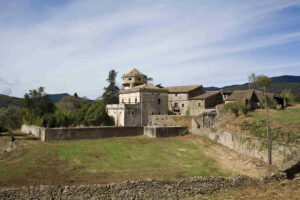
by Will Alsop
pp. 7–23
The estate Las Heras lies close to Girona in Spain. I was taken there by my client, in the form of a mystery tour. We arrived at a large house within 350 hectares. I felt instant affinity to this place before leaving the car. I asked my client: “Why did you buy this?” He answered: “…that is YOUR project – to tell ME!” The land exuded a sense of place which appeared irrational. Time and neglect had taken its toll on the main house and work began to repair the building.The estate has a long and tumultuous history; the past informs the present and creates context for the experience of the place. The future required a possible description. A narrative (novella) was an indulgence that allowed exploration of what might happen in the formation of the place. The book exists as a plan, a gazetteer volume of information, and a cookbook, intended to stimulate and encourage. The emerging project’s starting point is as an educational resource for anyone; particularly for architectural and art institutions.