
Archive
Category: Typology
Article
Typology
Subscribers
The University and the City. A Project at Pisa’s Former Marzotto Complex
by Sara Stillavato, Francesca Molle
pp. 141–163
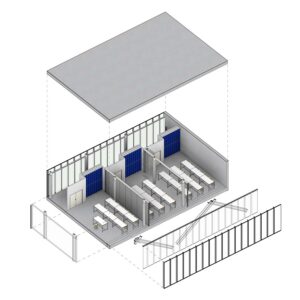
This article frames the expansion of the University of Pisa’s Fibonacci Campus as a threshold project: an interface between university and city operating within a historically stratified urban edge, where the former Marzotto industrial complex meets Pisa’s medieval walls. Building on contextual analysis of the site’s transformations – from twentieth-century rationalist factory to academic campus – this research discusses how new scientific programs can be inserted without compromising the legibility of the existing fabric. The design translates departmental needs for flexible laboratories and study environments into a spatial gradient that combines public accessibility and controlled research conditions. Ground-floor spaces are conceived as independently usable civic rooms, while open areas are reconfigured as shared green infrastructure that reconnects institutional and urban life. A comparative cost appraisal, developed from recent public tenders, frames feasibility from a public-client perspective and links adaptability of use to long-term economic sustainability. Rather than proposing a resolved model, the project advances a critical framework that makes legible the tensions between architectural intent, institutional governance, and civic appropriation inherent in any university expansion within a historic urban context.
Essay
Typology
Open Access
Microcinemas Rising in Europe: New Spatial Trends in Movie Theaters
by Diego Terna, Luca Maria Francesco Fabris
pp. 165–188
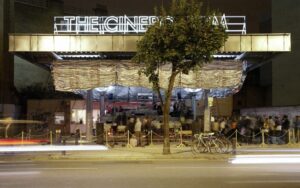
The research paper proposes a critical survey of recently emerged, new architectural spatial forms for hosting movie theaters in the European context. A trend showing a renewed focus on the quality of movies and programming, reverberating in the architectural space of cinema halls, which tend to adapt their features toward small numbers, focusing on privacy and fellowship among a few viewers, and searching for a kind of coziness, transforming cinema halls into spaces with an almost domestic feeling. This new kind of movie theater, called microcinema, is a fluid space within broader functions, where watching the projection on a screen offers an opportunity for intellectual speculation, no longer tied to personal concentration alone, but to public dialogue, where sharing empathy is the more critical experience, providing elements for a new systematic approach to the movie theater design.
Project
Typology
Subscribers
“L’École Poreuse” (1) A Project for an Innovative School
by Riccardo Zuliani, Brunella Angeli
pp. 91–125
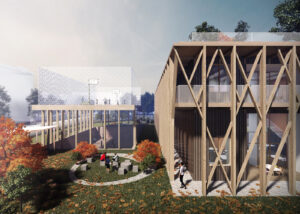
This paper details the design solution awarded at the 2017 international call for ideas for the design and implementation of fifty “innovative schools” launched by the Italian Ministry of Education and Research (MIUR). The project expands an ongoing personal research, focusing on the class layout in relation to the educational curriculum proposed inspired by the principles of Social Constructivism and with the final aim of providing continuity among nursery, infant and primary schools. The “School of Tomorrow” designed for the MIUR has no traditional desk, but modular tables of different sizes. There is no teacher desk, but an educator who moves among students, both in class and in the communal areas. Instead of the traditional class, there are size reconfigurable areas according to subjects taught and students’ needs. This school offers labs, ateliers and workshops. It has no corridors, but connective spaces equipped with poufs, sofas, soft seats and carpets. These areas become the functional and symbolic heart of the school - the Piazza and the Learning Street - hosting parties, assemblies, student works exhibitions and theatrical performances. The school of the future will stay open beyond school hours and will play the role of a civic center.
Buy
Already in your cart -
View cart
Project
Typology
Subscribers
Modular House. Coastal Typological Prototype
by Eric A. Gartner
pp. 69–90
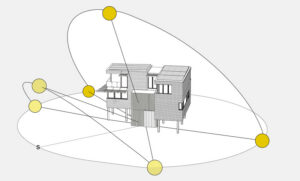
Climate change requires new approaches to coastal settlements at all scales. The architectural community must respond with solutions not only at the urban scale, but also at the scale of the single-family home, long an integral component of the American dream. The single-family typology has been critical to the exploration of architectural ideas and basic societal needs. With shifting coastlines and rising waters, the relationship between built-form and landscape must adapt without losing the important connection between the building and its site. Equally importantly, the transformation of this building type must be broadly available to communities with a wide range of economic resources. Our firm seeks to meet this need through the use of modular construction with thoughtfully restrained site work that limits the short-term impact on the environment, while providing long-term solutions necessary for acclimating to this changing world.
Buy
Already in your cart -
View cart
Article
Typology
Open Access
Prison, Architecture and Social Growth: Prison as an Active Component of the Contemporary City
by Luigi Vessella
pp. 63–84
How do we treat those who make mistakes? And what does this have to do with architecture? The paper will investigate the role of architecture in the design of prisons in order to understand how we could develop a project for a jail that is a place for both punishment and rehabilitation. The effectiveness of a prison is not given only by the efficiency of the justice system in force, but also by the articulation of spaces and by the quality of the architecture. The contradiction of the prison is revealed by its need to respond to two opposing demands: punishment and reintegration. This paper investigates the possible design approaches aimed at designing a new jail typology, through an attempt to "break" the macro-themes that characterize the building of the prison and within these dichotomies work on the "boundary-line" between opposing realities: freedom―constriction; openness―closure; etc. If prison architecture were brought back into the debate regarding contemporary design culture, it could have a significant impact for society especially in terms of opportunities and cultural growth.