
Microcinemas Rising in Europe: New Spatial Trends in Movie Theaters
ABSTRACT - The research paper proposes a critical survey of recently emerged, new architectural spatial forms for hosting movie theaters in the European context. A trend showing a renewed focus on the quality of movies and programming, reverberating in the architectural space of cinema halls, which tend to adapt their features toward small numbers, focusing on privacy and fellowship among a few viewers, and searching for a kind of coziness, transforming cinema halls into spaces with an almost domestic feeling. This new kind of movie theater, called microcinema, is a fluid space within broader functions, where watching the projection on a screen offers an opportunity for intellectual speculation, no longer tied to personal concentration alone, but to public dialogue, where sharing empathy is the more critical experience, providing elements for a new systematic approach to the movie theater design.
While we are witnessing fluctuations in cinemagoing and a consequential concern about the future of movie theaters, we are also observing a trend toward the development of small, independent cinema halls in Europe, which are establishing themselves as bearers of new cultural and curatorial interests in opposition to the larger, more commercial movie theaters. This paper aims to demonstrate how this current trend offers spatial insights for imagining the cinema and entertainment spaces of the future, capturing the key characteristics of examples that range from urban to architectural and programmatic interpretations, which can be applied to new entertainment models. To illustrate this, the essay outlines a brief history of spaces dedicated to film screening, focusing on the relationship between individual and collective viewing, and then investigates the nature and key characteristics of microcinemas and their optimal balance between screening and spectators.
CINEMA AS AN INDIVIDUAL PLACE
In 1888, Eadweard Muybridge traveled in the United States to give a series of lectures on the “Zoopraxiscope,” which had first been shown five years earlier. This circular device groups a series of static photographs of moving subjects: its rotation reconstructs the movement of the photographed subjects in the viewer’s eyes through the “retina’s persistence of vision.” 1
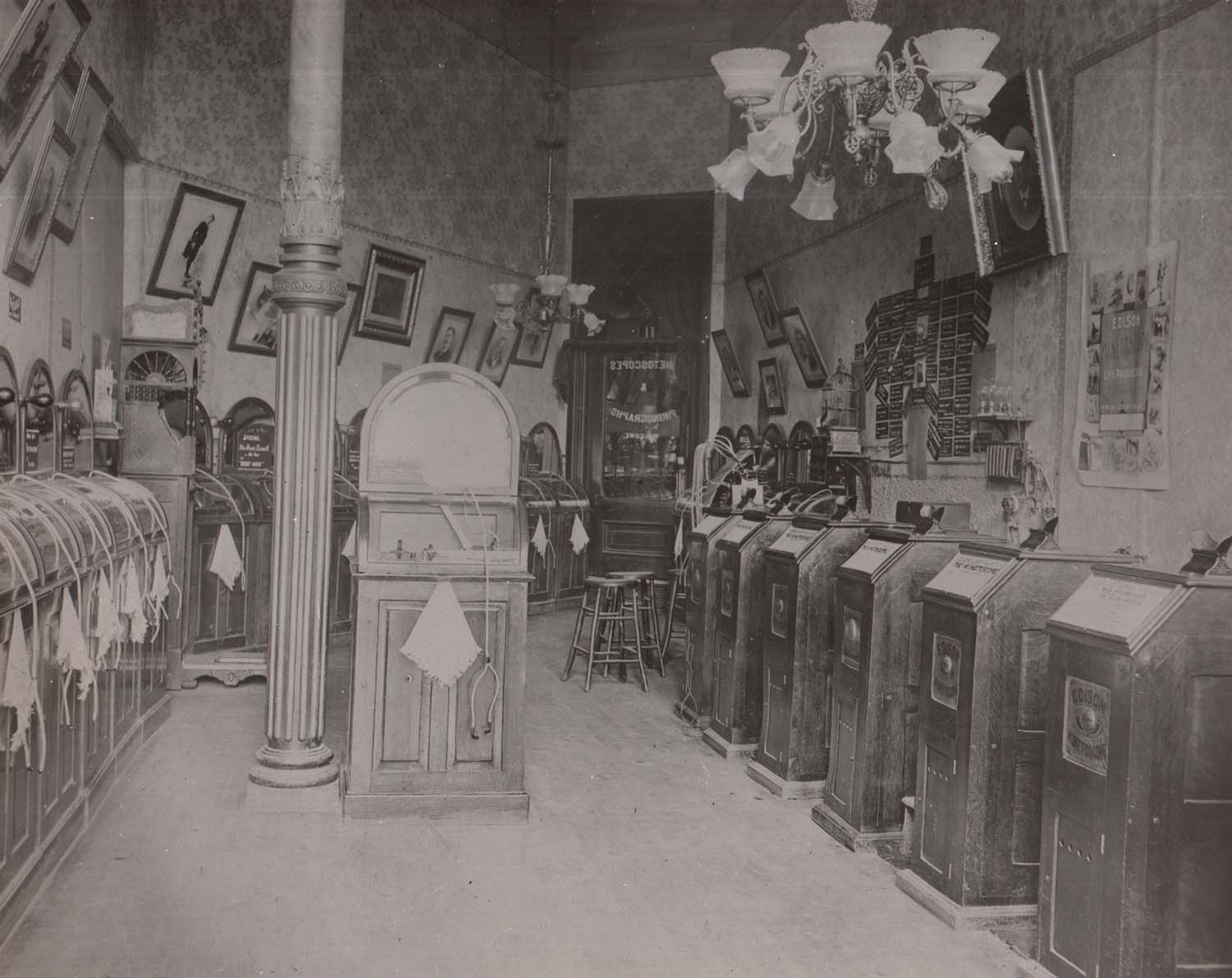
This is the modern birth of cinema in its basic form: a sequence of photos that must be shown at a speed greater than 10–12 frames per second, so that the viewer’s mind can transform it into fluid movement.2 Thomas Edison and his assistants likely attended a lecture by Muybridge at a time when the American inventor was considering the possibility of showing moving images, coupled with an audio device.3 The encounter with the American artist was fruitful: within a few years, they developed the “kinetoscope,” the first analog device for viewing moving images. It was a small cabinet in which a strip of film (the word “film,” hence became the word for cinematographic products) ran through spools, with a viewer at the top, through which the moving images could be seen. They were short movies that immediately found great success with the public, forcing Edison’s company to promote special venues where people could enjoy these “magical” visions.4
Cinema thus emerged as a device for individual entertainment: for a few, but significant, years, the movie-watching experience was a dialogue between the film and the viewer. The spaces housing the kinetoscopes revealed environments packed with devices, arranged in rows, anticipating the multiple solitudes that fill the Japanese Pachinko machine halls nowadays. Cinema, in the early years of life, was not a collective experience but a moment of personal, almost reflective, entertainment, in which the proximity of others does not prevent a certain detachment, a difference in participation that never reaches a moment of community.
EXPERIMENTS ON MINIMAL COLLECTIVITY
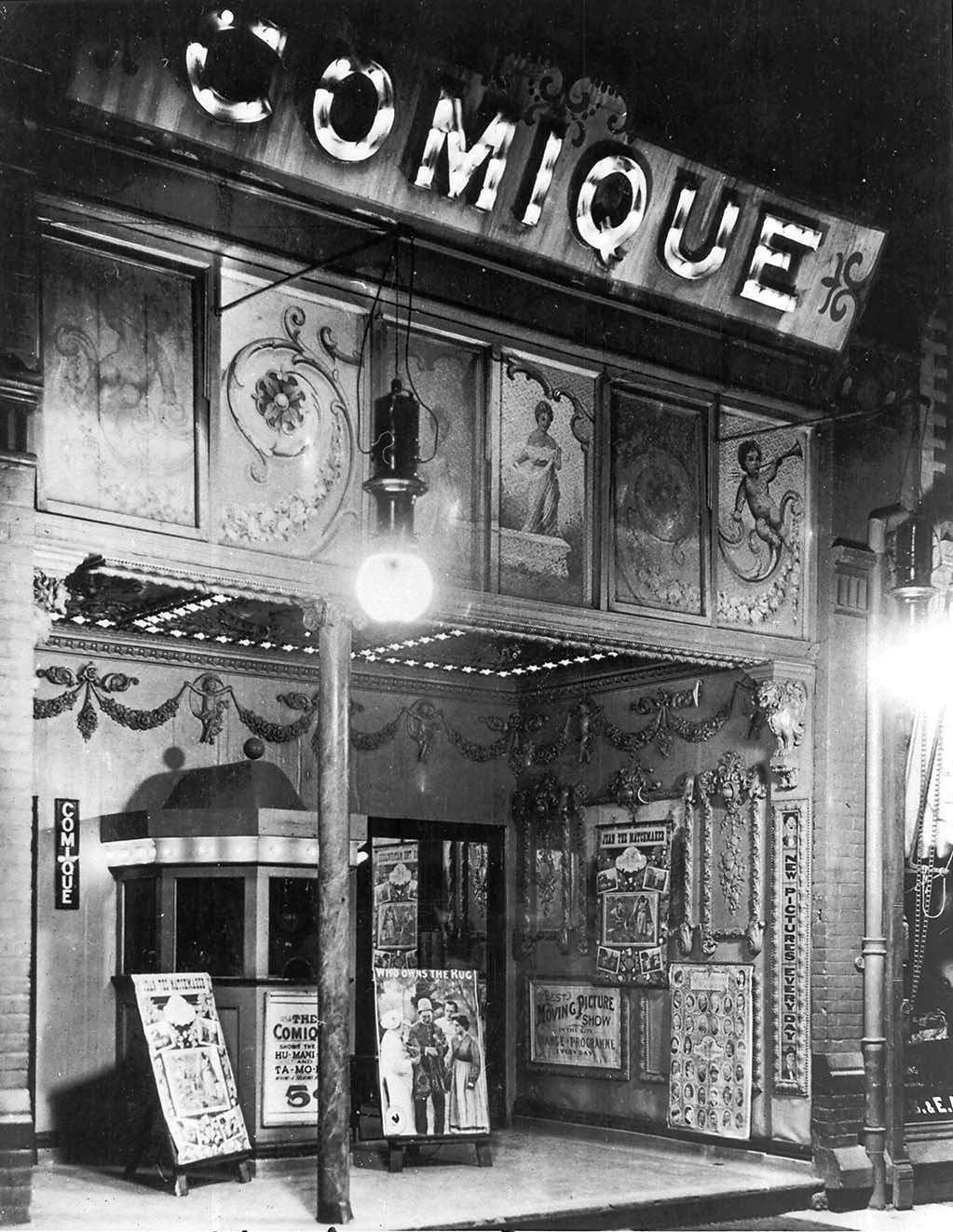
The success of the kinetoscope parlor lasted only a few years. It was supplanted, in the United States by Nickelodeon, and in Europe by the first screenings using the system invented by the Lumière brothers. Between the end of the nineteenth and the beginning of the twentieth centuries, we witness the sedimentation of a way of enjoying cinematic projection that destroyed the previous individual mechanism: from the first projections on the screen, the cinema became a collective entertainment device, starting to acquire the viewing ritual that continues to the present day: the sale of the ticket, the passage in the foyer, the darkness in the theater, the silence and concentration, the viewing, the exit, and the possible comments. The transformation from individual to collective space was rapid but driven by spatial and programmatic experiments. Nickelodeons, for example, were small theaters with just a few dozen seats, offering a bulimic programming: multiple viewings per day, each lasting a few minutes, in a non-stop program that did not even duplicate content, but instead promoted a constant change in offerings, encouraging viewers, thanks in part to the relatively low price (a nickel, or five cents), to consume the film voraciously.
Nickelodeon became the prototype of the movie theater, borrowing heavily from its closest relative, the theater. Experimentation led to the transformation of small theaters into viewing centers, with minimal sanitation and hygiene measures (even newspapers of the time complained about this) and a focus on the exterior. Nickelodeons were machines built for attraction, entirely urban mechanisms that emerged from city strips with eye-catching graphics, attempting to capture the constant flow of people drawn to these places. The almost brutal transition between the individualism of the kinetoscope and the first creation of community is underlined by the spatial form. Instead of focusing on the qualities of the interior room, the project is almost urban, seeking to call the community to action, or, better, to vision.
In Europe, the transition was more subtle (except for films shown in British penny gaffs 5): the first screening for a paying audience took place at the Salon du Grand Café on Boulevard des Capucines in Paris, when the Lumière brothers presented their invention to the public, a device capable of projecting film images onto a screen. Initially, screenings therefore took place in more refined venues, small theaters not explicitly designed for cinema, but conceived as multifunctional spaces, to be set up for different entertainment shows or for catering. While nickelodeons tell us about the birth of the entertainment hall dedicated to movie shows, the Lumière projections show how the functional mix of entertainment venues became vital for offering spectators a more complex experience.
GIGANTISM AND CRISIS
Cinema evolved rapidly in the early 1900s, and within a few years, we witness what has been called the “golden age of cinema,” in the 1920s and 1930s. This era saw the establishment of the typical movie theater layout – box office, foyer, and hall – with significant innovations in the technical aspects of projection and sound, and, above all, a strenuous pursuit of increasing the number of seats available to spectators. At this point, we arrive at an idea of collective vision that must be shared as widely as possible: the individual rooms begin to accommodate hundreds of people, then thousands, arriving, in more recent years, at the record of 5,048 seats at the Fox Theater in Detroit, built in 1928 and designed by the architect Charles Howard Crane.6 To further increase audiences, the first multiplex cinemas were built in the 1960s, with two or more screening rooms within the same building.
These cinemas have evolved to the present day, with buildings designed to blend seamlessly within large shopping malls, transforming commercial spaces into the large foyers of multiplex cinemas. There, viewers are led into a complete entertainment experience that encompasses strolling, shopping, recreation, dining, and, of course, watching movies. The golden age of cinema coincided with a considerable increase in moviegoing, which continued until the 1950s, before suffering a steep decline that lasted until the 1980s. After 1990, moviegoers increased slightly as multiplex theaters grew until 2000. From the early years of the new millennium, moviegoers declined less sharply but steadily until 2020, when the pandemic dramatically reduced their numbers. Even today, moviegoing numbers, although increasing, have not yet reached pre-coronavirus pandemic levels.7
NEW, ANCIENT EXPERIMENTS
We are therefore observing a sector in difficulty, part of a creative industry that has not yet experienced an actual decline, but is fragmented across different consumption platforms, which have altered the typical rituals of cinema: choosing a film, purchasing a ticket, silence, concentration, but, above all, the shared feelings of other people watching the same movie – like a small orchestra: the contemporaneity of smiles, laughter, sighs, strangled screams, tears. In this historical context, however, as unpublished finds, discoveries from a distant past – such as the advent of grotesques at the end of the fifteenth century, when the underground remains of the Domus Aurea in Rome were discovered – some practices from the past seem to return today to experiment with that approach between the individual and the small community, which accompanied the first steps of nascent cinema. These are not entirely new experiments: already in the early 1970s, Peter Kubelka, along with P. Adams Sitney and Jonas Mekas, proposed a strange blend of individualism and collectivity.
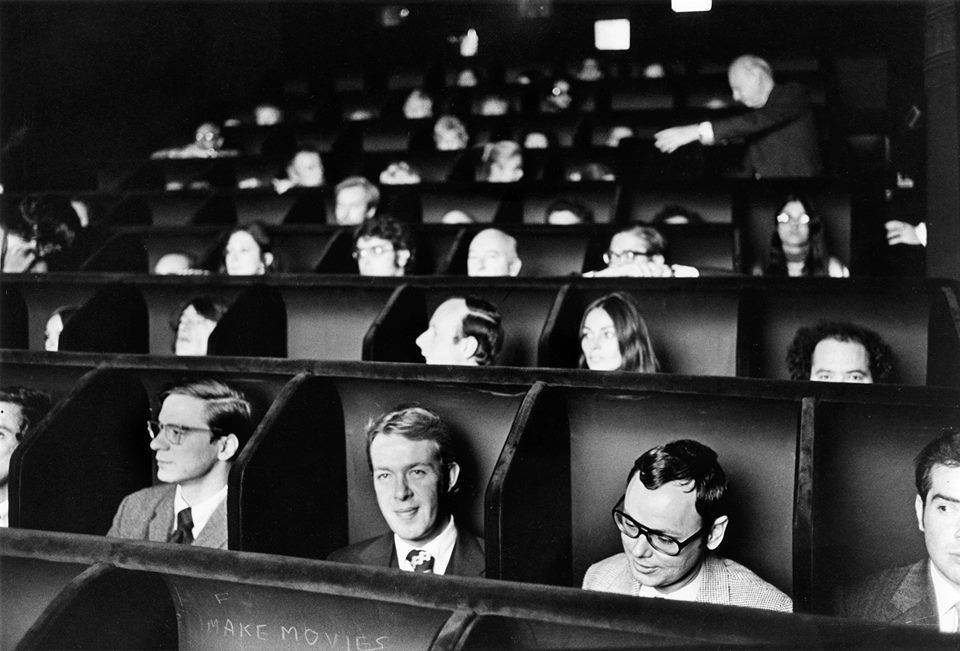
The “Invisible Cinema” is a project for a cinema that hides itself, leaving only the screen in view. The designers proposed masking every element that characterizes the theater – from the seats to the walls, floors, and ceilings – with a uniform black color, so that they would be completely lost from view when the lights were dimmed. To “eliminate” the presence of other spectators, they proposed that each seat have edges, preventing viewers from seeing others once seated. It is an abstract place, which attempts to return to that dual relationship between spectator and film, ignoring the community or at least reducing it to a secondary presence that must not disturb a vision that is as focused as possible. The project, implemented on two occasions, was not met with a favorable response, due to technical issues: a sense of claustrophobia, difficulty dissipating heat between seats, but, probably, because cinema by its very nature requires a certain sense of “extended intimacy,” of being part of a small event in which, for a few hours, one can release feelings in a controlled situation.
RETURN TO THE COMMUNITY
“A man who lived only a private life, who like the slave was not permitted to enter the public realm, or like the barbarian had chosen not to establish such a realm, was not fully human.” 8 Many of Hannah Arendt’s writings echo concepts related to the definition of a community of persons, as the construction of social mechanisms between equal individuals who share common interests.9
In this dialogue between the individual and the collective, the artists and curators Rebecca Barten and David Sherman introduced an idea that was utterly opposed to the contemporary flourishing of multiplex buildings, proposing a return to small numbers, to control over programming, to a more reduced spatiality that allowed for greater conviviality, mutual recognition, a potential for dialogue, and a sharing of experience.
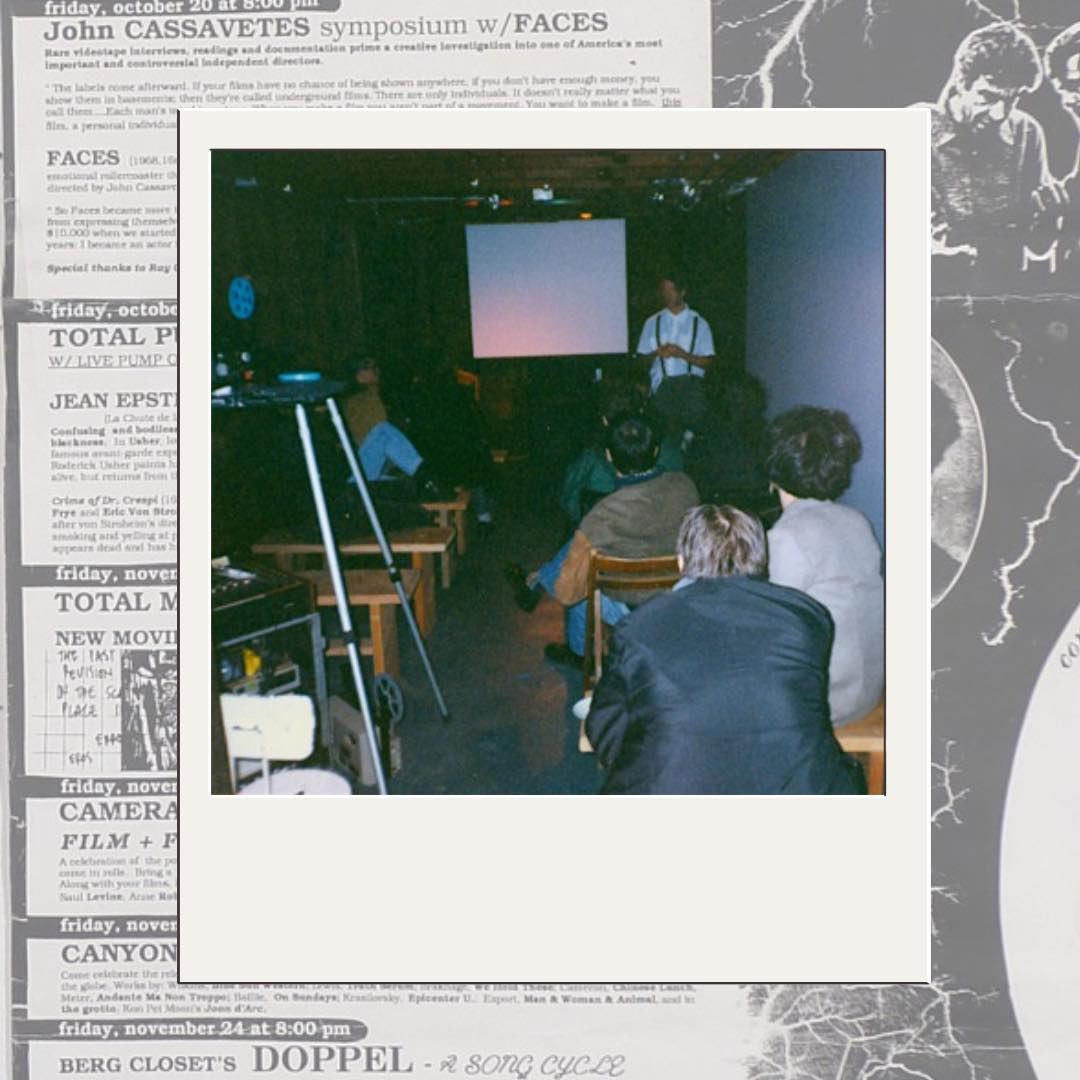
[…] From 1994 to 1997, Total Mobile Home microcinema presented underground film in a thirty-seat cellar cinema located in curators Rebecca Barten and David Sherman’s home on McCoppin Street in San Francisco. With a notably handmade, hermetic aesthetic, TMH [Total Mobile Home, editors’ note] screenings championed idiosyncratic artistic vision through intimate, creatively curated programs. In 1994, coining the term microcinema, Barten and Sherman inadvertently summarized the artist-as-exhibitor zeitgeist and inspired a worldwide movement of intimate exhibition venues.10
The microcinema conceived by Barten and Sherman is a space free from commercial logic, defined by a thoughtful, curatorial programming concept, and seating for approximately thirty people. Its setting is entirely domestic: the entrance is via the artists’ home’s staircase, which leads directly to the basement, where a small projection screen and a projector are installed on a table. The wooden structural system is visible, reminiscent of typical American balloon-frame homes: the walls are lined with electricity meters and the home’s technological systems, evoking underground situations, small clubs hidden in the depths of the city, and the darkness that allows for irregular yet fertile encounters.
This space would be the prototype for every small one related to cinema in the years to come, based on two assumptions: quality in movie schedule and small numbers. In this sense, an essential quality would be lost, overshadowed by the more content-related aspects of cinema: the spatiality of the place, its architectural qualities, if we exclude attempts to create a certain coziness, a small space inspired more by sensations of domestic comfort than by those of a communal public space.
CONTEMPORARY EXPERIMENTS
Since the 1950s, especially in France with the cinémas d’art et d’essai, forms of cinemagoing that were more closely tied to cultural and curatorial logics have been experimented with. However, the difficulties encountered in losing audiences from the 2000s to the present have caused the situation of these cinemas to deteriorate, with reduced revenues and, often, the need for external funding, leading to the closure of a significant number of theaters, a trend exacerbated by the pandemic. In recent years, however, we have seen a return to small cinematographers: a return, therefore, to the idea that cinema could once again be projected by a community of interested people, in a space somewhere between public and private, focusing on the feeling of comfort, the sharing of feelings, and modest spaces, but without becoming too personal. To a certain extent, we have witnessed a trend that has not accepted the gigantic scale of enormous theaters and multiplexes. However, neither has accepted the marked individualism that, from kinetoscopes to Invisible Cinema, attempted to create spaces of maximum, ultra-personal concentration.
A recent article in the British newspaper The Guardian 11 highlighted a new interest among younger generations toward independent cinematographers, programming both vintage films and contemporary movies that transcend the mainstream (the so-called “blockbusters”), offering a carefully considered schedule that touches the sensibility of a specific audience often grouped to create cultural calendars, also appreciating second viewings and reruns. Paul Gallagher, program manager at Glasgow Film Theater, explains that “[…] gradually, in the years since then, this younger audience is now starting to join the dots and see that there are cinemas around that play stuff from the history of cinema. It’s not just new films, but that whole rich history of cinema.” 12 These independent programs are frequently organized within reduced settings (a tendency already highlighted in another article by The Guardian 13 and, more recently, in the digital journal The New York Groove 14).
In a certain way, new spaces are trying to recreate that interest in the magic typical of nickelodeon, and in those situations of functional mix that were created with the first Lumière screenings: today, microcinemas are experimenting with different ways of creating a space for screenings, an alternative to what we consider more standard. Three spatial typologies can be distinguished, which decline the theme of microcinema in a gradient of spatial design that goes from a minimum to a maximum:
– urban microcinemas,
– light and temporary microcinemas, and
– multifunctional microcinemas.
This cataloging seeks to capture the relationship between architectural space and community, in relation to the context in which this relationship develops: the first cases show examples in which the space is almost nonexistent and then expands to encompass the urban fabric; in the second typology, the space seeks to encompass the community through brief appearances which focus on the ritual of cinema to define its architectural boundaries; the latter cases demonstrate a need for functional and programmatic hybridization to broaden the audience of interest, giving the cinematic “aura” 15 less weight, and so a more welcoming space.
URBAN MICROCINEMAS
Many of these projects begin by highlighting the public aspect of screening venues: that is, they work to create a community within a comprehensive framework, that of society, namely the city. These are often temporary projects that cannot be permanent, precisely because they represent a moment of exceptionality, a different use of the city, which usually conflicts with everyday life. However, thanks to these projects, a different kind of urbanity is discovered, a possibility of using the city in a way that expands the perimeters of living, transporting a moment of emotional stasis into a function of the urban fabric. They are zero-volume spaces, because they are linked to the primordial act of constructing that line of projection that shatters on a screen, which is the cinema hall in its most basic degree. In this case, spatial values are primarily found in the choice of location, which creates a setting of primary importance: they are therefore not simply open-air cinemas, but localization projects, which broaden the threshold between the public and the private, including the territory, whether natural or artificial.
Since 2020, the “Cinema Galleggiante” [Floating Cinema] 16 has been transporting the movie theater onto the water in Venice, in a context where the historic Italian town fades away, and viewers encounter the primordial marine environment. During the two-week program, two platforms, generally used for heavy transport in the lagoon, are set up: one as a technical facility – with a projector, screen, audio, and control – and one as an audience area. Arranged perpendicular to each other (the technical platform must maximize the distance between projector and screen), they are anchored south of Giudecca Island, a quarter of Venice where, just a few meters from the bank, one feels as if they are on the open lagoon sea. This creates a new sensation of being face to face with the seawater, without urban intermediaries. To avoid the sail effect, the screen fabric is micro-perforated, making it slightly transparent. On some evenings, this allows a glimpse of the moon behind the projection for a few minutes. At the expense of final quality, this adds a natural element to the visual experience, in a play of complexity that makes cinema an experience beyond itself: new, capable of bringing back the ancient “magic” of moving images.
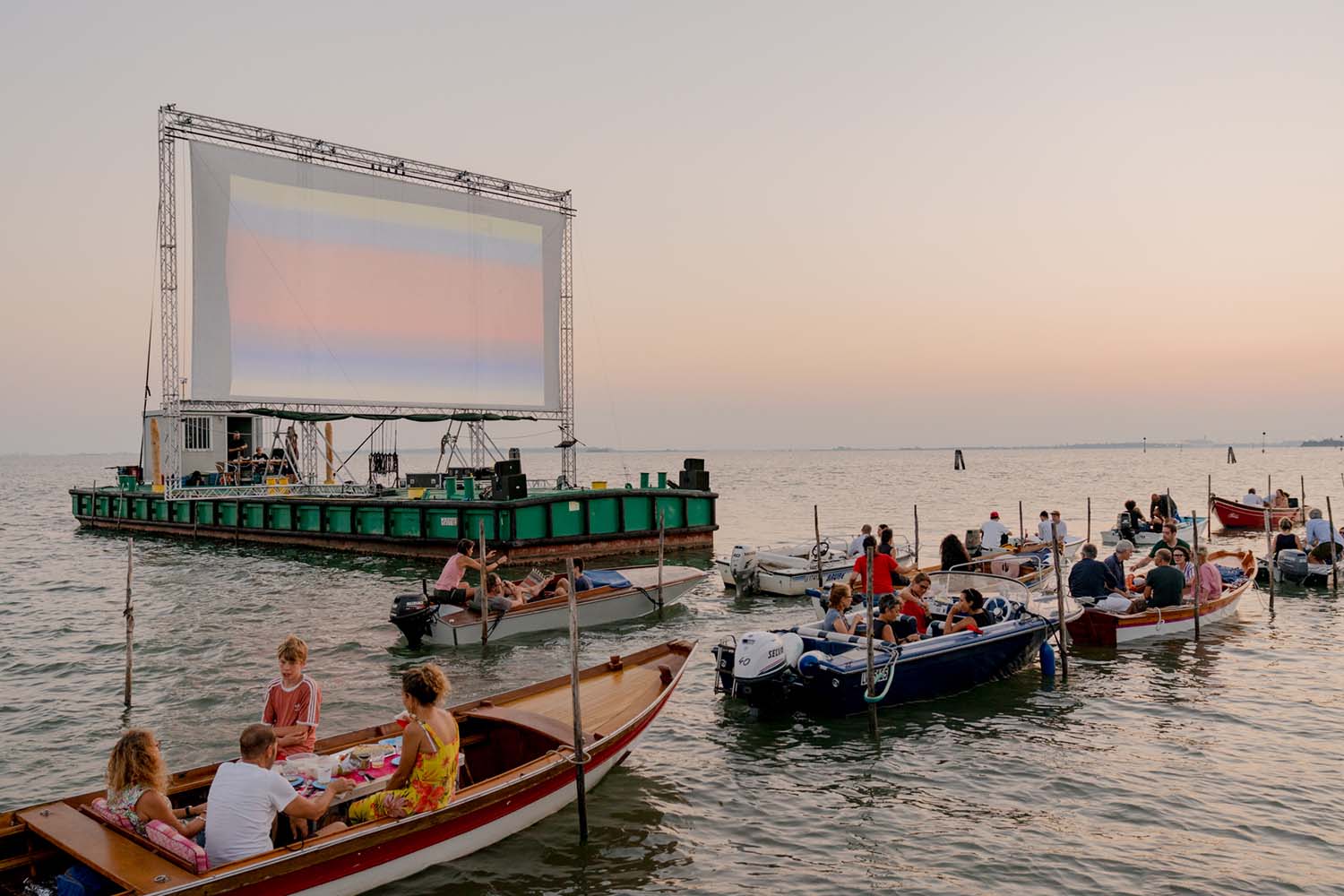
The Cinema Galleggiante was born after a significant experience at the 2012 Venice Architecture Biennale, during which the German architect Ole Shereen presented a project built for the first time in the Andaman Sea of Thailand: still under the name of “Floating Cinema,” Shereen proposed a modular system of micro-platforms that can be quickly attached, creating a multifunctional level that accommodates seating and control rooms. The modules are made of inexpensive, recycled materials, with construction systems inspired by the experiences of local Thai fishermen, expressed through simple geometric shapes. This creates a nautical docking system, a small port of variable size depending on the attached elements. Unlike in the Cinema Galleggiante, here the screen remains on dry land, thus eliminating the feeling of complete immersion in the marine environment, while seeking a connection with the urban landscape. It is a partial experience, yet one that aims to maintain a relationship – the very essence of Venice – between built environment and nature, an inseparable intertwining of nautical flows and terrestrial movements.
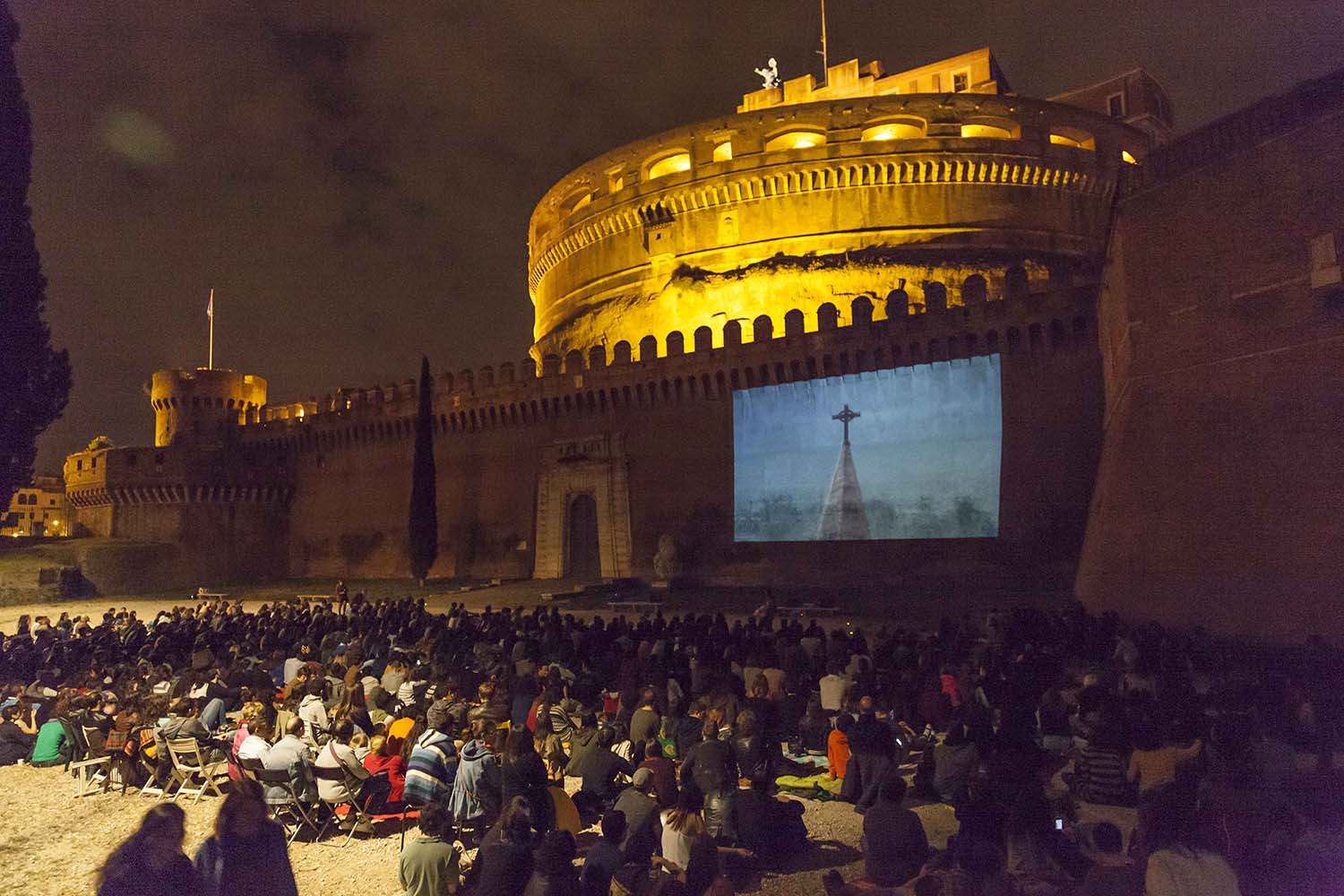
This historical connection, underlined by the link created by the cinema’s projection line between sea and land, is also a relationship of new sharing of urban spaces that underpins the “Schermi Pirata” [Pirate Screens] project in Rome, Italy. In a recent interview, Roman activist Valerio Carrocci explains:
Schermi Pirata was born after the closure of Piccolo Forno Cinema, the space we managed between Cinema America and the first Cinema in Piazza in the summer of 2015. At that point, our experience was becoming institutionalised: we had formed the association, we regularly paid rights for the films to distributors and SIAE [Italian Society of Authors and Publishers], and we had a license for public performances. However, we did not have a screen, so we decided to steal the city’s monuments [using Rome’s monuments background as a screen, ed.]. We tried to choose titles with architectural or historical connections; for example, we projected Pink Floyd’s The Wall on the Tiber embankment, or The Rocky Horror Picture Show (1975) on Castel Sant’Angelo.17
Just as the Cinema Galleggiante seeks a primordial space to erase the cinematic experience and construct a new event, the Pirate Screens destroy the very concept of projection, declining it as an addition to the urban settings of the ancient walls that create the city: it is an updated public space, revived through more contemporary media. Cinema thus becomes an awareness of urban space, the welcoming underbelly of a town usually found outside, but which is once again incorporated into human experience, constructing a new interior. The connection between audience and screen, underscored by Ole Sheeren’s Venetian project, becomes here a fundamental act in reviving a new approach to the movie theater, which does not consider it as a closed building, but rather a space of communal opportunity, even to the detriment of the quality of the viewing experience. A complex urban approach that, however, also reverberates in indoor spaces, as in the Cinemittu, considered one of the smallest cinemas in the world, inaugurated in 2024 in Longone Sabino, a small mountain village about 100 km [62.14 mi.] from Rome. Amid a dramatic depopulation trend in Italy’s inland areas, the small village has lost most of its inhabitants and, most importantly, all essential services, except for a small grocery store.
Through local associations, famous actors, and, above all, the complicity, help, and encouragement of the few remaining residents, Cinemittu was born inside the old post office building, with twelve seats and a weekly programming of 2–3 movies shown on weekends. The impact of this cinema’s opening is not so much architectural: the theater is a small room characterized by exposed stone walls and opens directly onto the small outdoor plaza. It is precisely this outward influence that spatially defines the small cinema hall: after its opening, a small restaurant is being reborn, the village library is being expanded, the reuse of the old community oven and the opening of a hostel are being planned, given the influx of spectators from distant parts of the area. A series of spaces overlooking the village’s modest public spaces is being revitalized, demonstrating the cinema’s influence as an essential urban device. More than spatial qualities, then, we can observe the capacity of a community to function and to transform an urbanized environment. Like the old nickelodeons, it is the outside that tells the story of the inside. In this case, the references are almost symbolic. Still, the redevelopment, restoration, and reclamation work on the public space stems from a core. Cinemittu, in its small space, can only accommodate up to twelve people while transforming an entire area.
LIGHT AND TEMPORARY MICROCINEMAS
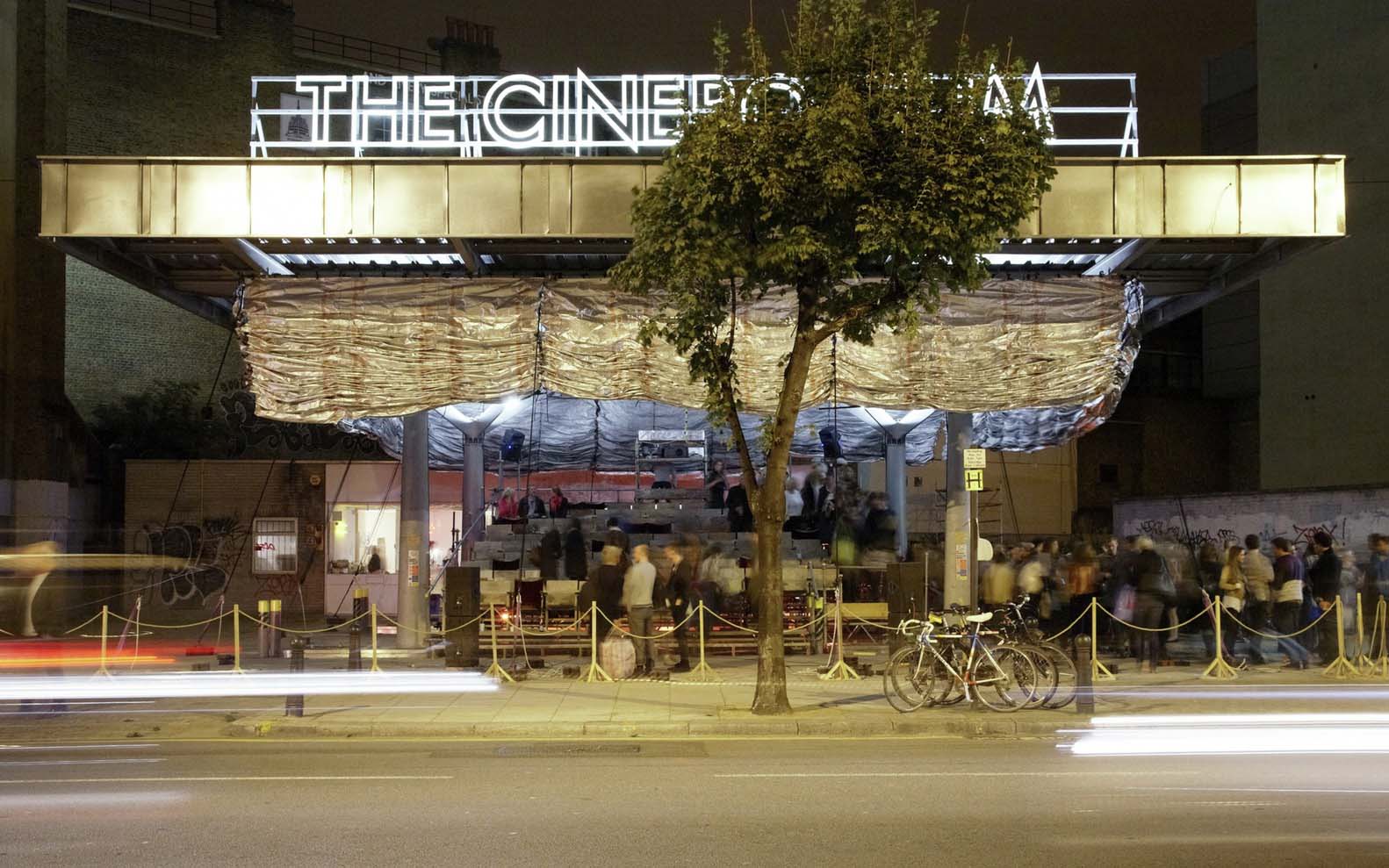
In 2010, there were 4,000 abandoned gas pumps in the United Kingdom, evenly distributed throughout urban areas, serving the widespread needs of vehicular traffic. In London, the Assemble Studio collective proposed a community-building project through a collaborative effort to construct furniture and spaces, exploiting existing shelters to create a neighborhood cinema. All it needed was a simple tent enclosing the shelter’s boundaries: the Cineloreum, a flexible, lightweight, and affordable space for screening films, has been created. The movie theater has become an agent of redevelopment, revealing a hidden yet potentially powerful space: from a now-ancient function, representing a vision of the city so closely tied to vehicular congestion, pollution, and the small and large non-places that characterize large portions of the territory, an even older function is activated, yet one imbued with new meanings. This is achieved with a lightweight material, a curtain, which rises and falls in an almost erotic movement, revealing yet concealing. The furnishings built by volunteers only strengthen this sense of community, which is provided by a space, not just a function. This English cinema demonstrates the potential of screening spaces, even in temporary situations, thanks to the simplicity of the technologies required to operate them: the very concept of microcinema here emancipates itself from the immoderate pursuit of extreme audiovisual quality, focusing on space and the encounters that take place in it.
The Venetian architectural practice Omri Revesz Design, with the project “Street Cinema,” proposed the activation of public space through an artistic installation, which allows for use throughout the day, enriching a place of passage with additional possibilities: it is a pause in the flow, a moment of discovery that moves its essence, but is controlled through different forms of activity. The cinema itself is no longer a fixed place, but rather a place of change, of imbalance, like the wave motion it overlooks.

Thus, again, in the Open Kino Pavillon, designed by the Kyrgyzstani artist Erika Hock and installed in Arnhem, The Netherlands, in 2021, a temporary structure that stands out as an interface between sculpture and architecture. It is a bridge, a ribbon that twists on itself, creating a slight belly capable of hosting an audience and serving as a projection screen. In this case, the movie theater becomes a place of protection, a small, equipped pergola, open to different uses, which, however, are based on the relationship between the seat, the shelter, and the moving images. Taking up some of the anarchic methods of the Pirate Screens, the artist offers increased possibilities for using open spaces, a sort of upgrade, with nods not only to sculpture and architecture but also to street furniture, imagining a small place of reflection that separates the viewer from the potential urban frenzy.
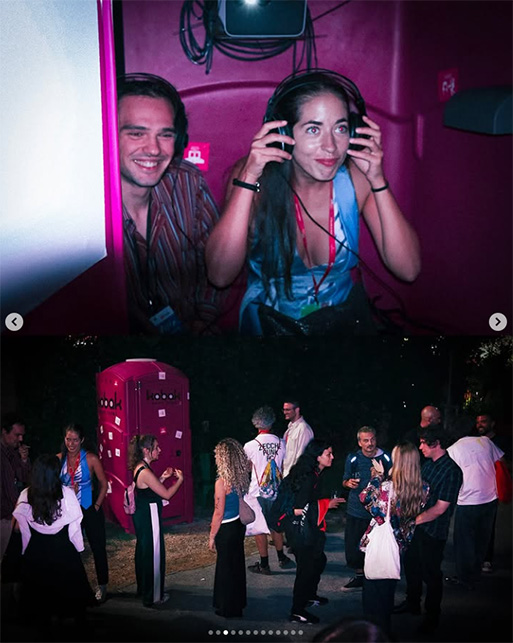
During the 2025 Venice Film Festival, Futura Association, a Venetian collective of artists, expressed an ironic reflection by setting up a portable toilet as a movie theater. “Cinema is in the Toilet,” as they titled their performance, allows people, one or two at a time, to watch a movie while sitting on a temporary restroom plastic toilet, emphasizing that cinema is anywhere moving images exist, thus returning to the prehistory of the media, to Edison’s kinetoscopes, and their exclusive relationship between individual and projection. The intense pink color of the plastic enclosing the toilet is the ironic element with which Futura Association, as posted recently on social media, reflects:
Cinema is made in the cinema hall. We often tell ourselves this. However, how difficult is it to achieve it in your own way of doing it? With a language that does not copy, that dares, that surprises. […] a portable toilet that had nothing to do with the elegance of a cinema hall, yet it became a movie theatre. Lines to go to the bathroom transformed into lines for a movie. People were surprised, laughing, and talking. Because cinema – at least for us at Futura – is not just the screen. It is the before and the after. It is being together. We know that a film is always watched alone, but it is everything that happens around it that brings it to life.18
MULTIFUNCTIONAL MICROCINEMAS
In addition to their urban and temporary aspects, microcinemas are also emerging in Europe through the consolidation of some more traditional cinemas which are permanently inserted into existing buildings, consolidating their history and positioning themselves as solid alternatives to more commercial theaters, through hybridizations with different functions, often linked to catering, but also to hospitality and commerce. That is, the aim is to create conditions so that the movie theater, unlike in previous cases, is not in close contact with the public space, yet is continuously frequented, fostering a sense of community alongside the theater itself. Many of these venues, in fact, seek a passionate audience that finds the very walls of the movie theater a comfortable place to spend a few hours, regardless of the film being shown.
It thus becomes difficult to distinguish whether the cinema is the driving force behind the venue, or, conversely, whether the functions associated with it are. The interplay is powerful and constitutes a kind of “super-function,” for which a cause-and-effect analysis is often unnecessary, as one function cannot exist without the other. In Krakow, Poland, Mikro Kino and Kino Kika have been operating since 1984 and 2012, respectively: these are small multiplexes that share entrances with residential units in the same building. Their defining characteristic lies precisely in this blend of “domesticity.” 19 The cinema foyer is thus divided into two sections: the first comprises a shared access corridor to the residential section, and the second serves as the actual entrance. The access corridor is an unexpected space: brightly colored, it houses furniture, bicycles, posters, and notices, in a fertile domestic disorder.
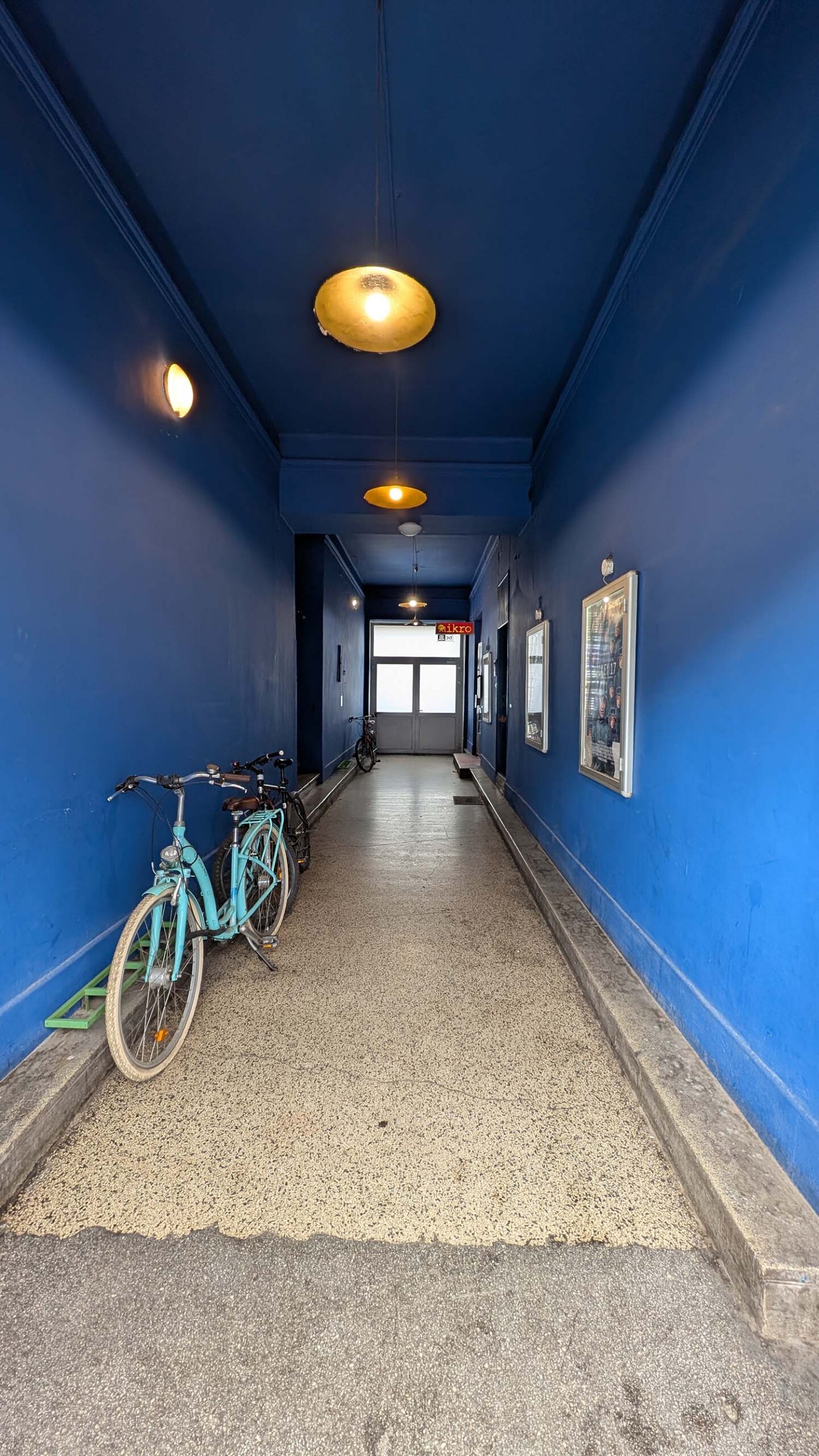
The cinemas consist of several screens: two with 123 and thirteen seats for the Mikro Kino, and five with forty-four, twelve, twenty, forty-nine, and twenty seats for the Kino Kika. Within a highly compact space, a significant degree of fragmentation is therefore chosen, enabling a remarkably varied programming that allows different audiences to select according to their tastes.
In both cases, the rooms are tiny, which creates an extreme sense of comfort, emphasized by the very informal furnishings in Kino Kika, with beanbags instead of armchairs. Reducing the number of spectators also affects the level of formality accepted, allowing for the design of spaces that are less designed, yet highly coherent.
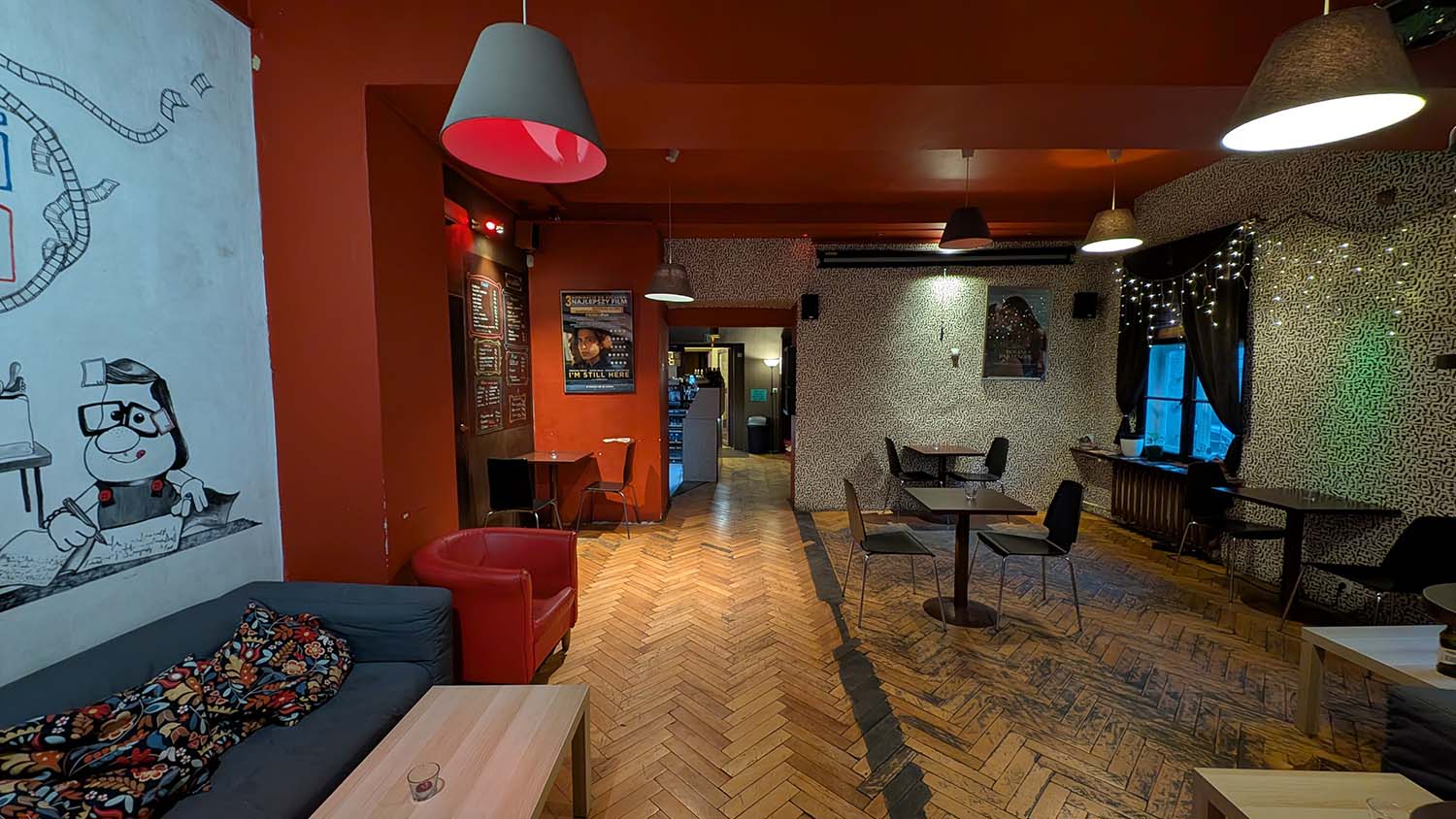
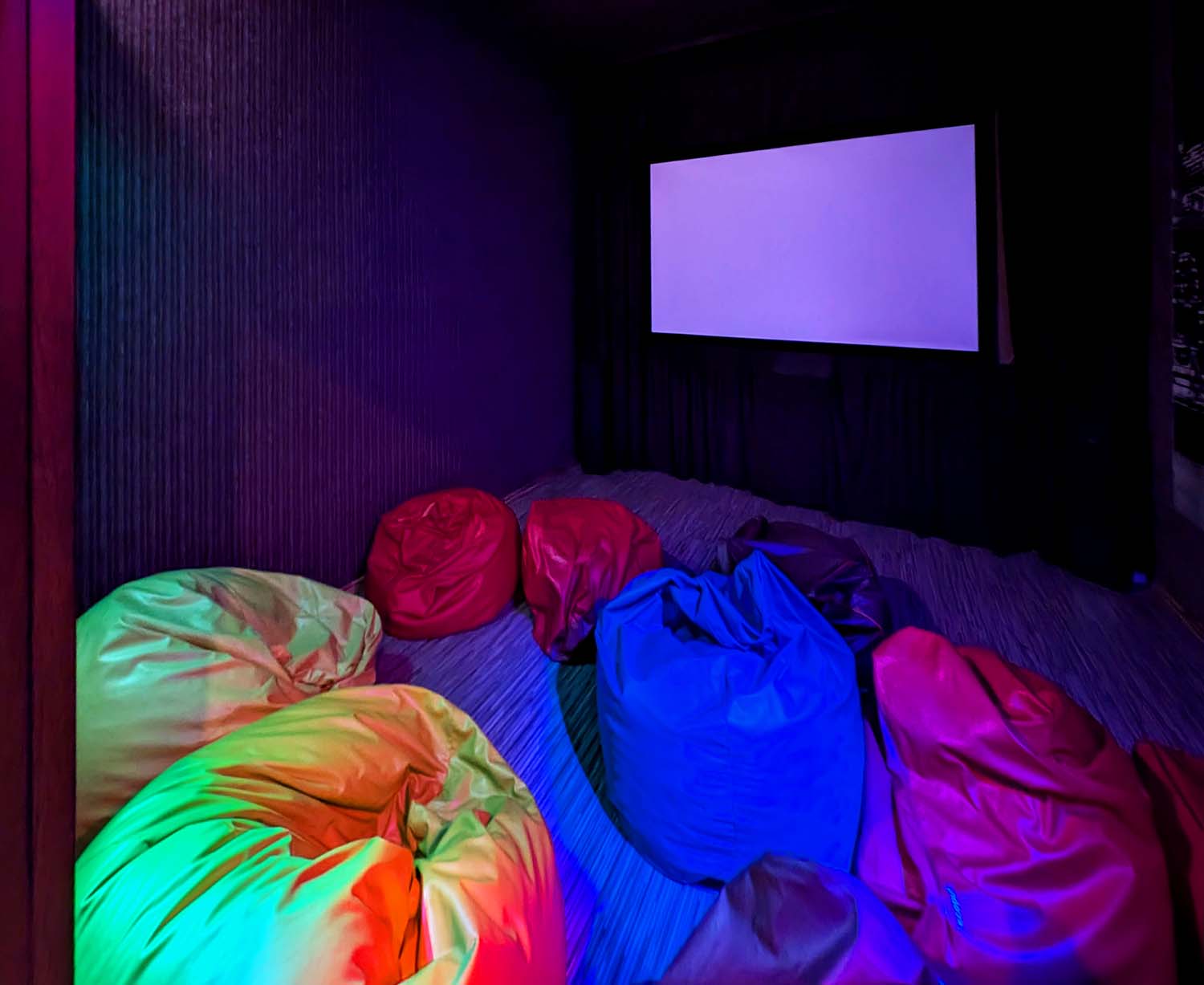
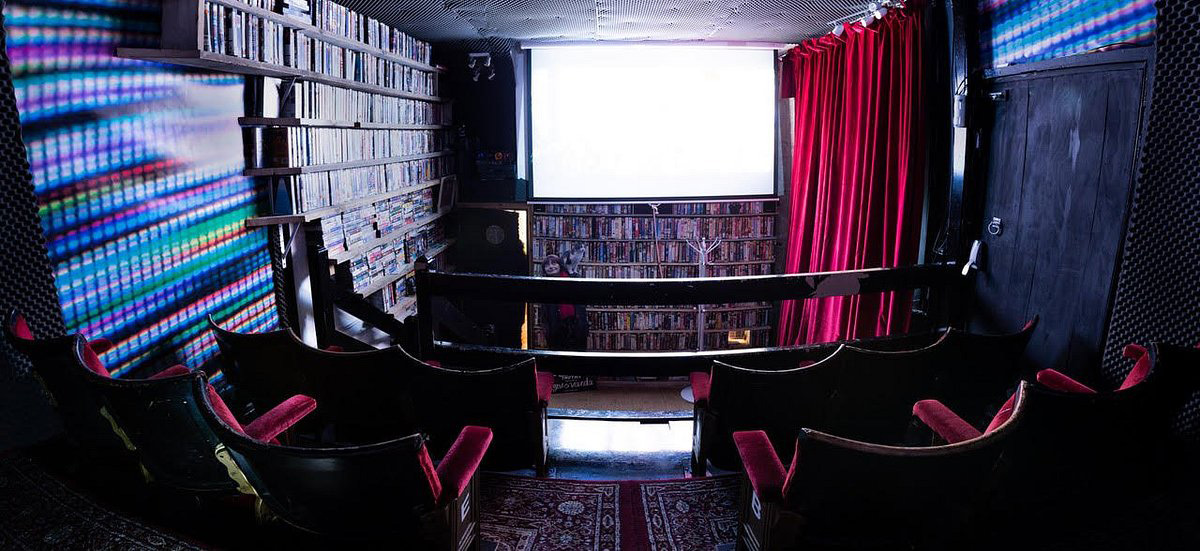
Then there are hybrid spaces, a bookshop, a bar, and a reading room, which hark back to the first examples of screenings by the Lumière brothers, in which people go to the movie theater regardless of whether they’re watching a film. This interplay of functions is also evident at 20th Century Flicks – Tiny Cinemas & Movie Rentals, a DVD rental shop opened in Bristol in the early 1980s. Over the years, the store also experimented with film screenings, eventually opening two cinema halls, one seating eight, and the other, ten people. These small projection rooms are surrounded by walls lined with DVDs (the archive contains more than 20,000 titles): it is a space whose essence lies precisely in archiving, in giving tangible form to an ethereal element like a projection. Everything is designed to convey a sense of chaos, an informal disorder reminiscent of settings from children’s films, mysterious shops from which incredible adventures spring to life. Nevertheless, the two projection rooms within the shop try to create an order, for example, by defining, despite the very low numbers, a stepped stall to observe the screen without visual impediments.
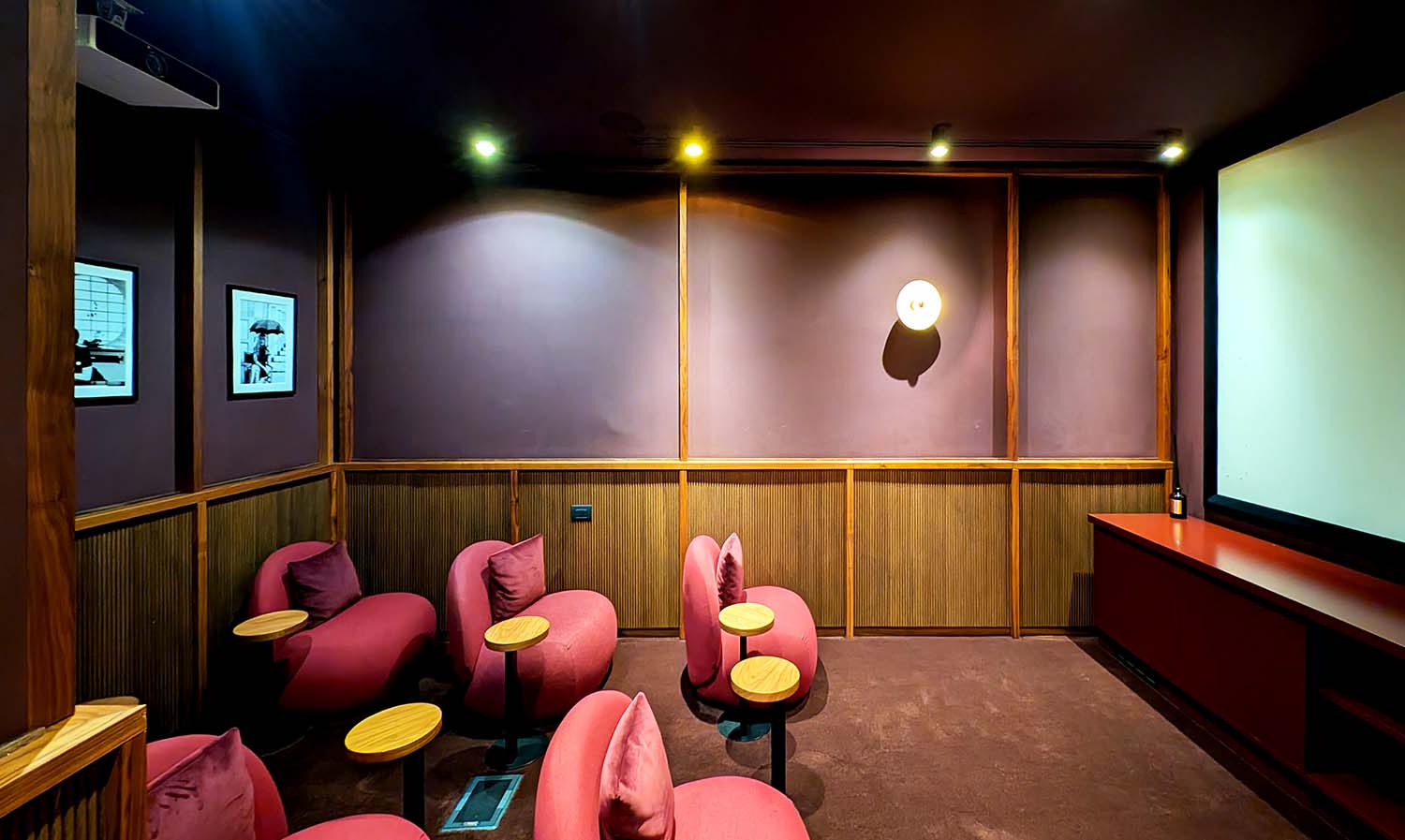
Rome’s Cinema Velabro, opened in mid-2023 and designed by Garibaldi Architects, features a spatial design that blends multifunctional uses. The movie theater is located within a hotel, tucked away from the entrance foyer and almost hidden, accentuating the extreme intimacy of the theater’s spaces. It seats just six people in a playful space with almost caricatural, highly designed furnishings, in keeping with the rest of the hotel, which aims to convey a luxurious yet refined feel. The materials are warm, with a focus on fabric on the floors and walls to enhance soundproofing and reduce reverberation. Despite its size, the cinema seeks an informal approach, but in this case, it pays close attention to audiovisual aspects, creating a theater for quality screenings. The movie theater is open to the public, with a program that includes uses other than film screenings: parties, sporting events, and popular shows. The cinema hall thus seeks to build a multifaceted identity, increase its audience, and engage the outside world in an open yet very discreet way.
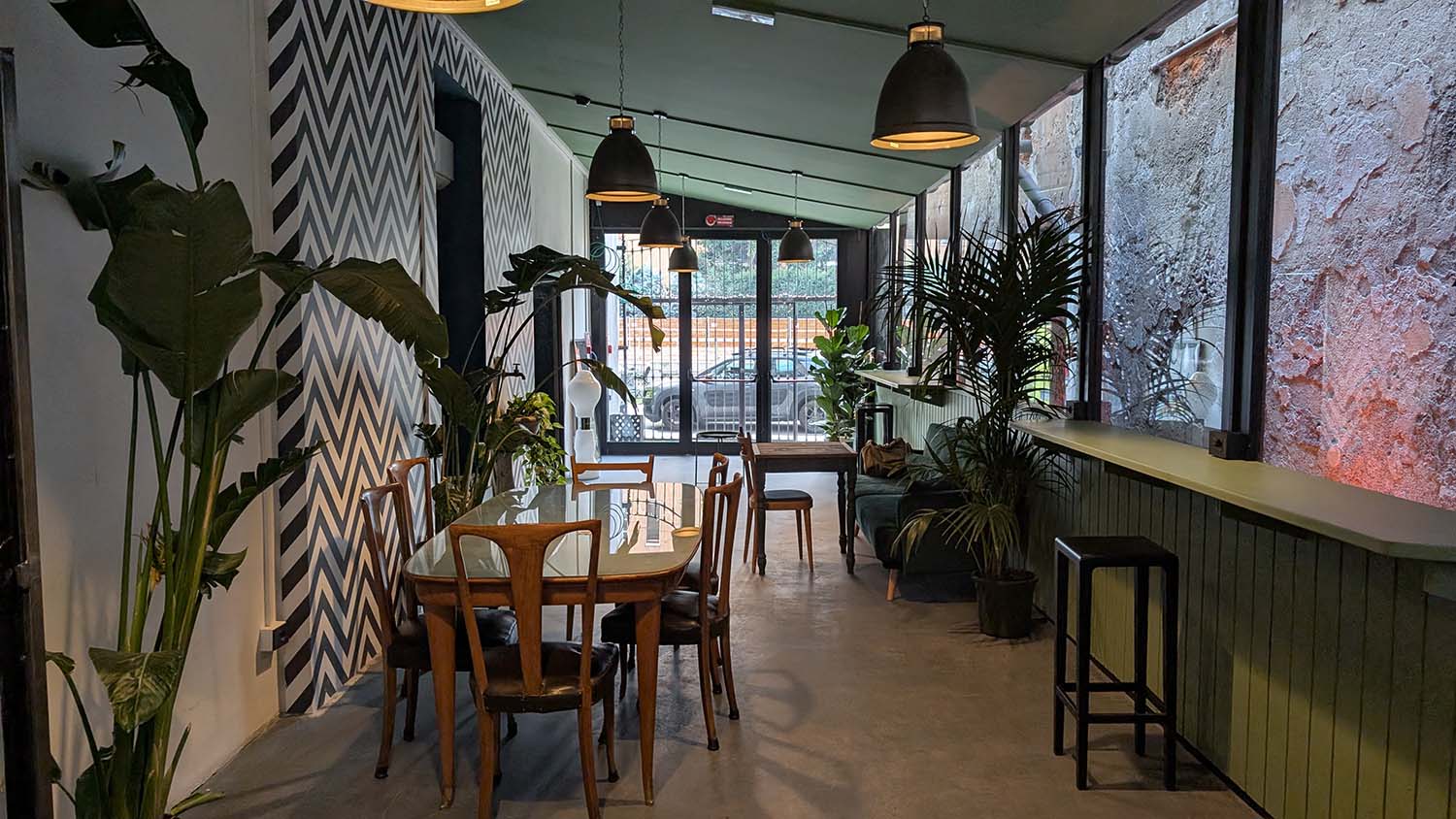
In Milan, Noise Il Cinemino, designed by Atelier delle Verdure with Graziano Palamara, opened at the end of 2025. A historic jazz venue has been transformed into a live music venue, complemented by a thirty-seat cinema. Here too, the primary function is tied to an activity other than the cinema: a bar that also offers live performances. Within a long, narrow structure, the space overlooks a small courtyard; it is an interior yet entirely transparent for the outside, expanding views and possible configurations. It feels like part of a public space, yet at the same time very private, almost residential: the small courtyard is squeezed between the tall buildings surrounding it, giving it a domestic feel.
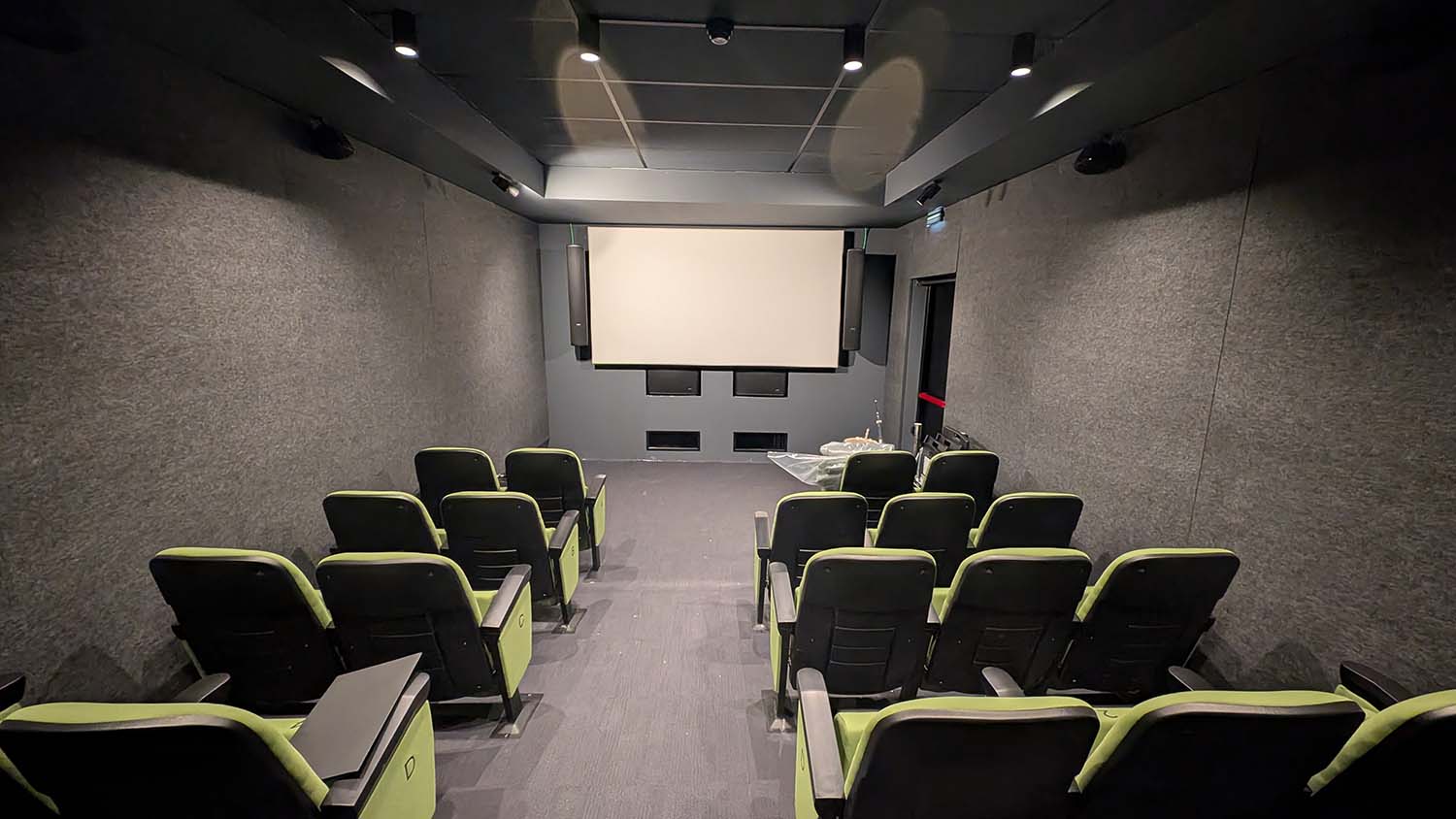
The movie theater, in this case, is a small discovery: as with Cinema Velabro, the space is almost hidden, requiring slow exploration, delving deeper into the venue’s entrance. This reveals the very heart of the bar: a small room with about thirty seats that almost seems like a scale model of a commercial cinema, perfectly designed for acoustics, views, and comfortable seating. The movie theater then becomes a small treasure trove of new possibilities, an alteration in the rituals of the bar, which brings its own rituals, clearly mixing the functions, without any real prevalence, perhaps giving rise to a possible new imaginary for the movie theater of the future.
CONCLUSIONS
Facing an unclear future for commercial and multiplex movie theaters, we observe a rising interest in new forms of film projection that emancipate themselves from the logic of big numbers, focusing on the quality of programming and the curatorial selection of movies. Spatial issues are following this trend, proposing new elements that can rethink the entertainment hall of the future. The rise of microcinemas in Europe defines one possible way: they have great flexibility in programming, able to work on commercial programs, artistic curations, and projects of a different nature, and to adapt to contingent situations and changes in the needs and sensibilities of spectators. The architectural space that characterizes microcinemas is also highly adaptable: it is difficult to find common characteristics, precisely because of the changeability of programs and possibilities, but some topics and data seem to repeat themselves:
– A new relationship with the outside, whether it be total, as in open-air cinemas, or mediated by light and temporary installations.
– The ability to engage with the urban surroundings, seeking to eliminate “filter” spaces between the city and the hall: the foyers lose their function of gathering and sorting spectators, becoming spaces with different uses, more measured, in direct contact with the outside.
– The emphasis is on content rather than space, a content not intended simply as viewing a film (on the contrary, the audiovisual qualities may be slightly overlooked), but as a space, still multifunctional: in the movie theater, the spectator does not have to sit down to watch a film, but can stay for a discussion, organize a party, or reserve the space to watch other content, considering the theater as an additional living space, a small living room that everyone can use.
– The need to complement the cinema function with other programs, not in a commercial context, where any other functions are closely tied to viewing (the distribution of drinks and food before the movie, for example): the aim is to equalize the importance of functional programs, to create greater lightness. Thus, spectators may go to the movie theater, but they may also stop at a café, read a book, discover an old DVD, or chat with a friend. Conversely, a patron at a bar, or bookstore, or shop, may decide to see a film, even without having planned it. This creates a multiplicity of possibilities, making the space even more flexible and adaptable.
– Cinema and cinemagoing can still be considered an event, as it was during the first screenings: always through a theme of extreme flexibility, today the movie theater is a space that “does not exist” except in the forms it can gradually reconstruct: a flexible, mobile pavilion, a room created for entirely different functions, a small cutout within a larger function, microcinemas allow for ultra-temporary adaptation to current situations.
References
-
Arnal, Mikael and Agnes Salson. Cinema Makers: The Renewal of Indie Cinemas. Le Blog Documentaire, 2019.
Associazione Piccolo America. Piccolo America. 10 anni. Self-Publishing, 2021.
Darelli, Virgil. Le sale cinematografiche di provincia. Il caso Lombardia (1905–1965). Carocci Editore, 2025.
Herbert, Stephen. A History of Pre-Cinema. Taylor & Francis, 2023.
Kostovska, Ivana, Marius Øfsti and Jakob Isak Nielsen. Small European Films: Challenges and Drivers of Change for Distribution and Exhibition. 2025.
Credits
-
Figure 1: © Thomas Edison National Historical Park.
Figure 2: © William James family fonds, City of Toronto Archives.
Figure 3: © Anthology Film Archives.
Figure 4: © David Sherman & Rebecca Barten.
Figure 5: photo by © Riccardo Banfi, courtesy of Riccardo Banfi & Microclima.
Figure 6: © Fondazione Piccolo America.
Figure 7: © Cinemittu.
Figure 8: © Assemble Studio.
Figure 9: © Futura Association.
Figures 10–12 and 14–16: photos by © Diego Terna.
Figure 13: © 20th Century Flicks.
Acknowledgments
-
The entire paper is the product of collaborative research by the two authors. This article is a scientific dissemination product developed within the research “FUTURSpaCE – FUTURe Spaces for Cinema and Entertainment” funded by the Italian Ministry of University and Research (Progetti di Ricerca di Rilevante Interesse Nazionale – Bando 2022. Prot. 2022MWYS93).
Notes
-
“Persistence of vision is the optical illusion that occurs when the visual perception of an object does not cease for some time after the rays of light from it have ceased to enter the eye.” “Persistence of Vision,” The University of Arizona. Wyant College of Optical Sciences website – https://wp.optics.arizona.edu/oscoutreach/persistence-of-vision/.
-
Stephen Herbert, A History of Pre-Cinema (Taylor & Francis, 2023).
-
“This Month in Physics History. February 2, 1893: Edison Records First Sneeze on Film,” American Physical Society website – https://www.aps.org/archives/publications/apsnews/200102/history.cfm.
-
Charles Musser, Before the Nickelodeon. Edwin S. Porter and the Edison Manufacturing Company (University of California Press, 1991).
-
“A 19th-century term for a rudimentary kind of theatre offering cheap entertainment, usually in the form of melodrama; such theatres were often referred to as ‘penny gaffs’, on the basis of the admission price,” The Oxford Dictionary of Literary Terms (3rd ed.), 2008.
-
“Fox Theatre Building,” Michigan Economic Development Corporation – https://www.miplace.org/historic-preservation/programs-and-services/historic-landmarks/fox-theatre/.
-
“Domestic Movie Theatrical Market Summary 1995 to 2026,” The Numbers – https://www.the-numbers.com/; “Towards a New Normal? Cinema Attendance in Europe Keeps Growing, up by 18% in 2023, Although Pre-Pandemic Highs Remain Far,” European Audiovisual Observatory website, February 15, 2024 – https://www.obs.coe.int/en/web/observatoire/home/-/asset_publisher/wy5m8bRgOygg/content/towards-a-new-normal-cinema-attendance-in-europe-keeps-growing-up-by-18-in-2023-although-pre-pandemic-highs-remain-far; Elisabetta Brunella, “Drop in European Audiences, but with Exceptions. The Slow Growth of European Multiplexes Continues. Almost 6,000 Digital Screens Throughout the World European,” European Cinema Journal, International Edition, no. 1 (May 2008) – https://www.mediasalles.it/journal/ecj1_08ing.pdf; Michelle C. Pautz, “The Decline in Average Weekly Cinema Attendance, 1930–2000,” Political Science Faculty Publications, no. 25 (2002) – https://ecommons.udayton.edu/pol_fac_pub/25; Richard Deiss, “Cinema Statistics. Growth in Cinema-Going Continues in 2000 and 2001,” Statistics on Audiovisual Services, Theme 4 (2002) – https://ec.europa.eu/eurostat/documents/3433488/5450506/KS-NP-02-004-EN.PDF/6cdf62fb-84db-4cf5-a3c7-27c1bbeac98e?version=1.0.
-
Hanna Arendt, The Human Condition (University of Chicago Press, 1958).
-
“The community concept has maintained a constant and growing interest in urban studies and many related fields. The analysis of the policy boundaries and related issues on community action practices are nowadays important to understand various political interests concerning these territorial phenomena. […] In recent years there has been an increasing interest in the debate on the role of communities in urban studies. […] This steady growth of references citing the role of the community within the political arena can for instance be observed looking at global data on Google trends in Google news search category during the time period from 2008–16 […] The origin of this continuing interest seems to derive from the importance of the concept of community within large and diverse forms of political language. Therefore, this interest seems to grow together with the crisis of participation in democratic systems, as the Economist Intelligence Unit (EIU, 2014) ‘Democracy and Its Discontents’ report suggests for the whole of western society (the EU in particular) during the past five years.” Luca Tricarico, “Community in the Urban Debate: New Research Trends to Support Future Planning Agendas,” EUROCITIES, Making Cities: Visions for an Urban Future (2016) – https://re.public.polimi.it/retrieve/e0c31c0b-1644-4599-e053-1705fe0aef77/30VisionsForCities_TRICARICO.pdf.
-
“Total Mobile Home microCINEMA,” David Sherman Films website – https://www.davidshermanfilms.com/Total_Mobile_Home.html.
-
Sinéad Campbell, “‘I Don’t Touch My Phone. At Home, I’d Be Scrolling’: Why Young People Are Flocking to Independent Cinemas,” The Guardian, August 13, 2025 – https://www.theguardian.com/film/2025/aug/13/why-younger-people-are-flocking-to-independent-cinemas.
-
Ibid.
-
Claire Armitstead, “Welcome to the Microplex! The Hidden World of Britain’s 1,500 Tiny Cinemas,” The Guardian, October 11, 2023 – https://www.theguardian.com/film/2023/oct/11/welcome-to-the-microplex-the-hidden-world-of-britains-1500-tiny-cinemas.
-
Brad Hanford, “Microcinemas Are Booming in New York City — Here’s Where to Find Them,” The New York Groove, October 30, 2025 – https://nygroove.nyc/10-microcinemas-nyc/.
-
“What is aura? A peculiar web of space and time: the unique manifestation of a distance, however near it may be. To follow, while reclining on a summer’s noon, the outline of a mountain range on the horizon or a branch, which casts its shadow on the observer until the moment or the hour partakes of their presence – this is to breathe in the aura of these mountains, of this branch.” Walter Benjamin, A Short History of Photography, originally published in Die literarische Welt of September 18 and 25 and October 2, 1931.
-
“Cinema Galleggiante – Acque Sconosciute” is a project curated by Edoardo Aruta, Alessandra Messali and Paolo Rosso, presented by Microclima.
-
Nicola Gerundino, “Dieci anni de Il Cinema in Piazza,” Zero, June 7, 2024 – https://zero.eu/it/persone/dieci-anni-di-cinema-in-piazza-cinema-america-trastevere-san-cosimato-monte-ciocci-cervelletta/ (translated by the authors).
-
Futura Association posted at @futurafilm_, on Instagram, September 6, 2025 – https://www.instagram.com/p/DOQcpUWDZpD/?hl=en&img_index=3 (translated by the authors).
-
“[…] spaces with the traditional meanings and architectural characteristic of living rooms are appearing in public or semi-public places, such as bars, hotels, airports, museums, offices, etc. Such places represent the new socialization hubs of a society based on maximizing performance and speed […] Such places respond more directly and appropriately to a different idea of living in the porous space of the post-identity city, flexible, inclusive, augmented, open to continuous exchange and interaction between cultures.” Flavio Martella, Marco Enia, “Towards an Urban Domesticity. Contemporary Architecture and the Blurring Boundaries between the House and the City,” Housing, Theory and Society 38, no. 4 (2021) – doi: 10.1080/14036096.2020.1789211.