
Archive
Tag: community
Essay
Typology
Open Access
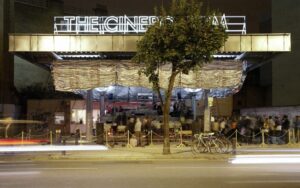
Microcinemas Rising in Europe: New Spatial Trends in Movie Theaters
by Diego Terna, Luca Maria Francesco Fabris
pp. 165–188
The research paper proposes a critical survey of recently emerged, new architectural spatial forms for hosting movie theaters in the European context. A trend showing a renewed focus on the quality of movies and programming, reverberating in the architectural space of cinema halls, which tend to adapt their features toward small numbers, focusing on privacy and fellowship among a few viewers, and searching for a kind of coziness, transforming cinema halls into spaces with an almost domestic feeling. This new kind of movie theater, called microcinema, is a fluid space within broader functions, where watching the projection on a screen offers an opportunity for intellectual speculation, no longer tied to personal concentration alone, but to public dialogue, where sharing empathy is the more critical experience, providing elements for a new systematic approach to the movie theater design.
Essay
Subscribers
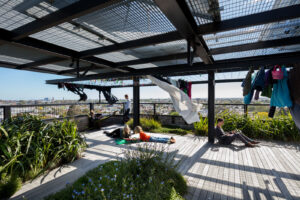
Process of Commoning in the Production and Proliferation of Shared Space
by Olivia Hamilton
pp. 287–300
Commoning describes the social and psychological process that individuals and collectives are involved in as they establish and manage space and life shared in common. The values that underpin commoning can be adapted by spatial and urban designers to privilege and encourage more inclusive and shared social, civic and environmental conditions and disrupt existing models and economic forces that currently organise private and public space. Commoning produces spaces and social relations through participation, developing in the protagonists a sense of agency over their lives. Design practitioners with interests in the processes of commoning can engage with those values to interrupt the homogenization of communities and the cauterization of spatial imagination by commercial imperatives. Drawing on design precedents, theorists and activists involved with various aspects of contemporary commoning, this paper proposes how designers can be informed and guided by the interrelated spatial and social modes of productions that are integral to commoning. Through a commitment to commoning, spatial designers can encourage and support commoning and proliferate values capable of transforming the future.
Buy
Already in your cart -
View cart
Article
Open Access
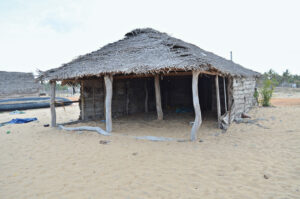
Challenges of Disaster Relief Housing: Evaluating Coastal Domestic Typologies in Eastern Sri Lanka
by Kira Bre Clingen, Mark Robert Bavoso
pp. 601–628
In the aftermath of the December 2004 tsunami, an unprecedented natural disaster that disproportionately affected the impoverished and conflict-ridden eastern coast of Sri Lanka, the outpouring of disaster relief and support for housing reconstruction was primarily led by international aid organizations for the erection of capital-intensive dwellings to allow for immediate habitation. Three case studies representative of significant housing typologies deployed since the tsunami are investigated: two global prototypes sponsored by foreign aid, and one informal, vernacular construction. We argue that in Sri Lanka the aid-housing-as-commodity paradigm - which in its specificity and immutability disregards the robust tradition of integration between natural and built environments and between individual and community - represents an increasingly and unsustainably risky expenditure of capital resources due to the likelihood of more frequent disasters in coastal zones. We argue for a shift toward spatial frameworks, not static prototypes, which take into account that the longer temporal dimension of rebuilding community and housing after a natural disaster is not necessarily synonymous with expensive, structurally robust building practice.
Project
Open Access
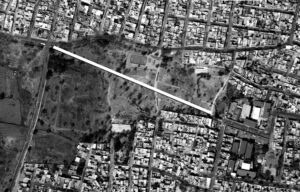
Walk the Line. Architecture as a Catalyst for Socio-Spatial Connectivity
by Tatiana Bilbao, Nuria Benitez
pp. 153–171
Miravalle is a relatively new neighborhood in Iztapalapa borough, by the eastern edge of Mexico City. It has been identified as a highly-marginalized area, as its 11,000 residents have poor access to public infrastructure, high rates of violence, and socio-economic discrimination is something most experience. Nonetheless, the community has worked together with the aim of improving the conditions and quality of life in a small but outstanding way. As a group of architects, we are working with them to transform the main park of the area and neighboring communities into a walkable and safe recreational area. The prerequisite for city life is a walkable urban environment. If a safe line crossing the park could help diminish the insecurity and strengthen the connections between people and space within the neighborhoods, then architectural interventions as a stead for social development are guaranteed.