
Archive
Tag: infrastructure
Article
Landscape Urbanism
Open Access
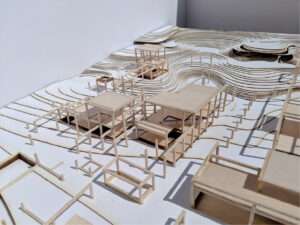
Ecologies of Leisure: Reimagined Architectures and Landscapes of Leisure and Infrastructure
by Carla Aramouny
pp. 197–218
The research detailed in this paper revolves around an ecological and spatial exploration for a derelict coastal area in Lebanon. It frames the possibility for an agile ecological approach to design, one that builds upon the latent derelict aspects and persisting disconnections in this specific area and that reimagines a potential new reality intermeshing the natural with the human and the infrastructural with the architectural. Within the format of a research undergraduate studio, the approach and work discussed here present possible synthetic scenarios for coastal developments in Lebanon, and suggest alternative production, programmatic, and ecological strategies.
Article
Sustainability
Open Access
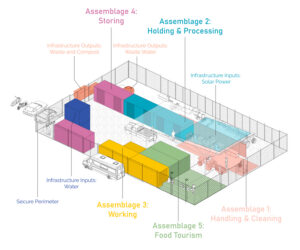
Food Hubs and Rebuilding Missing Middle Market Structure in Agriculture: The Social in Supply Chain Development
by Stephen Luoni
pp. 111–142
Tens of millions of Americans became food insecure during the COVID-19 pandemic as independent farmers dumped millions of tons of food due to economic lockdowns. Yet contract growers looped into vertically integrated monopoly supply chains escaped system breakdowns. Food provisioning is often seen as polarized between local scale and continental/global market scale. Food supply and consumption are functions more of market structure than scale. Farmers reliant on direct sales to local restaurants, schools, universities, and hospitals saw their markets evaporate overnight. This Food Away from Home market constitutes 54 percent of food consumed nationally yet is vulnerable since direct-to-consumer sales lack supply chain structure. Urban food hubs dotting American cities before their eclipse by agrifood monopolies could have maintained supply. The food hub was a resilient public supply channel (a food commons) organizing a plurality of local and global providers alike. To address food insecurity our food planning effort for the State of Hawaii is premised on building similar missing middle market structure featuring a food hub, a food innovation center, and farm base yard processing facilities.
Essay
Open Access
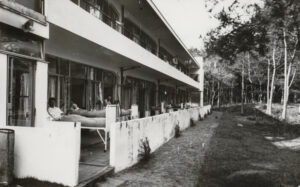
Imprints of an Invisible Virus: How Airborne Diseases Change Cities
by Aki Ishida
pp. 311–330
Once a clinical cure for COVID-19 is found, which infection prevention practices – both social and spatial – might remain, and what long-term impacts will they leave? This article examines the interrelationships between airborne diseases, social practices, and the design of physical and digital infrastructures for cities. Historically, infectious diseases have left long-term imprints on cities, from plumbing to hospitals. Spatial practices to prevent infection, such as clear physical barriers and car-free streets for socializing, must be implemented with a close examination of impacts on the mental, social wellbeing of both individuals and the broader community. Prevention practices examined include the use of transparent barriers that separate and connect people, the increased use of open windows, the adaptation of sidewalks and roads for physically distant socializing, and spatial negotiation and trust-building that occur in public spaces. As cities make design and policy changes to protect their citizens from the invisible virus, they must be mindful of the imprints the physical, social, and policy changes have on comprehensive wellness and equity for all people.
Essay
Open Access
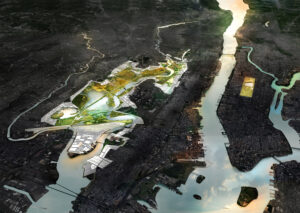
“Polyvalent Adaptation”: Design in a Temporal Context of Uncertain High-Risk Futures
by Alexander L. Ring
pp. 185–209
If greenhouse gas emissions ceased today, sea levels will continue to rise for centuries due to the time scale of climate change. This demands a fundamental shift from solely mitigating impacts to adapting to this new reality. Architects can play a key role but are often restrained by outmoded disciplinary norms, and financial and regulatory limitations. What we require is a new design paradigm that extends beyond site-specific needs and draws on the context of our high-risk future. “Polyvalent Adaptation” could significantly impact the profession and the future of our communities. This approach combines two concepts that are not new to architecture or to discussions surrounding sustainability and climate change, but, when married, amplify each others’ potential. Combining the temporal concepts of polyvalence and adaptation provides a new lens for tackling the conflict between the permanence of the built environment and the changing climate. From this perspective, projects can be designed and constructed to meet current needs, to provide projective agency capable of assisting in the aftermath of extreme weather, and to become support infrastructures for new settlement patterns.
Project
Urbanism
Open Access
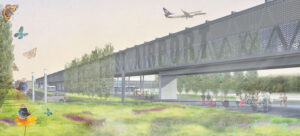
Architecture and Intermodality. Guidelines for the Architecture of the Intermodal Hub at the FVG Airport Ronchi dei Legionari
by Giovanni Fraziano, Thomas Bisiani, Luigi Di Dato, Claudio Meninno, Adriano Venudo, Marko Verri
pp. 85–109
The research addresses the topic of intermodality in terms of technical, typological, and architectural response of infrastructure systems, considering their relationship with the territory and the landscape. The study starts from the hypothesis of the development of a comprehensive intermodal hub in the Ronchi dei Legionari Airport (Friuli-Venezia Giulia, Trieste, Italy), integrated with the network of local public transport and railway infrastructure, considered in a scenario of sustainability over the medium term and updated with respect to the current economic situation. The first phase of the research focused on the definition of the guidelines for the design of the intermodal hub. Subsequently, the study verified the hypothesis by modeling some alternative scenarios, whose results led to the identification of a highly comprehensive set of data, consistent with the financial framework. Lastly, urban verification: the identified scenarios constitute a framework of alternative options corresponding to the minimum, optimal and critical conditions of the system as a whole. The possible alternatives prove the degree of versatility of the proposed layout which provides, as a whole, the possibility of opting for one of the proposed scenarios or for a more complex combination of the proposed solutions.