
Archive
Tipo contenuto: Essay
Essay
Theory
Open Access
The Act and Art of Architectural Critique: A Drawing, a House, and a Sign
by Andreea Mihalache
pp. 25–38
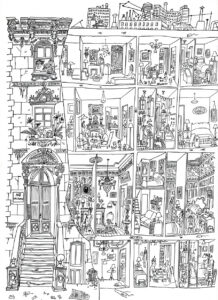
The role of criticism is not to split, but rather to bring matters together in an assembly. Philosopher Bruno Latour makes the argument that the responsibility of the critic, (and, implicitly, critique), is not to divide, but instead to “offer the participants arenas in which to gather.” In light of Latour’s proposition, I will examine the generative and creative role of architectural criticism and some of the many guises under which it might take shape. I propose that the critical call of architecture is often hidden in plain sight in works that camouflage themselves under seemingly disengaged positions, and which, upon closer inspection, act as resources of architectural imagination. Specifically, I examine Saul Steinberg’s drawing “Doubling Up” (1946), the Splitnik (the American model-house showcased at the American Exhibition in Moscow, 1959), and Robert Venturi’s sign for the Grand’s Restaurant (Philadelphia, 1961-1962)
Essay
Open Access
Dotte Agency: A Participatory Design Model for Community Health
by Shannon Criss, Matt Kleinmann
pp. 213–237
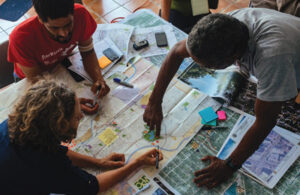
As community activists resist racial injustice, food insecurity, and infrastructural delinquency, many groups are attempting to articulate the voice of the citizen. It is within this landscape that architects have historically struggled to find common ground to afford democratic access for citizens to engage in discussions about the future of their city. Based upon surrogate models of other professions, there has emerged a proactive movement towards Social Impact Design. Like many urban core areas, our community faces a health epidemic compounded by poverty. In response to requests for collaboration, and through cross-disciplinary academic partnerships in both public health and social welfare, we have begun to leverage design advocacy to improve health outcomes. This has evolved into an alternative model of practice that advances public design through interdisciplinary, adaptive and incremental spatial agency. It is a sustainable practice that fosters conversations and supports events originating from within the community. Our approach seeks to scaffold an infrastructure of public health through methods of participatory design and advocacy. Through new forms of design intelligence and collaborative design tools, our critical spatial practice demonstrates new ways for how architectural design can be relevant to society.

Essay
Urbanism
Open Access
Urban Hacking. A Nobel Project for the Redundant City
by conrad-bercah
pp. 99–118
In 1963, Constantinos Doxiadis, Buckminster Fuller and Marshall Mc Luhan signed, among others, the little known “Delos Declaration,” which alerted the world that the “problem of expanding urban area may soon outstrip all other problems facing mankind, except that of nuclear war.” In the year 2016, it is clear to most that the “urban meltdown” has indeed outstripped “all other problems facing mankind, ‘including’ the possibility of nuclear war” and the reality of the financial meltdown, of which it is a direct result and from which there is no U-turn. How can we assure that modern cities develop a regenerative relationship to the living world on whose health they ultimately depend?The current scenario is dominated by the Redundant City whose march cannot be stopped ex-ante. Staying clear of Renzo Piano’s misguided (and falsely politically correct) rhetoric of urban mending, through "urban adjustments" we have a shot at trying to restore a sense of urbanity or “cityness” to constantly growing, shapeless conurbations. “Urban Hacking” argues for a new way to organize our urban systems, and for thinking and acting beyond what is considered “sustainable” development. Urban Hacking aims at establishing a healthier relationship between Natur and Kultur. The theory sponsors a new attitude towards urban matter based on little talked about modus operandi like demolition, recycling, multi-scaling and urban hacking.Urban Hacking may eventually lead to a Dörfer-Großstadt (metropolis of villages), namely an adjustable planning concept to counter the various redundancies of our time.
Essay
Theory
Open Access
Towards an Ethical Technique: Reframing Architecture’s “Critical Call” through Hannah Arendt
by Paul Holmquist
pp. 17–29
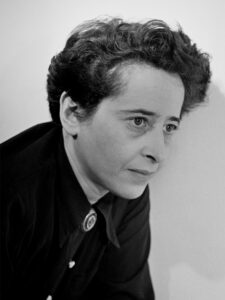
This paper examines how the critical vocation of architecture might be reclaimed through reconsidering the interrelationship of technique and politics in light of the political philosophy of Hannah Arendt. I argue that Arendt’s conception of a fabricated common world that is essential to establishing a properly human sense of reality opens up ways to rethink the constitutive political role of architecture. As a discipline, architecture comprises an "ethical technique" by which to guide the fabrication of the condition of "the common," and to constructively embody the recognition of a primary political reality arising out of human plurality. In so doing, architecture can projectively envisage and prepare for the emergence of a potential politics alternative to the apparatus of capital.
Essay
Theory
Open Access
The Absurd Alibi
by Joseph Godlewski
pp. 7–14
Published: 2016-01-28
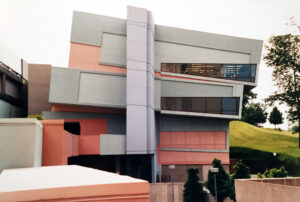
Generated from a discussion at the Fall 2015 ACSA Conference in Syracuse, New York, this article tackles the very topic of the conference (“Between Autonomous and Contingent Objects of Architecture”). It reflects on projects of autonomy (new and old) asking what they contribute to architecture as a discipline and profession. What, if anything, is at stake in such projects? It discusses some contemporary examples of autonomous and object-oriented theories of architecture. While autonomy originally posed a radical challenge to ways architecture was made and reasoned, this article contends that the critical energy generated with that challenge has been exhausted and replaced with disengaged copies of earlier experiments. It is unclear what insights these newer versions provide to architectural discourse. This article further conjectures that the socio-economic context in which autonomy re-emerges today is fundamentally altered leaving its advocates in a much more precarious position than the exponents of previous iterations of architectural autonomy. It concludes that notions of architectural autonomy are an absurd alibi, incommensurate with a discipline so constrained by social and economic expectations as architecture.
Essay
Tectonics
Open Access
A Matter of Tolerance
by Genevieve Baudoin
pp. 33–46
Published: 2016-01-28
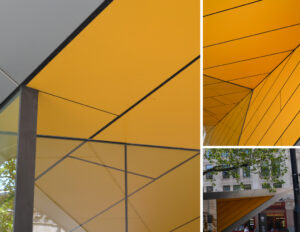
Tolerance lies at the crux between the contingencies of context and autonomous production. The problem of detailing lies, in part, on understanding that the detail, from its representation to its actualization, is the architecture: tolerance is what transpires in the transformation. It is a byproduct of the disciplinary autonomy of architecture that is created out of understanding contingency: designing with it is the making of architecture. The whole is no thing without its parts.
Historian Kenneth Frampton discusses "tectonics" as a series of opposites, particularly between the “ontological” and the “representational.” The design of details is thus suspended between what it “is” and its appearance. What is crucial to consider in this relationship is that the construction of those details must be designed in any work of architecture. In the translation from drawing to built work, the design must accommodate reality: the imprecision of equipment, humans, materials, and site. The literal gaps given over to “reality” are what we understand as tolerances.
Tolerance exists between the lines of a drawing, but it is virtually the only way to ensure a building can be created on site. It can also be seen as something outside the control of the architect – a building is contingent on the tolerances supplied by manufacturers and agreed upon with contractors. The gymnastics of designing for or with tolerance is typically done behind the scenes so that the representation of the building (idea) and the building (form) appear the same.
This essay will explore architects with a particular insight into tolerance, and who seek to maintain control of the parameters of variability inherent to the design of construction through details. The work of architects including SHoP, Kieran Timberlake, and Frank Gehry will be considered for their attitude towards and understanding of the nature of tolerance. Their work will be studied from built object back through the design process, examining the ways in which tolerance is tied to tectonic expression, where the parts (and what lies between them) facilitates the whole.
Essay
Urbanism
Open Access
Form after Urbanism: The Potential of Grossform
by Martin Hättasch
pp. 59–76
Published: 2016-01-28
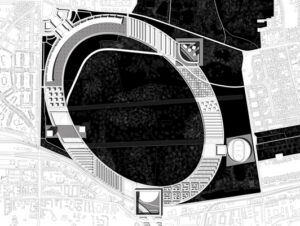
Grossformen im Wohnungsbau is the title of an unassuming pamphlet that German architect O.M. Ungers published in 1966 as part of the Veröffentlichungen zur Architektur series (VzA #5) during his tenure at the TU Berlin in the 1960’s. In it Ungers reimagines the singular architectural intervention at a scale between architecture and urbanism as a counter measure to the rapid urbanization brought about by Europe’s postwar boom. The formal coherence of Grossform (literally meaning “large form” in German) could provide a framework within which the unplannable processes of the contemporary city played out, while acting as stable markers of identity in an expanding urban field of increasing formlessness. Many of the ideas introduced in Grossformen would resurface throughout Ungers’ career, and eventually find their way into the better known Green Archipelago project. But where the morphologically pure islands in the Green Archipelago form a “dialectic city” only as a federation of ideal fragments, the scaleless concept of Grossform equally suggests the possibility of the island itself becoming a “dialectic object,” containing the exacerbated differences of the archipelago within. Faced with an urban environment in which traditional tools of urbanism have come to be swept away irrevocably by a limitless proliferation of building production, this reconsideration of the urban agency at the architectural scale appears highly pertinent today. Reconstituting the conceptual underpinnings of Grossform and outlining the trajectories of the “dialectic city” and “dialectic object” in reference to Ungers’ work, this paper aims to contribute to the (re)emergent debate on the conditions and constitutions of the architectural object: Through the combination of programmatic neutrality and formal specificity, Grossform may serve as the starting point for a contemporary paradigm in which the architectural object carries renewed urban relevance beyond its bounded form.
Essay
Cross-Disciplinary Studies
Open Access
Casting Call: Spatial Impressions in the Work of Rachel Whiteread
by Peter L. Wong
pp. 97–110
Published: 2016-05-01
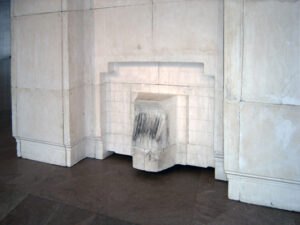
For more than 20 years, Rachel Whiteread has situated her sculpture inside the realm of architecture. Her constructions elicit a connection between: things and space, matter and memory, assemblage and wholeness by drawing us toward a reciprocal relationship between objects and their settings. Her chosen means of casting solids from “ready-made” objects reflect a process of visual estrangement that is dependent on the original artifact. The space beneath a table, the volume of a water tank, or the hollow undersides of a porcelain sink serve as examples of a technique that aligns objet-trouvé with a reverence for the everyday. The products of this method, now rendered as space, acquire their own autonomous presence as the formwork of things is replaced by space as it solidifies and congeals. The effect is both reliant and independent, familiar yet strange. Much of the writing about Whiteread’s work occurs in the form of art criticism and exhibition reviews. Her work is frequently under scrutiny, fueled by the popular press and those holding strict values and expectations of public art. Little is mentioned of the architectural relevance of her process, though her more controversial pieces are derived from buildings themselves – e,g, the casting of surfaces (Floor, 1995), rooms (Ghost, 1990 and The Nameless Library, 2000), or entire buildings (House, 1993). From an architect’s perspective, Whiteread offers an unsettling interpretation of architectural space, one that is dependent on filling space to the brim, barring life from entering or holding it in suspended animation from within. This paper argues that architectural form, whether fashioned from contingencies or autonomous acts, has reached a saturation point in architectural criticism. The work of Whiteread helps forge an alternative reading that embraces the object-oriented methods inherent in design by turning the tables on our fascination of figural form and the obsession of substance. The essay analyzes several of Whiteread’s projects in order to explain the meaning and techniques of her work, and places them within the context of Luigi Moretti’s 1953 essay on the “Structures and Sequences of Spaces.” It concludes with research work that attempts to use Whiteread’s method to better understand the figural and material attributes of architectural space.