
Archive
Tipo contenuto: Essay
Essay
Urbanism
Subscribers
From Totality to Relationality: Ludwig Hilberseimer’s Superblock and the Relational Urban Form
by Liang Wang
pp. 63–89
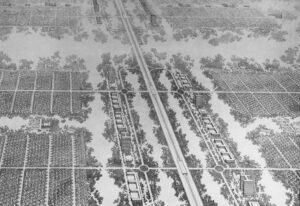
This essay examines two interrelated concepts – the superblock and the relational urban form – through the urban studies of Ludwig Hilberseimer. It advances three arguments. First, it situates Hilberseimer’s superblock within his broader project to reform the city and its architecture through a socio-ecological framework – an effort largely overlooked in twentieth-century architectural history. Second, it repositions the superblock within the lineage of modern urban formations, emphasizing its transitional role from the implementation of the master plan toward the instrumentalization of relational form. Third, it demonstrates his superblock proposition enables relational urban formations across scales and geographies and, therefore, remains relevant to contemporary urbanism. The essay argues that Hilberseimer’s superblock is not a fixed compositional entity but a proto-relational form: a spatial system structured by interdependence, hierarchy, and part-to-whole relations. Through close analysis of texts, drawings, and diagrams, it reveals a multi-scalar framework operating across building, settlement, and regional levels. Relational urban form thus emerges as an operational principle – one that mediates scales, accommodates changes, and organizes urban transformations incrementally.
Essay
Urbanism
Subscribers
A Prairie Archipelago
by Martin Hättasch, Dean Almy
pp. 91–118
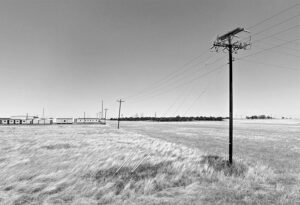
The Green Archipelago, introduced by Oswald Mathias Ungers in 1977 in response to Berlin’s depopulation, amplified a lack of urban coherence by reducing the city to a series of idealized urban islands floating on a green “sea.” This framework established a dialectical relationship between zones of urban intensity – islands – and a diffuse, low-intensity landscape – the sea. Within this duality of formal control and laissez-faire, the island preserves the authority of architectural form and serves as the site of concentrated urbanity. Conversely, the “sea” is the city’s antithesis – defined not by its content but by its emptiness. But how can the dialectic of the archipelago be sustained – or initiated – under conditions of rapid urban expansion, when the starting point is an urban landscape that, in its entirety, resembles the “sea”? Building on research into the periphery of Austin, TX, this essay proposes a conceptual reversal of the archipelago without abandoning its fundamental principles: where Ungers’ dialectical agency resides in the island’s architectural morphology, the Prairie Archipelago shifts this agency to a landscape capable of producing friction, limits, and differentiation from within.

Essay
Narration
Subscribers
The Evolving Shape of Post-Cold War Space: Architecture, Empire, and Spatial Sovereignty in the Arctic
by Eric Nay
pp. 7–21
Svalbard is warming faster than anywhere else on Earth. Average temperatures are up, and sea ice is declining. Life there means having to adapt to longer summers and shorter, warmer winters. Svalbard, a Norwegian Arctic Archipelago located midway between mainland Norway and the North Pole, and the spectral presence of abandoned Soviet-era coal mining towns on the peninsula are the subjects of this paper. Shaped by Soviet coal mining, this essay is framed by an analysis of spatial haunting and Cold War/neocolonial aspirations and current anxieties around climate change. Evidence is rendered concrete through abandoned industrial architecture and the combined spectres of war and climate catastrophe in the region. This conceptual framework provides a setting for the analysis of Pyramiden, an abandoned Soviet coal mining town on Svalbard. It serves to explore the Arctic as more than terra nullius; rather, it presents a region of ambiguous spatial sovereignty produced in the interstices of governance. This highlights an evolving spatiality that rests on Arctic fantasies and imaginaries materialized in “haunted” sites like Pyramiden.
Essay
Theory
Open Access
Aesthetics and Epistemological Decentralization: Toward an Embodied Framework for Museum Space
by Majed Awadh Alghaemdi, Abdulrahman Bin Burayk
pp. 189–209
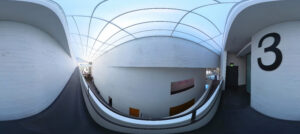
Museum architecture shapes how knowledge is encountered. This article develops the concept of epistemological decentralization to describe spatial configurations that resist privileging a single interpretive route, enabling multiple encounters with content through movement and perception. Two questions drive the argument: first, under what conditions can museum space redistribute epistemic agency without reducing that shift to apparent freedom within a scripted order; second, what spatial conditions support distributed meaning-making rather than staging participation while preserving institutional authority. Drawing on Merleau-Ponty’s phenomenology, the study develops an interpretive reading of Steven Holl’s Kiasma Museum of Contemporary Art in Helsinki (1998), structured around four registers: The Solicited Body, The Lived Body, Bodily Attunement, and The Chiasm. The reading shows that route optionality, navigational oscillation, proprioceptive orientation, and sectional layering can shift interpretive positions from an institutional center toward a more distributed field. The argument connects spatial configuration to the embodied dynamics through which meaning is assembled in museum experience.
Essay
Typology
Open Access
Microcinemas Rising in Europe: New Spatial Trends in Movie Theaters
by Diego Terna, Luca Maria Francesco Fabris
pp. 165–188
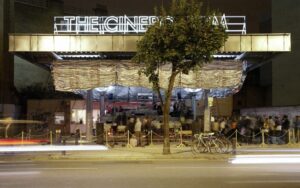
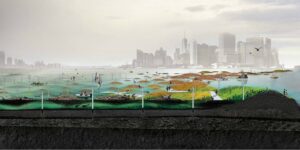
The research paper proposes a critical survey of recently emerged, new architectural spatial forms for hosting movie theaters in the European context. A trend showing a renewed focus on the quality of movies and programming, reverberating in the architectural space of cinema halls, which tend to adapt their features toward small numbers, focusing on privacy and fellowship among a few viewers, and searching for a kind of coziness, transforming cinema halls into spaces with an almost domestic feeling. This new kind of movie theater, called microcinema, is a fluid space within broader functions, where watching the projection on a screen offers an opportunity for intellectual speculation, no longer tied to personal concentration alone, but to public dialogue, where sharing empathy is the more critical experience, providing elements for a new systematic approach to the movie theater design.
Essay
Subscribers
From Human to Holobiont: Reframing the Human/Nature Divide in Urban Architecture
by Elizabeth L. McCormick
pp. 269–284
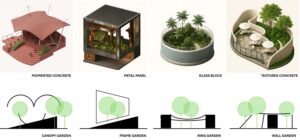
Urban environments have long been shaped by a conceptual boundary that separates humans from nature, positioning nature as something external to be controlled, excluded, or aestheticized. In architecture, this worldview has materialized through technologies of separation – sealed facades, HVAC systems, and airtight enclosures that engineer the indoors as sanctuaries from the natural world. These spatial logics have not only shaped cities but have influenced cultural attitudes, public health outcomes, and our collective understanding of what it means to be human in a changing climate. Scientific advances like the Human Microbiome Project challenge the paradigm of human exceptionalism, revealing the human body as an ecological community, rather than an individual organism. Instead, biologist Lynn Margulis describes us as holobionts – interconnected networks of microbial and physiological relationships that blur the lines between humanity and ecology. If we are not separate from nature, then the boundaries we construct must be rethought. This paper introduces the holobiont as a design-relevant paradigm that embraces ecological entanglement and environmental heterogeneity, positioning buildings as dynamic participants in a larger web of life.
Buy
Already in your cart -
View cart
Essay
Subscribers
From Empty to Evergreen: Gardens as Architectural Design Forces
by Bramasta Putra Redyantanu, Stephanus Wirawan Dharmatanna, Elvina Shanggrama Wijaya
pp. 309–331
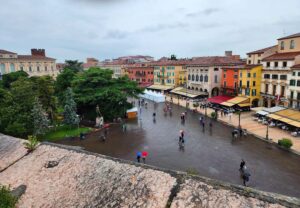
This study reframes gardens from decorative elements to active, generative agents in architectural design. It investigates how gardens shape spatial systems, support social interaction, and catalyze ecological processes in urban contexts. Four case studies from Tanatap Café, Ring, Frame, Wall, and Canopy Gardens show that gardens do more than enhance aesthetics; they initiate new design strategies and spatial organizations. Using a force-based framework, the study identifies spatial qualities, experiential conditions, and preferred configurations to reveal how gardens influence material, ecological, and social dimensions. Findings are organized into three themes. (1) Residue to Rules: Garden as Generator positions gardens as producers of spatial structure. (2) Edge that Breathes: Porosity as Threshold interprets garden boundaries as active membranes that enable interaction and ecological flow. (3) Frame is the Form: Typology as Emergent demonstrates how garden arrangements generate new urban types. By presenting gardens as essential ecological and functional components, the study contributes to ecological urbanism and argues for shifting from viewing nature as complementary to a nurturing, formative force in urban design.
Buy
Already in your cart -
View cart
Essay
Subscribers
Ecological Nature of the City: “Ecologicality”
by Karim W. F. Youssef, Karam Alkatlabe
pp. 231–248
To enhance their resilience against global environmental and economic challenges, cities require an ecological upgrade that leverages the city as a key strategic scale for urban ecology. We must thus consider the ecological nature of the city from the vantage point of a complex adaptive system that has evolved its relationship with the natural environment over time due to various factors, including physical, structural, demographic, economic, and technological. Many strategies and interventions at different spatial scales have cast the city within a fixed image that risks reducing the city’s ecological nature to its physical dimension. To counteract reductionist framing, this paper adopts an eco-critical perspective, viewing the city as a hyperobject (as defined by Timothy Morton), which comprises five dimensions: viscosity, nonlocality, temporal undulation, phasing, and interobjectivity. The paper aims to unpack these five dimensions as they pertain to the ecological disposition of cities (i.e., their ecologicality), to pave the way for tackling the question of the naturalization of the city beyond a systems thinking approach of a regenerative paradigm to an assemblage thinking that grasps the hyperobjectivity of cities.
Buy
Already in your cart -
View cart

Essay
Theory
Subscribers
Train Yourself: Architectural Recycling Between Digital and Physical Realities
by Andy Bako
pp. 21–43
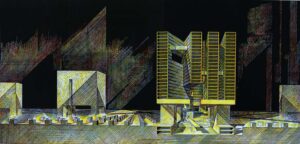
As generative AI reshapes architectural practice, a critical paradox emerges: while new computational tools offer unprecedented creative possibilities, the physical resources essential to building grow increasingly scarce. This paper investigates how architecture can productively engage this tension through novel approaches to material recycling and digital transformation. Rather than treating physical and virtual domains separately, this research proposes an integrative framework where design emerges through continuous feedback between material manipulation and computational processing. The exhibition Train Yourself demonstrates this methodology, presenting a series of experimental artifacts that evolve through iterative exchanges between physical material, AI-driven formal exploration, and imaging techniques. These hybrid objects gain definition through recursive operations that blur boundaries between physical construction and digital representation. Beyond resource conservation, this approach reveals how architectural practice might cultivate new forms of creative intelligence capable of navigating between material constraints and computational possibilities. The findings of this research suggest a mode of practice where designers orchestrate dynamic interactions between physical matter, algorithmic processes, and human intention, pointing toward a more nuanced understanding of ecological sensitivity in contemporary design practice.
Buy
Already in your cart -
View cart
Essay
Theory
Subscribers
The Contemporary City as Archipelago: From O.M. Ungers’ Berlin to the Global Collage City
by Gregorio Froio, Monica Manicone, Matteo Benedetti
pp. 45–65
This essay critically examines the continuing relevance of the archipelago city – as theorized by Oswald Mathias Ungers in the 1970s – as a morphological and conceptual framework for understanding contemporary urban conditions. Originally developed in response to the fragmentation and depopulation of post-war Berlin, the archipelago city posits a model of urban organization based on autonomous, differentiated spatial units or ‘islands’ within a continuous green matrix. The essay situates this model within a broader theoretical lineage, drawing connections with Colin Rowe’s “collage city,” Aldo Rossi’s theories of typology and memory, and Rem Koolhaas’s concept of “junkspace.” Through morphological and compositional analysis, it explores how Ungers’ vision has been reinterpreted in projects from the 1990s to the present, including proposals by Franco Purini and Laura Thermes. These case studies highlight the adaptability of the archipelago paradigm in the contexts of accelerated urbanization, formal heterogeneity, and socio-political complexity. Finally, the essay reflects on the limitations and potentials of the model in an age marked by globalized urban development, the rise of the zone and the increasing marginalization of architectural agency.
Buy
Already in your cart -
View cart