
Aesthetics and Epistemological Decentralization: Toward an Embodied Framework for Museum Space
ABSTRACT - Museum architecture shapes how knowledge is encountered. This article develops the concept of epistemological decentralization to describe spatial configurations that resist privileging a single interpretive route, enabling multiple encounters with content through movement and perception. Two questions drive the argument: first, under what conditions can museum space redistribute epistemic agency without reducing that shift to apparent freedom within a scripted order; second, what spatial conditions support distributed meaning-making rather than staging participation while preserving institutional authority. Drawing on Merleau-Ponty’s phenomenology, the study develops an interpretive reading of Steven Holl’s Kiasma Museum of Contemporary Art in Helsinki (1998), structured around four registers: The Solicited Body, The Lived Body, Bodily Attunement, and The Chiasm. The reading shows that route optionality, navigational oscillation, proprioceptive orientation, and sectional layering can shift interpretive positions from an institutional center toward a more distributed field. The argument connects spatial configuration to the embodied dynamics through which meaning is assembled in museum experience.
Museums are institutions of knowledge whose epistemic conditions are partly constituted through spatial organization. Architecture regulates visibility, structures movement, and distributes patterns of co-presence; in doing so, it does not merely contain artefacts and interpretations already formed elsewhere but helps constitute the conditions under which attention is directed, relations are perceived, and meaning is assembled. Museum layouts operate as instruments of institutional authority: an embedded “museum script” works through architecture, layout, and display to generate a programmed experience underwritten by disciplinary authority,1 while museum architecture has historically inscribed fixed interpretive structures that persist independently of changing curatorial approaches.2 Participation must be spatially enabled rather than rhetorically proclaimed, so that exhibition design can support exploration in ways that allow visitors to become “co-authors” of meaning.3 What requires closer specification is the architectural basis of this redistribution – the conditions under which spatial organization genuinely redistributes interpretive agency rather than multiplying the mechanisms through which authority is maintained.
THE PROBLEM OF EPISTEMIC SPACE
Architecture does not merely contain curatorial content; it affects what can be known, from where, in what sequence, and through what forms of bodily engagement. Display may be understood, following Whitehead, as “embodied theory”: knowledge is constructed not only through labels and texts but also through spatial articulation and the routes by which visitors assemble relations among what they encounter.4 Two questions follow from this formulation. First, under what conditions can museum space redistribute epistemic agency – shifting interpretive labor from the institution toward the visitor – without reducing that shift to merely apparent freedom within an already stabilized order? Second, what spatial conditions support distributed meaning-making rather than staging participation while preserving the underlying authority of the curatorial script? These questions are not primarily aesthetic. They concern the politics of spatial organization and the kinds of knowing subjects that different museum configurations produce.
Steven Holl’s Kiasma Museum of Contemporary Art in Helsinki (1998) offers a pertinent case for addressing these questions. Its organization departs from centralizing models by foregrounding route multiplicity, perspectival layering, and the absence of a compulsory itinerary. Holl frames the building through Merleau-Ponty’s concepts of chiasm, intertwining, and reversibility; at Kiasma, parallax names the way spatial relations shift as the body moves, disclosing space through changing alignments of surfaces, openings, and trajectories rather than from a fixed vantage point. This paper proposes the concept of epistemological decentralization to describe spatial arrangements in which the institution’s capacity to stabilize a single path through content is reduced – affording visitors multiple possibilities of encounter through movement, orientation, and perception. Decentralization does not imply the disappearance of curatorial expertise; it implies a re-situation of that expertise within a more distributed field of interpretive possibility. The argument proceeds through four phenomenological registers – The Solicited Body, The Lived Body, Bodily Attunement, and The Chiasm – each identifying a distinct mechanism through which spatial conditions organize and distribute the conditions of knowledge.
SPATIAL LOGICS OF CENTRALIZATION
Museum architecture has repeatedly reproduced centralizing spatial logics across changing typological forms. In the nineteenth-century enfilade, authority was inscribed in sequence itself: a single route organized the order of encounter and, through that order, the terms of interpretation. Tony Bennett’s “organized walking” named this condition precisely sequential passage through galleries materialized developmental narratives, as visitors retraced an evolutionary logic step by step.5 The modernist white cube did not abolish this structure but transformed its mode of operation: explicit sequencing gave way to the claim of neutrality. Yet there is no such thing as neutral installation; white walls construct a particular viewing subject defined by silent contemplation, aesthetic distance, and the privileging of the disembodied eye.6 Contemporary signature architecture introduced a further displacement, concentrating experience around iconic atria, ramps, and promenades that gather movement and attention into new centers of orientation. Even where circulation appears open, these devices continue to organize experience by atmospheric and visual means rather than by explicit route prescription.
The recent embrace of participation and interactivity is often presented as a corrective to such centralizing tendencies, but the spatial conditions of participation require closer examination. A curated journey designed to produce heightened affective or sensory effects may increase visceral engagement while leaving institutional control intact. Andrea Witcomb’s notion of a “pedagogy of feeling” clarifies the relevant distinction: affect may function either as a genuine opening of epistemic possibility or as an instrument for steering visitors toward predetermined conclusions.7 An analysis of the Tate Modern is instructive here. Despite its thematic display and apparent openness, the layout operates as a restrictive structure, producing the appearance of interpretive freedom while continuing to regulate the pattern of exploration.8 This is precisely the condition that epistemological decentralization must avoid. The issue is not whether museums exercise epistemic authority, but whether a particular spatial logic genuinely redistributes interpretive agency or multiplies the mechanisms through which authority is maintained.
THE POLITICS OF EPISTEMIC SPACE
Museum space does not merely organize movement; more fundamentally, it helps constitute the conditions under which knowledge becomes possible. Four theoretical perspectives illuminate this claim from distinct but mutually reinforcing angles: the spatial organization of conduct; the partitioning of perceptibility; the distribution of agency across human and non-human entities; and the inscription of perspectival difference into built form. Together they produce a picture of museum space as a politico-epistemic field – and it is a picture that requires, for its completion, a phenomenological account of how embodied subjects actually live within the conditions it identifies.
Michel Foucault’s analyses of disciplinary institutions establish that architecture operates through what he called dispositifs – heterogeneous apparatuses consisting of discourses, architectural forms, regulatory decisions, laws, and philosophical propositions, all working in concert to maintain the exercise of power within a society.9 Central to this analysis is what Foucault identifies as the art of distribution: the placement of bodies in space through techniques of enclosure, partitioning, functional organization, and ranking. These mechanisms are simultaneously “a technique of power and a procedure of knowledge” – that is, the spatial arrangement of bodies is inseparable from the production of the epistemic conditions under which those bodies can know and be known.10 Museum layouts operate through precisely this dispositif logic: calibrated sequences of movement and visibility shape interpretation before any particular curatorial statement is made. What this lens brings into sharp focus is the spatial organization of conduct – how the placement and movement of bodies constitute the epistemic conditions under which those bodies can know and be known. What it does not extend to is the perceptual dimension of that same organization: what can be seen and said, and who may occupy the positions from which perception and speech become possible.
Jacques Rancière’s concept of the distribution of the sensible opens the question of perception that the dispositif analysis holds at its edge. The question here is not only the control of movement but the partitioning of what can be seen, heard, and said, and of who may occupy the positions from which perception and speech become possible.11 Architecture participates in this distribution by structuring encounters and authorizing positions of viewing before any curatorial statement is made. Built form can enact disidentification – refusing the perceptual positions that a distribution of the sensible would otherwise assign, loosening stable spatial properties so that walls become something other than walls and circulation becomes something other than transit.12 A museum that disrupts scripted paths and refuses a singular authoritative viewpoint may thereby contribute to a redistribution of the sensible, opening new positions from which meaning can be made and claimed. Yet this lens operates at the level of partition and position – who may be seen and heard within a given distribution of the sensible. What it does not bring into focus is the material agency of the constituents that structure that field: walls, thresholds, vitrines, and objects do not merely carry a distribution; they actively produce the conditions of what can be perceived, in ways that exceed their role as surfaces of partition.
Bruno Latour’s actor-network theory displaces the opposition between active subjects and passive objects by distributing agency across heterogeneous actants.13 Crucial here is the distinction between mediators and intermediaries: an intermediary transports meaning without transformation, functioning as a black box that passes an input unchanged to its output; a mediator transforms, translates, and modifies meaning in ways that are not predictable from either its origin or its destination.14 Within the museum, walls, ramps, labels, sightlines, and artworks are not intermediaries that carry curatorial content to waiting visitors; they are mediators whose participation in the encounter changes what is encountered and how. Artworks solicit attention, redirect movement, and generate relations that neither architecture nor the visitor alone determines. Yet this lens, focused on the horizontal chain of mediators through which meaning is translated and transformed, does not bring into focus the cases in which two perspectives upon the same object are irreducibly non-coincident—where the difference between viewpoints is not a matter of network configuration but is inscribed into the appearance of the object itself, such that no translation resolves it.
Slavoj Žižek’s concept of parallax pushes the argument further by insisting that perspectival difference is not accidental but constitutive: “The gap is inscribed into the ‘real’ building itself – as if the building, in its very material existence, bears the imprint of different and mutually exclusive perspectives.” 15 The shift in an observer’s position corresponds to a shift in the object itself; what is disclosed does not converge upon a single higher synthesis. The consequence is not simply a geometric condition but a material one: the gap is produced and sustained through the building’s concrete surfaces and sectional depths – the material thickness through which any encounter with architecture must pass. Jonathan Hale argues, drawing on Maurice Merleau-Ponty, that the qualities of things we experience are “by definition, just what-it-feels-like to experience them,” so that body and material world are co-implicated rather than opposed.16 The perspectival gap Žižek identifies, therefore, becomes experiential only when a body, sharing in the building’s materiality through the thickness of its own embodiment, discovers that no single position suffices to complete the encounter. Yet this lens, trained on the structural inscription of perspectival difference into built form, does not reach the level at which that difference is inhabited—what bodily capacities the encounter requires, and how movement through spatial conditions successively discloses what no single position can contain. To focus at that level, a different lens is needed.
Taken together, these four lenses do not cohere into a unified theory; they converge on a common object. Each brings a distinct dimension of museum space into focus, and each has a characteristic angle of vision. Foucault’s dispositif illuminates the spatial organization of conduct and the constitution of epistemic conditions through body distribution but does not extend its focus to the perceptual field – what can be seen and said, and from which positions. Rancière’s distribution of the sensible sharpens the question of who may occupy positions of perception and speech but does not reach the material agency of the constituents that structure that field. Latour’s actor-network lens reveals how meaning is translated and transformed across chains of human and non-human mediators, but does not bring into focus the cases in which perspectival difference is not a relational matter but is inscribed into the appearance of the object itself. Žižek’s parallax lens discloses that constitutive gap as a condition built into architecture’s material existence but does not reach the level at which the gap is inhabited – what it requires of a body moving through it. It is precisely at that level that Merleau-Ponty’s phenomenology of perception operates – not as a fifth lens added to the others, but as the account of how structural and material conditions are lived from the inside. What appears as neutral circulation or “good design” may therefore be read more rigorously as a politics of knowledge; it can only be read that way, however, from the perspective of an embodied subject who inhabits these conditions – and that is the subject the following section develops.
PERCEPTION, EMBODIMENT, AND 4E COGNITION
Understanding how meaning emerges for embodied subjects requires a framework that operationalizes the four dimensions identified above – disciplinary, perceptual, agential, and perspectival – through lived spatial engagement. Maurice Merleau-Ponty’s phenomenology of perception provides that framework, operating across four levels that correspond directly to the four registers of the reading.
Perception, in Merleau-Ponty’s account, is not a passive reception of stimuli but an active orientation shaped by learned bodily capacities. The self he proposes is defined not by what it is but by what it can do – consciousness is originally “not an ‘I think that’ but rather an ‘I can.’” This formulation, bodily intentionality, names the pre-reflective grasp of a situation that allows us to cope with ongoing experience before intellectual analysis begins.17 Central to it is the body schema – not a static template but an evolving network of skills and dispositions, grounded in proprioception and kinaesthesis, that encodes what Merleau-Ponty calls motor cognition: the pre-reflective bodily grip that responds to the solicitations of the world before we consciously register them. The concept of optimal grip names the endpoint of this reaching: the configuration of body and world in which an object or scene is most fully disclosed. Merleau-Ponty states this directly in relation to art viewing: “For each object, as for each picture in an art gallery, there is an optimum distance from which it requires to be seen, a direction viewed from which it vouchsafes most of itself: at a shorter or greater distance we have merely a perception blurred through excess or deficiency. We therefore tend towards the maximum of visibility and seek a better focus as with a microscope.” 18 Optimal grip is not achieved once and fixed; objects reveal themselves in what Husserl called adumbrations – partial outlines that compel further exploration, since no single view exhausts a work. What museum architecture therefore does, epistemically, is structure the field within which this navigation can occur: a gallery that forecloses lateral movement or fixes viewing distances reduces the occasions on which optimal grip can be sought; a gallery that permits variable approach and revisitation from different angles multiplies them and extends the embodied constitution of meaning.
These insights locate Merleau-Ponty’s phenomenology within the broader framework of what has been called 4E cognition – a cluster of positions that understand cognition as simultaneously embodied, enacted, extended, and embedded. James J. Gibson’s ecological approach specifies the embedded dimension: affordances are action possibilities that emerge relationally between organism and environment, residing in neither independently. A spatial layout is therefore not a neutral container but a structured field of possibilities always already indexed to a body’s capacities and history of interactions.19 The foundational enactivist statement comes from Francisco J. Varela, Evan Thompson, and Eleanor Rosch: “perception is not simply embedded within and constrained by the surrounding world; it also contributes to the enactment of this surrounding world.” 20 Building on this, Alva Noë develops the enacted dimension: perception is not a process occurring inside the brain but something the organism does – constitutively active, inseparable from bodily movement, and coupled to its environment.21 Taken together, these positions converge on a single consequence: museum visitors do not passively receive information but actively constitute meaning through embodied movement within a spatially structured field. The museum is not a vessel for pre-formed interpretations; it is a field of cognitive possibility whose configuration directly shapes what can be known and how it can be known.
Merleau-Ponty’s phenomenology thus operates on four levels that correspond directly to the four registers through which this study reads Kiasma. The solicitation of movement by spatial configuration – and the open-search conditions this produces – is grounded in motor cognition and bodily intentionality: the body responds to the layout before deliberate orientation begins. The oscillation between perceptual guidance and cognitive reconstruction draws on the body schema’s capacity to sustain practical knowledge across changing conditions. The tacit modulation of attunement through spatial geometry operates at the level of what Merleau-Ponty calls the motor echo and the physiognomy of things – the body’s pre-reflective response to the qualitative character of its surroundings. And the chiasmic reversibility of seer and seen, in which the body is both perceiving and perceivable within a shared material field, draws on his late concept of the flesh as the common fabric from which both subjects and objects emerge. The phenomenological framework is therefore not an overlay applied to spatial analysis; it specifies how embodied subjects inhabit and are transformed by the conditions that spatial configuration produces.
METHOD AND CASE
This study employs a hermeneutic–phenomenological method to develop an interpretive account of how spatial configuration structures the conditions of epistemic possibility. Following Paul Ricoeur’s account of the hermeneutic arc, the reading moves from an initial grasp of the building as a whole, through analysis of its spatial parts, toward a progressively articulated understanding of what those parts disclose together.22 The goal, in David Seamon’s terms, is an approach that remains open to the thing studied, allowing the building to be “as fully present as possible” through sustained attention rather than premature conceptual closure.23 The reading proceeds through four registers – The Solicited Body, The Lived Body, Bodily Attunement, and The Chiasm – each grounded in the phenomenological framework developed above and each identifying a distinct mechanism through which spatial configuration shapes the conditions of knowledge. The resulting claims are interpretive and revisable, offered as specifications of conditions rather than predictions of outcomes.
Where the reading draws on Space Syntax concepts, it does so interpretively rather than computationally, without applying configurational analysis tools. Space Syntax analytical categories arise from and accurately point toward real-world aspects of lived spatial experience – they name the configurational structure within which embodied experience unfolds rather than translating that experience into measurable units that substitute for it. Phenomenology specifies the lived foundation of that unfolding: what Seamon calls the non-discursive synchronicity of habitual body in tune with the physical world. The two frameworks are complementary accounts of the same spatial phenomena at different levels of description – Space Syntax names the conditions; Merleau-Ponty’s phenomenology specifies what those conditions do to a body moving through them. Space Syntax here is not an analytical instrument applied to the building but the perceptual horizon within which spatial configurations become legible – the trained seeing that precedes and grounds the interpretive reading that follows.24
Kiasma Museum of Contemporary Art in Helsinki (1998) is selected for two reasons. Architecturally, Holl explicitly designed the building through sustained engagement with Merleau-Ponty’s phenomenology, tracing specific spatial decisions to passages from The Visible and the Invisible (1968) 25 – its organizational logic of route optionality, recursive return, and perspectival multiplicity makes it a strong case for testing whether spatial configuration can afford epistemological decentralization as the reading defines it. The building comprises two intertwined volumes – a rectilinear block aligned with Helsinki’s city grid and a curving form facing the city’s open landscape to the north 26 – linked by a ramped pathway that rises through the building, producing optionality and return conditions that support open search and recursive encounter. Curatorially, Kaija Kaitavuori develops the concept of the “participator function” – modelled on Foucault’s author function – to describe the visitor not as a recipient of institutional meaning but as a structurally positioned agent within the museum’s discursive arrangements,27 suggesting alignment between Kiasma’s architectural organization and its curatorial ambitions. The reading attends to what the building does spatially, not to what Holl intended it to do, while acknowledging that what architecture affords and what curatorship intends remain distinct registers.
KIASMA AND EPISTEMOLOGICAL DECENTRALISATION
The framework developed above is now brought to bear on Kiasma through four registers – The Solicited Body, The Lived Body, Bodily Attunement, and The Chiasm. Each register identifies a distinct spatial mechanism through which configuration participates in the conditions of knowledge. Together they address the two questions posed at the outset: whether spatial conditions can redistribute epistemic agency without reducing that redistribution to apparent freedom, and what spatial organisation supports distributed meaning-making rather than staged participation. The reading attends to spatial features and their experiential consequences – not to what the building is said to mean, but to what it does to a body moving through it.
The Solicited Body
The solicited body concerns how spatial configuration structures the order of encounter – what Merleau-Ponty describes as the solicitations of the world: the way a layout actively draws the body toward certain paths, positions, and relations before deliberate orientation begins. A distinction has been drawn between directed and open search: directed search presumes a stable target and uses space instrumentally; open search is exploratory, in which discovering an object is inseparable from discovering its position, and meaning emerges from the relation between what and where.28 Further research has demonstrated that museums produce spatial affordances that shape not merely circulation but the cognitive conditions under which meaning is constructed.29 In a museum context, open-search conditions are consequential because they embed interpretation in spatial relations: adjacency, sequence, and reappearance become part of what the visitor learns about the collection. Which works are juxtaposed, in what order they appear, and what comparisons become available depend on the path chosen – and that path is shaped by the layout.
What makes Kiasma’s spatial logic epistemically distinctive is its simultaneous operation across two spatial matrices, neither of which the visitor experiences independently. On one side, the visitor moves through a configurational matrix – linear gallery succession, double-height spaces, maze-like compression, open-plan floors – each producing a different quality of spatial continuity, enclosure, and legibility, drawing the body forward in a particular mode. On the other side, the same movement unfolds against a figurational matrix – the atrium void, the curved wall of ice, the crisscrossing bridges – elements that do not enclose the visitor but pull the eye upward and outward, reorienting the body within the whole before any deliberate decision is made. The epistemic consequence is that meaning is assembled at their intersection. Where the visitor stands in the configurational sequence determines which figurational elements are visible, and which figurational element is in view shapes how the surrounding configuration is read. No single position yields both simultaneously, compounding the combinatorial logic of route
optionality – the views are irreducibly different.
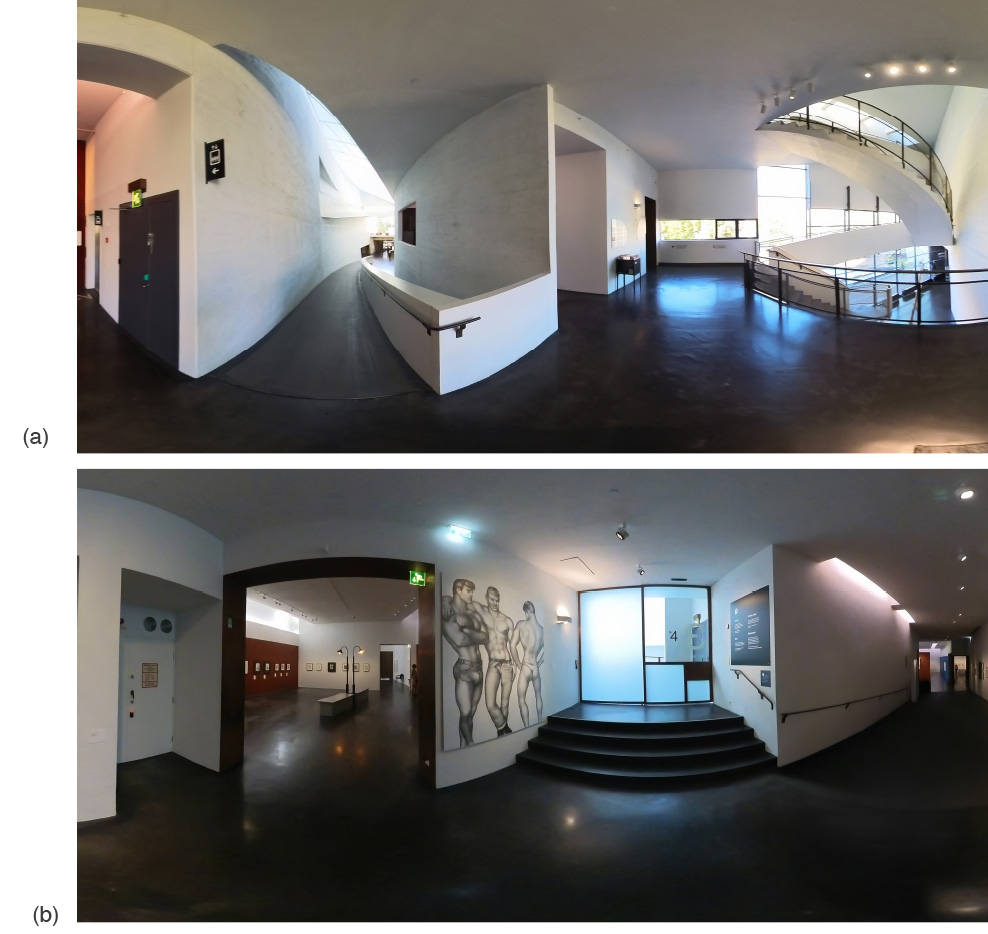
Kiasma structures circulation as a branching field rather than a singular sequence. At the liminal space of the second floor, the staircase ascending or descending to the right, the corridor continuing forward along the curved wall toward the galleries, and the door to the left – cued by the linear window marking a concealed gallery space – each solicits the body in a different direction simultaneously: the visitor is drawn before they decide (Fig. 1a). Different choices yield different encounter orders and different comparative possibilities among works. The pattern recurs: at the entrance to the Kokoelmat and Room X galleries, three distinct routes present themselves; between the third and fourth floors, visitors may take spiral stairs or the ramp through the sliding door (Fig. 1b). Crucially, what changes with each route is not only the path but the order in which works are encountered – and encounter order determines what adjacencies and contrasts become available to the visitor as interpretive frames.
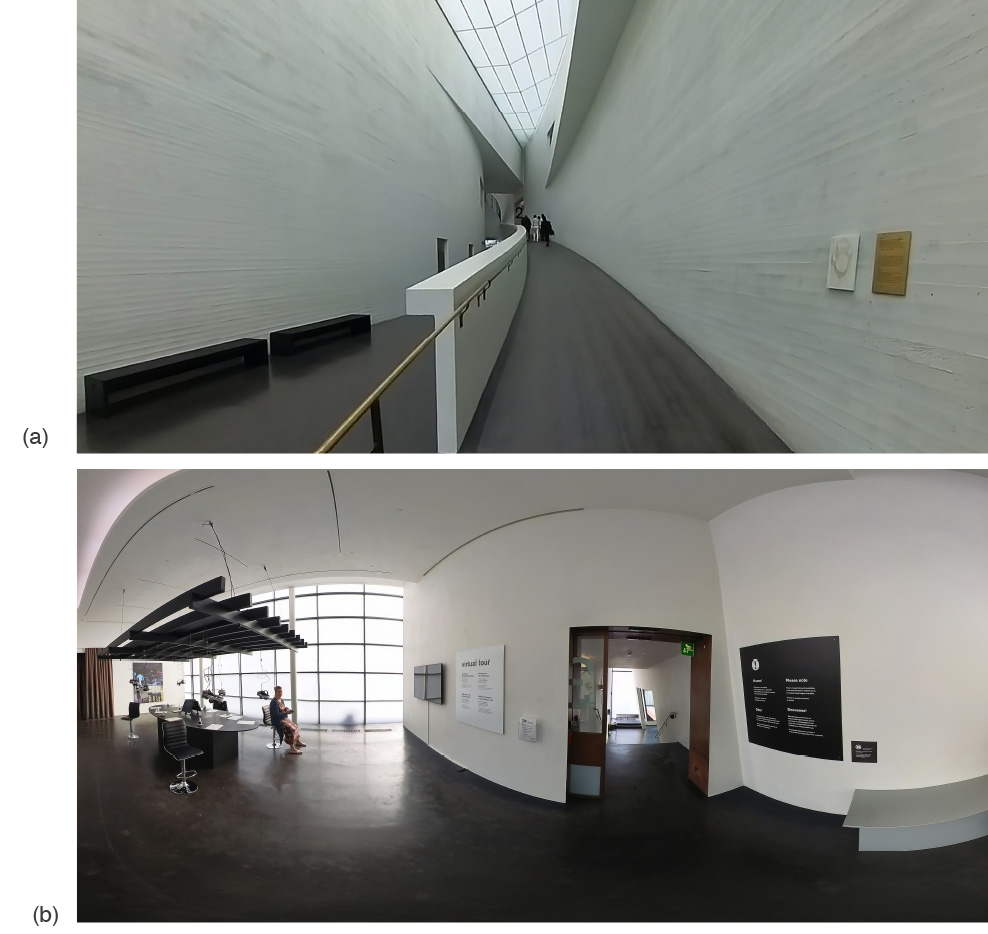
What the branching layout refuses is a fixed correspondence between spatial sequence and curatorial argument. Kiasma’s continuous ramp creates a directional pull – a sequential logic that, if followed uninterrupted, would deliver the collection as a prescribed argument. The sliding doors work against this: by isolating each wing, they break the sequential pressure and allow each section to be encountered in any order (Fig. 2a). The visitor must therefore compose a conceptual order through a self-determined path; the museum becomes less a narrated argument and more a field of possible arguments. Visitors do not receive an interpretation but actively assemble one. Spatial organization at Kiasma temporalizes comprehension: meaning is not available all at once from a fixed point but unfolds through the body’s sequential passage through a field of possible encounters (Fig. 2b).30
The Lived Body
If the solicited body concerns how spatial configuration structures the order of encounter, the lived body concerns how the body schema – in Merleau-Ponty’s account, the pre-reflective practical knowledge carried into every spatial situation – is activated, disrupted, and rebuilt through navigation, and what qualities of epistemic attention this process produces. A distinction has been drawn between navigation primarily “in the environment” – where visible openings invite movement and local cues guide action – and navigation primarily “in the head,” where cues are insufficient. An internal model of the layout must be rebuilt.31 Research on spatial cognition establishes that intelligibility – the correlation between local spatial properties and global layout structure – determines whether environmental cues suffice for navigation or whether cognitive reconstruction becomes necessary.32 Museums commonly produce oscillations between these modes; the design question is how such oscillations are distributed and what kinds of attention they elicit. An environment that resolves too readily produces directed search; one that never resolves produces disorientation rather than discovery.
The body schema operates automatically when environmental cues are sufficient – the space recedes from awareness, and movement proceeds without deliberate orientation.33 When cues fail, the schema must be consciously rebuilt – and it is precisely in this reconstruction that the visitor’s active engagement with the layout is most fully demanded. Oscillation between the two modes keeps this knowledge in productive tension: neither fully automatic nor fully deliberate but sustained at the threshold where spatial awareness and epistemic attention coincide. Kiasma holds visitors at the productive boundary between familiarity and strangeness. Its galleries are structurally similar enough to prevent disorientation, yet distinct: asymmetrical doorway positions, varying ceiling heights, and differences in spatial proportion prevent full habituation. Detailed acts of perceptual engagement are activated by unfamiliarity: a space that has become fully habituated recedes from awareness, while one that is entirely strange produces disorientation rather than discovery – keeping the senses at the threshold where automatic operation gives way to active engagement. The effect is cumulative: no single gallery announces its difference, but the building as a whole refuses to become transparent.
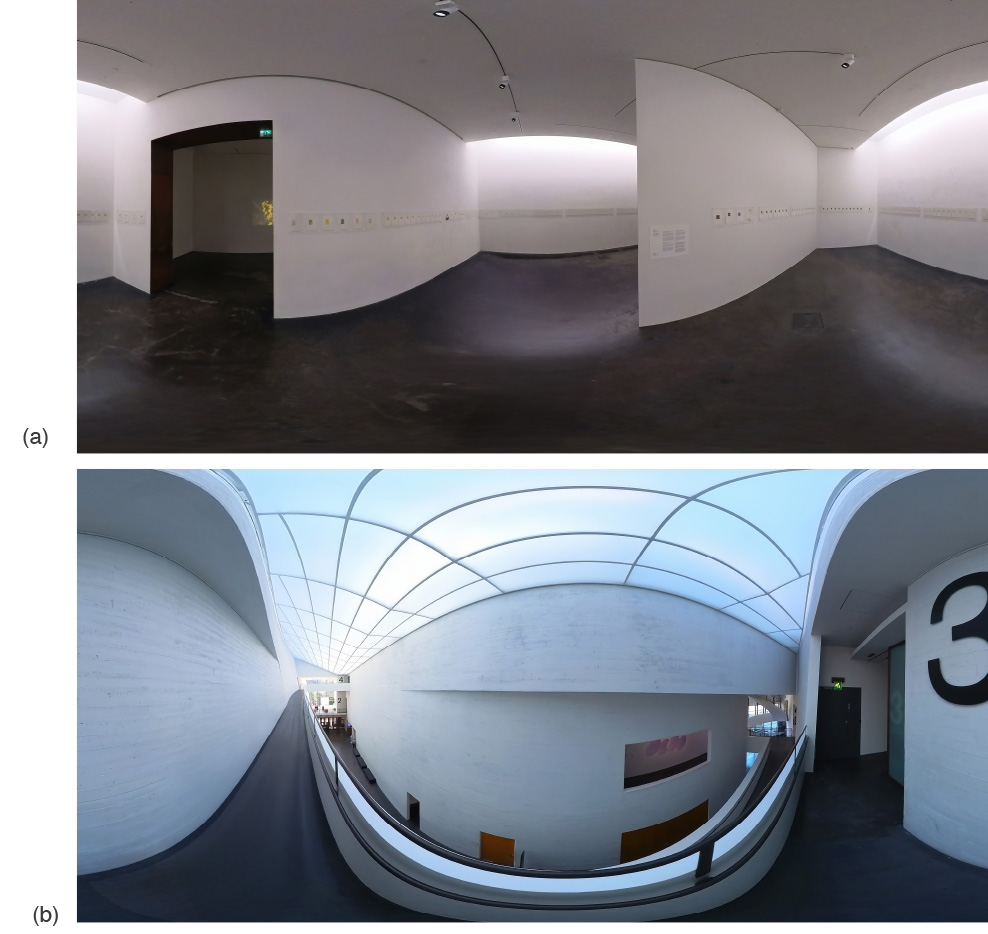
The same oscillation operates in circulation. Within the galleries, strong perceptual cues support navigation “in the environment”: across the gallery sequence, acid-treated brass doorways and asymmetrical framed openings continuously cue the next threshold, carrying the body through without requiring the retrieval of a cognitive map (Fig. 3a). Simultaneously, circulation periodically activates navigation “in the head”: along the second-floor corridor leading to the galleries, a cutaway through the wall frames a view of the ramp between the third and fourth floors – while from the ramp, the same aperture opens an elevated view down to the corridor below – making the building’s vertical section momentarily legible from both directions, suspending flow and briefly drawing visitors beyond their immediate visual field into the larger spatial whole (Fig. 3b). The oscillation structures the visit as a rhythm – flow, then decision, guidance, then choice – and it produces a specific quality of attention: enough perceptual continuity to move with confidence, enough branching to keep orientation active. This produces what has been characterized as a deep-core experience: comprehension is delayed, and visitors compose the collection progressively.34 Decentralization here operates by distributing epistemic work across alternating modes so that orientation and meaning are composed through movement rather than fixed in advance. This is the spatial dimension of Rancière’s distribution of the sensible: not a fixed allocation of perceptual positions but a continuous redistribution of them through movement.
Bodily Attunement
The third register concerns proprioceptive attunement – in Merleau-Ponty’s account, the body’s ongoing orientation to the spatial field that surrounds it – and how spatial configuration can modulate that orientation below the threshold of conscious attention, shaping the conditions under which artworks are encountered without prescribing a response. Proprioception is not a purely internal process but a relational one, activated by movement through a spatial field that keeps changing the terms of that orientation. It depends on variation: a spatially uniform environment yields nothing for proprioception to register, whereas one that varies continuously yet subtly keeps the body in a state of active reorientation without demanding explicit attention – a condition that spatial sequencing and the structure of visibility help produce: sequence, rhythm, and the sizing of openings, gallery volumes, and thresholds modulate what the visitor attends to – distributing attentional conditions between environment and content rather than collapsing them into either.35
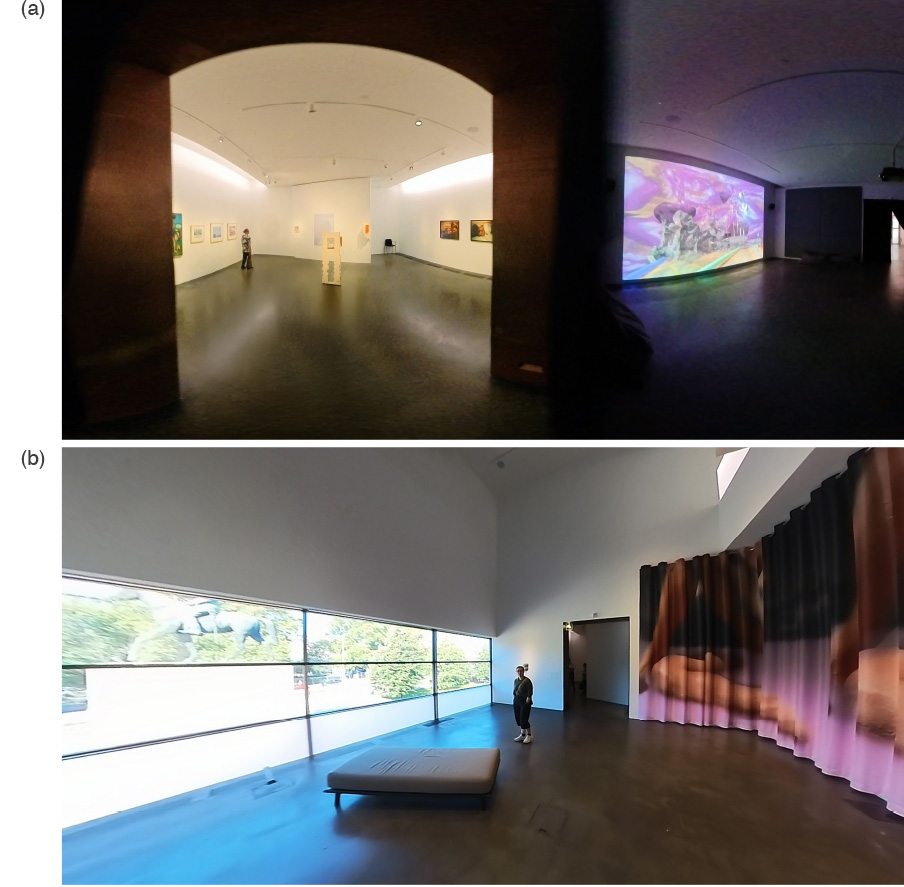
Kiasma produces this condition through configurational contrast – variations in ceiling height, volume, and spatial proportion – rather than through sensory overlay. The Printti Gallery is three connected spaces that share a low ceiling height and intimate spatial proportions that keep the body in proximity to what is displayed: the compressed scale calibrates the body schema toward a mode of close, sustained attention (Fig. 4a). This shifts entirely in Studio K, a double-height space with expansive views – the body schema suddenly recalibrates as enclosure gives way to openness, posture adjusts, and the conditions of attention reorganize around a larger field (Fig. 4b). The shift is felt before it is named: proprioceptive reorientation precedes conscious recognition of the spatial change. The building does not privilege one mode of engagement over the other – it moves between them, ensuring that no single proprioceptive condition can become the default through which all works are encountered.
It should be acknowledged that spatial modulation of this kind is not neutral: a building that shapes attention below the threshold of conscious registration organizes the conditions of response without the visitors’ awareness. What prevents this from becoming a form of implicit control is structural: because spatial variation – ceiling height, volume, threshold position, sectional contrast – operates independently of any fixed sequence, each visitor encounters it in a different order, from a different bodily position, at a different point in their visit. The modulations cannot converge on a predetermined outcome as a directed route can. They calibrate the perceptual ground without specifying what is perceived from it, sustaining a field of attentional possibility whose outcomes remain genuinely open.36 Decentralization at the level of attunement therefore operates not through route structure but through the calibration of perceptual ground itself – shifting the conditions of encounter without prescribing its terms.
The Chiasm
The final register concerns the chiasmic intertwining of the seer and the seen – in Merleau-Ponty’s account, the reversible relationship in which the body is both perceiver and perceivable, embedded in a shared material field, such that no single position can claim to observe from outside the field it surveys.37 To look at an object is already to inhabit it – objects in view “remain abodes open to my gaze,” so that perception is a bodily taking-up of a position rather than a neutral registering of presence.38 A work encountered from one direction and then revisited from another is not the same object seen twice – it has been inhabited differently, because the body’s history of approach has changed. Flesh is the primal element out of which subject and world emerge in mutual relation – the seer cannot possess the visible without being of it, and the gap between positions is not a deficiency but a condition of perception itself. In the museum, this means that no viewing position is neutral. Each encounter is already an exposure, a bodily taking up of a situation that cannot be exchanged for another without remainder.
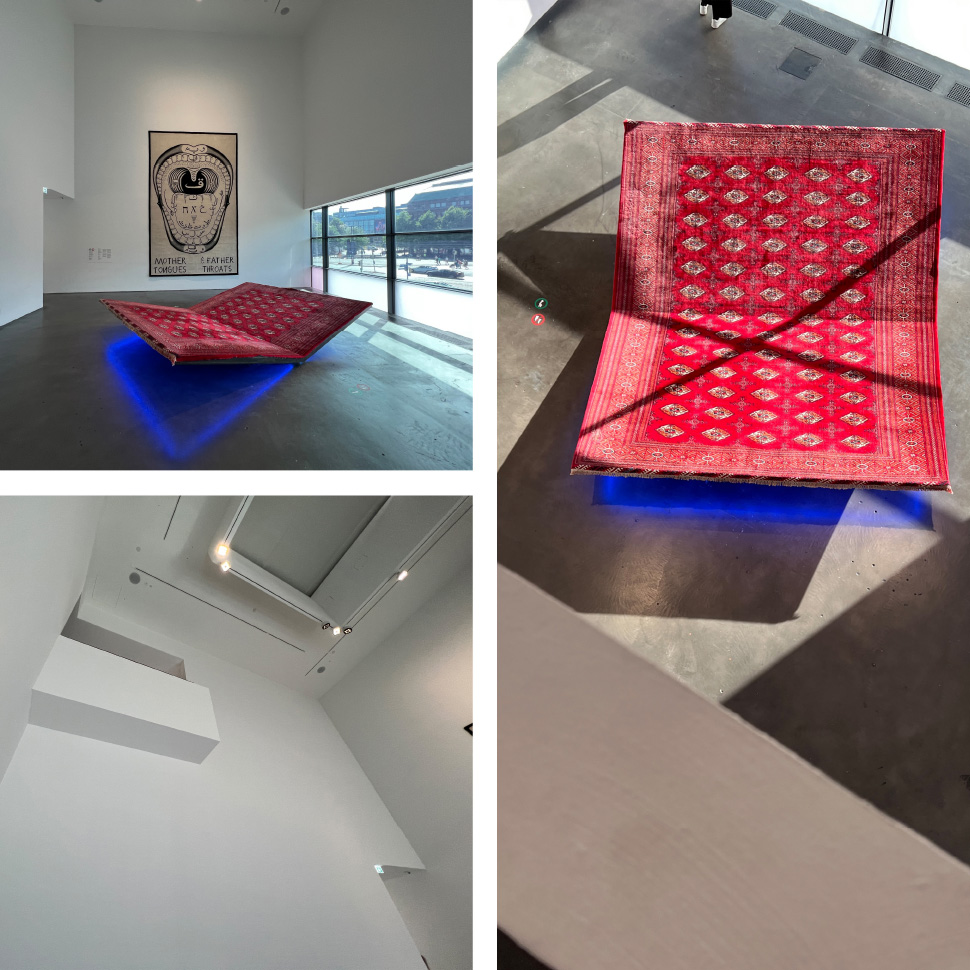
Kiasma’s sectional organization produces these conditions spatially. The crisscross bridge through the atrium overlooks both the atrium void and Helsinki city center beyond, placing the visitor at a threshold between interior and exterior, between gallery and world. The fourth-floor balcony of Studio K (Fig. 5) allows visitors to look down at exhibits that others engage with at eye level: intimate proximity and synoptic overview are simultaneously available without either being privileged. These are not merely different viewing positions but different epistemological positions – and the building makes their difference structurally unavoidable.
The folding route repeatedly brings visitors to bridges from which different levels are visible; having occupied one position and now occupying another, visitors perceive the museum as a field of possible encounters rather than a fixed sequence. Holl’s perceptual parallax and Žižek’s ontological parallax converge here: the building does not merely offer multiple views but materializes their non-identity. What makes this condition epistemically productive is that the reversal is never complete: the visitor on the balcony and the visitor at floor level each see what the other cannot. No position absorbs the other, and no single vantage can settle what the work means. Epistemological decentralization at the level of the chiasm therefore exceeds route multiplicity: the institution cannot occupy a position outside the shared perceptual field produced by the spatial configuration.
This is not a weakening of the institution but a repositioning of it. Curatorial authority does not dissolve when the building refuses to offer a sovereign viewpoint; it is relocated into the field rather than above it. The institution continues to select, sequence, and frame – but it does so as one participant in a perceptual field that the building holds open, not as the occupant of a position from which the whole is legible in advance. What the chiasm produces, architecturally, is a structural condition in which institutional and visitor perspectives are co-present and mutually implicated: neither can claim priority, nor be reduced to the other. Authority remains – but it is distributed through the field rather than administered from outside it.
In this final register, the two questions posed at the outset receive their most direct answer. Museum space can redistribute epistemic agency when it affords positional conditions under which no single institutional perspective can stabilize meaning – when the gap between viewpoints is not a design deficiency but a condition built into the spatial experience itself. Distributed meaning-making becomes possible when the building refuses to offer a position from which the whole can be surveyed and interpreted in advance, instead returning each encounter to a body whose history of approach is irreducibly its own. The institution’s authority is not abolished; it is relocated into a field it can no longer stand outside of.
TOWARD DECENTRALISED EPISTEMIC SPACE
Museum architecture is not epistemologically neutral. Spatial configurations distribute perceptual capacities, organize bodies in relation to objects, allocate agency across human and non-human entities, and inscribe perspectival difference into built form – constituting the conditions under which knowledge becomes possible rather than merely housing it. This paper developed a framework for specifying those conditions, drawing on Merleau-Ponty’s phenomenological framework and 4E cognition, articulated across four registers. A hermeneutic-phenomenological reading of Kiasma shows how route optionality, navigational oscillation, proprioceptive orientation, and sectional layering can afford conditions for redistributing interpretive positions from a single institutional center toward a more distributed field, making the case that epistemological decentralization is not a curatorial attitude but a spatial possibility.
The two questions posed at the outset can now be answered directly. Museum space can redistribute epistemic agency without reducing that redistribution to apparent freedom by affording spatial conditions – branching routes, threshold decisions, irreducible viewing positions, and sectional contrasts that multiply opportunities for meaning-making rather than stage openness within a controlling itinerary. This case shows how spatial conditions can support distributed meaning-making by sustaining oscillation between perceptual guidance and active reconstruction, modulating proprioceptive attunement through spatial contrast without prescribing a response, and resisting synthesis across viewing positions, making the plurality of encounters perceptible rather than absorbing it into atmospheric coherence.
The reading presented here attends spatial configuration and its phenomenological consequences – route structure, navigational conditions, proprioceptive modulation, and sectional organization – and does not extend to curatorial program, the specific content of works displayed, or the color and material properties of objects themselves, all of which would bear on a fuller account of epistemological decentralization. These remain productive directions for further work, particularly in relation to exhibition design theory and the conditions under which different bodies of work solicit different modes of attention. The question this framework poses is not whether museums exercise epistemic authority – they inevitably do – but how that authority is spatially configured, and what kinds of knowing subjects different museum configurations produce.
References
-
Bennett, Tony. The Birth of the Museum: History, Theory, Politics. Taylor & Francis, 1995.
-
Foucault, Michel. Discipline and Punish. Translated by Alan Sheridan. Vintage, 1995.
-
Gibson, James J. The Ecological Approach to Visual Perception. Psychology Press Classic Editions. Taylor & Francis, 2015.
-
Hale, Jonathan. Merleau-Ponty for Architects. Taylor & Francis, 2017.
-
Hillier, Bill. Space Is the Machine. Cambridge University Press, 1996.
-
Holl, Steven. Parallax. Princeton Architectural Press, 2000.
-
Kaitavuori, Kaija. The Participator in Contemporary Art: Art and Social Relationships. Bloomsbury Publishing, 2018.
-
Latour, Bruno. Reassembling the Social. Oxford University Press, 2005.
-
Merleau-Ponty, Maurice. Phenomenology of Perception. Translated by Colin Smith. Taylor & Francis, 1982.
-
– –. The Visible and the Invisible. Translated by Alphonso Lingis. Northwestern University Press, 1968.
-
Noë, Alva. Action in Perception. The MIT Press, 2004.
-
Peponis, John, Craig Zimring, and Yoon Kyung Choi. “Finding the Building in Wayfinding.” Environment and Behaviour 22, no. 5 (1990): 561–71.
-
Rancière, Jacques. The Politics of Aesthetics. Translated by Gabriel Rockhill. Continuum, 2004.
-
Ricoeur, Paul. Interpretation Theory: Discourse and the Surplus of Meaning. Texas Christian University Press, 1976.
-
Seamon, David. “A Lived Hermetic of People and Place: Phenomenology and Space Syntax.” In Proceedings, 6th International Space Syntax Symposium, vol. 1, edited by A. Sema Kubat et al. Istanbul Technical University, Faculty of Architecture, 2007.
-
Tzortzi, Kali. Museum Space: Where Architecture Meets Museology. Ashgate, 2015.
-
Varela, Francisco J., Evan Thompson, and Eleanor Rosch. The Embodied Mind: Cognitive Science and Human Experience. The MIT Press, 1991.
-
Wineman, Jean, and John Peponis. “Constructing Spatial Meaning: Spatial Affordances in Museum Design.” Environment and Behaviour 42, no. 1 (2010): 86–109.
-
Witcomb, Andrea. Re-Imagining the Museum: Beyond the Mausoleum. Taylor & Francis, 2003.
-
Žižek, Slavoj. “The Architectural Parallax.” In The Political Unconscious of Architecture, edited by Nadir Lahiji. Ashgate, 2012.
Credits
-
Figures 1–5: photos by © Majed Awadh Alghaemdi.
Acknowledgments
-
Author Majed Awadh Alghaemdi gratefully acknowledges the Ongoing Research Funding Program (ORF-2026-1975), King Saud University, Riyadh, Saudi Arabia. The authors declare no conflict of interest.
Notes
-
Carol Duncan and Alan Wallach, “The Museum of Modern Art as Late Capitalist Ritual,” Marxist Perspectives 1, no. 4 (1978): 28–51; and Carol Duncan, Civilizing Rituals: Inside Public Art Museums (Taylor & Francis, 1995), 12, 107.
-
Michaela Giebelhausen, “Museum Architecture: A Brief History,” in A Companion to Museum Studies, ed. Sharon Macdonald (Blackwell, 2006), 223–44.
-
Andrea Witcomb, Re-Imagining the Museum: Beyond the Mausoleum (Taylor & Francis, 2003), 143.
-
Chris Whitehead, Museums and the Construction of Disciplines (Duckworth, 2009), 20, 24–26; and Chris Whitehead, Interpreting Art in Museums and Galleries (Taylor & Francis, 2012), 23.
-
Tony Bennett, The Birth of the Museum: History, Theory, Politics (Taylor & Francis, 1995), 186.
-
Mary Anne Staniszewski, The Power of Display (The MIT Press, 1998), 61.
-
Andrea Witcomb, “Toward a Pedagogy of Feeling: Understanding How Museums Create a Space for Cross-Cultural Encounters,” in The International Handbooks of Museum Studies: Museum Theory, ed. Andrea Witcomb and Kylie Message (John Wiley & Sons, 2015), 321–44; and Andrea Witcomb, “Understanding the Role of Affect in Producing a Critical Pedagogy for History Museums,” Museum Management and Curatorship 28, no. 3 (2013): 255–71.
-
Kali Tzortzi, Museum Space: Where Architecture Meets Museology (Ashgate, 2015), 187.
-
Michel Foucault, Discipline and Punish, trans. Alan Sheridan (Vintage, 1995; or. ed. 1975), 135–94; and Eilean Hooper-Greenhill, Museums and the Shaping of Knowledge (Taylor & Francis, 1992).
-
Gordana Fontana-Giusti, Foucault for Architects (Taylor & Francis, 2013), 83–86. The phrase “technique of power and a procedure of knowledge” draws on Foucault’s own formulation in Discipline and Punish, 148.
-
Jacques Rancière, The Politics of Aesthetics, trans. Gabriel Rockhill (Continuum, 2004), 7–8.
-
Joseph Bedford, “Introduction: How Does Architecture Distribute the Sensible?,” in How Does Architecture Distribute the Sensible?, ed. Joseph Bedford (Bloomsbury, 2026), 1–20. The concept of disidentification as an architectural operation is developed at 8–12.
-
Bruno Latour, Reassembling the Social (Oxford University Press, 2005), 39–42, 63–86.
-
Albena Yaneva, Latour for Architects (Taylor & Francis, 2022), 50–51. Yaneva’s analysis of the Berlin key provides the clearest architectural instantiation of this distinction: the key is not an intermediary that opens a door, but a mediator that transforms the social relations of access and obligation.
-
Slavoj Žižek, “The Architectural Parallax,” in The Political Unconscious of Architecture, ed. Nadir Lahiji (Ashgate, 2012), 253.
-
Jonathan Hale, “Found Spaces and Material Memory: Remarks on the Thickness of Time in Architecture,” in The Material Imagination: Reveries on Architecture and Matter, ed. Matthew Mindrup (Ashgate, 2015), 174–75. Hale draws directly on Merleau-Ponty’s account of the reversibility between seer and seen and on the idea that the qualities of perceived things are constitutively bound to the body’s material encounter with them.
-
Maurice Merleau-Ponty, Phenomenology of Perception, trans. Colin Smith (Taylor & Francis, 1982), 68–9, 78, 98–103, 139, 352. The gallery-viewing passage (352) is contextualized for the museum in Jonathan Hale, “Narrative Environments and the Paradigm of Embodiment,” in Museum Making: Narratives, Architectures, Exhibitions, ed. S. Macleod et al. (Taylor & Francis, 2012), 198–99. For the architectural operationalization of motor cognition, bodily intentionality, and the solicitations of the world, see Jonathan Hale, Merleau-Ponty for Architects (Taylor & Francis, 2017), 13–19, 47–48.
-
Merleau-Ponty, Phenomenology of Perception, 352.
-
James J. Gibson, The Ecological Approach to Visual Perception, Psychology Press Classic Editions (Taylor & Francis, 2015; or. ed. 1979), 119, 129.
-
Francisco J. Varela et al., The Embodied Mind: Cognitive Science and Human Experience (The MIT Press, 1991), 174.
-
Alva Noë, Action in Perception (The MIT Press, 2004).
-
Paul Ricoeur, Interpretation Theory: Discourse and the Surplus of Meaning (Texas Christian University Press, 1976), 87. Ricoeur’s account of the hermeneutic arc provides the methodological model for a reading that moves through four spatial registers toward a synthetic claim about epistemological decentralization.
-
David Seamon, “A Way of Seeing People and Place,” in Theoretical Perspectives in Environment-Behaviour Research, ed. Seymour Wapner et al. (Plenum, 2000), 163.
-
David Seamon, “A Lived Hermetic of People and Place: Phenomenology and Space Syntax,” in Proceedings, 6th International Space Syntax Symposium, vol. 1, ed. A. Sema Kubat et al. (Istanbul Technical University, Faculty of Architecture, 2007), iii-08; and Bill Hillier, “The Architectures of Seeing and Going” in Proceedings of the 4th International Space Syntax Symposium, ed. Julienne Hanson (Space Syntax Laboratory, University College London, 2003), 06.1–06.2.
-
Steven Holl, “The Crisscrossing,” Chiasmi International 9 (2007): 21–22. All Merleau-Ponty quotations in this note are from The Visible and the Invisible [see note 37 for details], as cited by Holl, with page references to the Lingis translation.
-
Steven Holl, Parallax (Princeton Architectural Press, 2000), 26.
-
Kaija Kaitavuori, The Participator in Contemporary Art: Art and Social Relationships (Bloomsbury Publishing, 2018), 6, 17–19. Kaitavuori develops the concept of the “participator function” – modelled on Foucault’s author function – to describe the visitor as a structurally positioned agent within the museum’s discursive arrangements.
-
John Peponis et al., “Finding the Building in Wayfinding,” Environment and Behaviour 22, no. 5 (1990): 561–71.
-
Jean Wineman and John Peponis, “Constructing Spatial Meaning: Spatial Affordances in Museum Design,” Environment and Behaviour 42, no. 1 (2010): 86–109.
-
Alberto Pérez-Gómez, “In Search of a Poetry of Specifics,” El Croquis 93 (1999): 18–27. Pérez-Gómez argues that the manipulation of perspective through movement serves to “temporalize” objective experience, emphasizing the body’s status as an oriented being in space.
-
Sean Hanna, “Intelligibility and the Structures of Freedom,” in Museum Configurations, ed. John Peponis (Taylor & Francis, 2024), 82–86.
-
Alan Penn, “Space Syntax and Spatial Cognition: Or Why the Axial Line?” Environment and Behaviour 35, no. 1 (2003): 30–65.
-
Hale, Merleau-Ponty for Architects, 15.
-
Tzortzi, Museum Space, 191.
-
Kali Tzortzi, “Movement, Visibility, and States of Museum Experience,” in Museum Configurations, ed. John Peponis (Taylor & Francis, 2024), 64–79.
-
Jakub Krukar, “A Stimulating Museum Space: ‘Glancing Away’ and Engaging Working Memory In-Between Exhibits,” in Peponis, Museum Configurations, 101–102; and Jakub Krukar and Ruth Conroy Dalton, “How the Visitors’ Cognitive Engagement Is Driven (but Not Dictated) by the Visibility and Co-Visibility of Art Exhibits,” Frontiers in Psychology 11 (2020): 350.
-
Maurice Merleau-Ponty, The Visible and the Invisible, trans. Alphonso Lingis (Northwestern University Press, 1968), 133–35.
-
Merleau-Ponty, Phenomenology of Perception, 79.
-
test