
Urbs and Orbis: A Display of Actual Rome. An Exhibition at the MAXXI
On December 7, 2025, at Gallery 1, on the ground floor of the MAXXI (National Museum of 21st Century Arts) in Rome, the exhibition Roma nel Mondo [Rome in the World] was inaugurated, curated by Ricky Burdett and Izabela Anna Moren, and produced by the MAXXI Contemporary Architecture and Design Department.
NARRATIVES OF THE ETERNAL CITY
With its varying cross-section and its elongated, curvilinear morphology, the ground-floor gallery designed by Zaha Hadid becomes the stage for a grand narrative in four acts. This narrative attempts to capture the manifold natures of Rome through an unprecedented lens, distinct in its critical, instrumental, and curatorial methodologies that display the city far beyond its mere “image.” Yet, it is precisely this image – which never claims to convey absolute truths, but rather relative, affective, and projective visions – that serves as the dominant device in narratives of Rome. These accounts view history as a project and the project as memory, blending heritage and invention, from Marcello Piacentini 1 to Ludovico Quaroni 2 and Paolo Portoghesi,3 to name but a few.
Since the era of the Severan Forma Urbis – the monumental marble map engraved in the third century AD, recently relocated to a modest museum in the Caelian Hill Park – Rome has fostered a pervasive mythology where fiction and reality overlap in a fertile, productive manner. This has allowed all its inhabitants, including transient visitors well beyond the era of the Grand Tour,4 to participate in a theater of the absurd where everything can coexist in a sort of metempsychosis between eternity and evanescence. This frantic cohabitation of objects is sublimated by one of Giovanni Battista Piranesi’s most enigmatic works, the Ichnographia Campi Martii antiquae urbis, wherein the city rediscovers itself as a texture of traces testifying to the “presence of an absence” to borrow Jacques Derrida’s phrasing. Piranesi’s collage of interstitial figures delineates “an urban entity that does not function” where – unlike Giovanni Battista Nolli’s Pianta di Roma, which underpins the dialectic of modern architecture – “there are no clear figure-ground relationships,” ultimately “weakening all metaphysical concepts of truth and ideality.” 5
The Roman palimpsest, however, is not merely imaginary. It creates unique concrete condition and complexity that Robert Venturi categorized as “both-and” as opposed to “either-or.” 6 More than any other city, Rome has seduced vedutisti: architects, artists, archaeologists, writers, and photographers who learned the “lesson” of history and “transparent” time – distinct from “space, which is opaque,” as Giulio Carlo Argan writes specifically regarding Rome – allowing one to perceive the abyssal layers of its stratification.7 In 1787, Goethe described his Roman stay as “a second Christmas, a true rebirth,” while for Lord Byron, in his encounter with historical and existential ruin, the city became the place to lay down his grief.
Sigmund Freud used Rome as a metaphor to explain the ambivalent mechanisms of memory and repression: a “psychical entity” that unabashedly exhibits a “great mess” [gran pasticcio] of wreckage and spoils from every era through temporal synchronies that render it eternally contemporary. Just as psychoanalysis digs into the hidden depths of the unconscious to decode conscious behavior, urban scholars have obsessively scrutinized Rome to unlock its enigmatic, evocative power. As caput mundi [capital of the world], a universally “exceptional” case, Rome owns an elusive identity. Even Christian Norberg-Schulz – in his first essay applying the notion of genius loci to the city – seems reluctant to attribute a single spirit to it. He remains aware of a rhapsodic, fragmented nature that mirrors its urban form, both on the surface and within the massive archaeological repository of its subsoil.8
Ultimately, the Roman enigma is not resolved by its “image” that “communicates monumentality and grandeur,” but rather by an “idyllic” character that may appear “surprising at first glance.” According to the Norwegian critic, Rome’s idyll resides in its “rustic simplicity which links it to nature. There is probably no other European capital capable of expressing such an attachment to nature, nor any other place where nature is so ‘humanized’.” 9 These words opened the 1978 catalog for Roma Interrotta [UneternalCity], the first major exhibition on Rome held in the Markets of Trajan. Curated by Piero Sartogo, the exhibition proposed Nolli’s 1748 map as a canvas onto which a refined exercise of critical-projective design could be grafted. Alongside Sartogo, this circle of twelve architects included James Stirling, Robert Venturi, Rob and Leon Krier, Costantino Dardi, Paolo Portoghesi, Colin Rowe, Aldo Rossi, Antoine Grumbach, Romaldo Giurgola, and Michael Graves. They were asked to rewrite history – designing the past to reshape the future, following a distinctively Italian methodology rooted in Bruno Zevi’s critica operativa [operative criticism].10 The exhibition was a highly authorial product, perfectly attuned to a time that still celebrated the idealized figure of the “starchitect-author.” The traces it left behind fueled introspective disciplinary debate, that arguably widened the gap between architecture and wider society.
A few years later, in 1983, another exhibition on Rome opened at Castel Sant’Angelo. Of an entirely different nature, it sought to dismantle certain false myths – chiefly the romantic notion of the “open city” – which inevitably clashed with the illegal, marginal, clandestine, and unplanned reality of the modern metropolis, a breeding ground for escalating forms of spatial injustice. The volume La metropoli spontanea. Il caso di Roma 1925–1981 (1983) analyzed the practice of unauthorized building [abusivismo], a practice deeply embedded in the capital’s history since 1870.11 Driven “primarily by speculative aims,” this rapid expansion caused the city to grow tenfold in just over 150 years.12
While local critics often dismissed abusivismo as a purely local pathology, a comparative glance at eleven other Mediterranean and Latin American cities reveals informal growth as a global phenomenon that systematically degrades natural resources.13 In short, the idyll described by Norberg-Schulz gave way to an anatomy described by Giulio Carlo Argan as “flat and formless like poured polenta,” 14 a clear “manifestation of the rifts between the logic of decision-making processes in urban planning and management, and the logic of market systems.” 15 An urgent need emerged for a profound revision of urban planning tools moving beyond the ideological approach that merely labeled spontaneity as “deviance” without offering a credible framework for “normalcy.”
ROME IN THE WORLD IN FOUR ACTS
Roma nel Mondo predictably confronts these two precedents: Roma Interrotta, which examined city’s historic core, and La metropoli spontanea, which mapped its complex peripheries. This connection aligns with Burdett’s theoretical premise: that understanding the essence of a city requires merging two distinct yet complementary perspectives. The first is an objective view, grounded in physical evidence and built realities. The second is a subjective, imaginative view, shaped by Rome’s enduring global cultural resonance. Crucially, these two lenses constantly challenge, contradict, and contextualize each other.16 Nevertheless, this exhibition introduced several essential novelties, shaped largely by Ricky Burdett’s unique background.
The great-grandson of Ernesto Nathan – Rome’s reformist mayor who challenged landed aristocrats and Vatican circles from 1907 to 1913 – Burdett moved from Rome to England at the age of nineteen to study architecture. His academic career, however, unfolded at the London School of Economics (LSE), where he has directed the LSE Cities and Urban Age rogram for over thirty years. It is precisely this simultaneously “outsider/foreign” gaze – shared by the entire curatorial team, which includes no Roman figures – and yet “sentimental” attachment that lends Burdett’s exhibition its original edge, maintaining a sharp critical distance inflected by a deep expertise in global urban trends. As curator of the 10th International Architecture Exhibition at the Venice Biennale – Cities, Architecture and Society (2006) 17 – Burdett became known for a rigorous and data-driven approach.
This “scientific Calvinism” maps the genetic code of cities – what he calls DNA – using strict comparative metrics. By analyzing demographic, environmental, and social indicators, his quantitative methodology exposes the structural dynamics and systemic inequalities of urban change, challenging long-held assumptions and parochial biases. Global urban rankings are often rigid and imperfect, yet they consistently place Rome below European peers like Berlin, Vienna, and Madrid.18 This performance, compounded by structural anomalies like a lack of industrialization and the pervasive institutional presence of the Vatican, often obscures the real transformations occurring within the city.
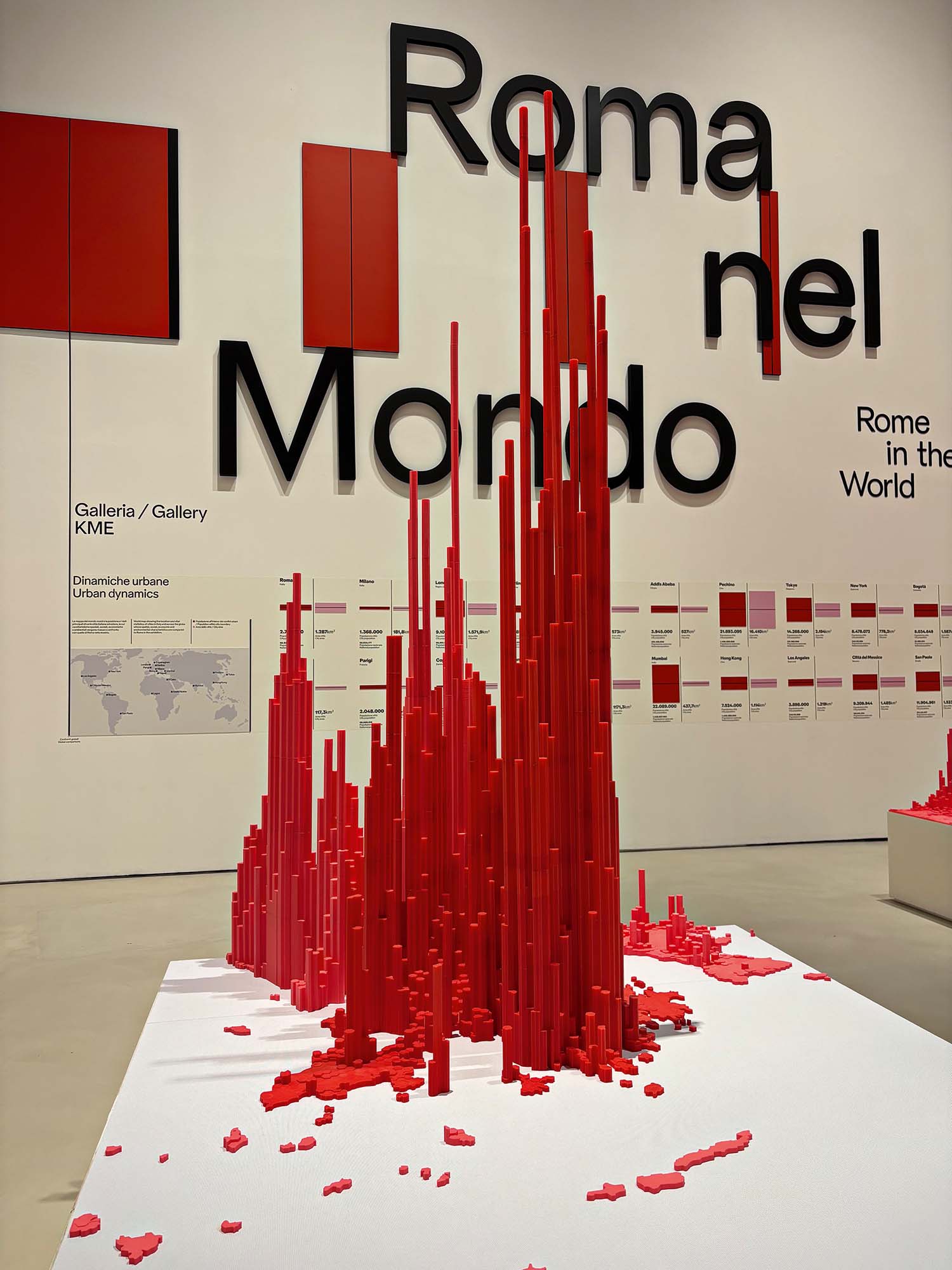
To counter this invisibility, Burdett and his research team of sixty scholars translate with masterly skill raw data into a sophisticated visual grammar accessible to architects and planners as well as to a broader public. Measured, weighed, quantified, and scrutinized under a telescope that lays bare every minute detail – every infrastructural, demographic, economic, and environmental layer conditioning its physical and functional reality – Rome is programmatically compared with eighteen other global metropolises. These were illustrated in the first room, in all their iconic differences, through striking bespoke photography featuring London by Peter Bialobrzeski, Beijing by Olivo Barbieri, Mexico City by Armin Linke, Hong Kong by Francesco Jodice, Lagos by Martin Roemers, and Mumbai by Peter Bialobrzeski. The curators described this deep diagnostic reading as an “MRI scan” of the city, using a wide array of spatial and narrative devices rather than relying solely on static images.
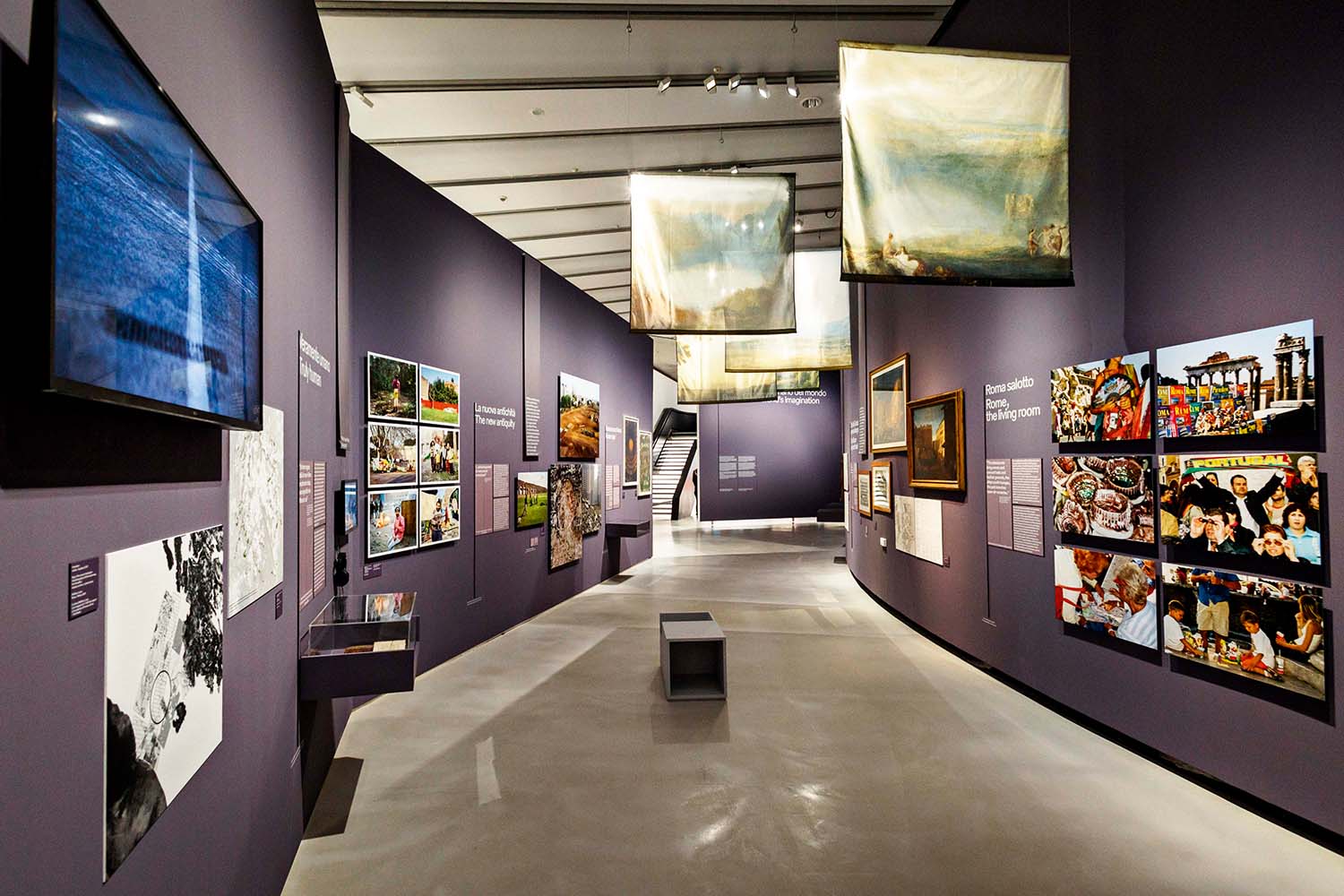
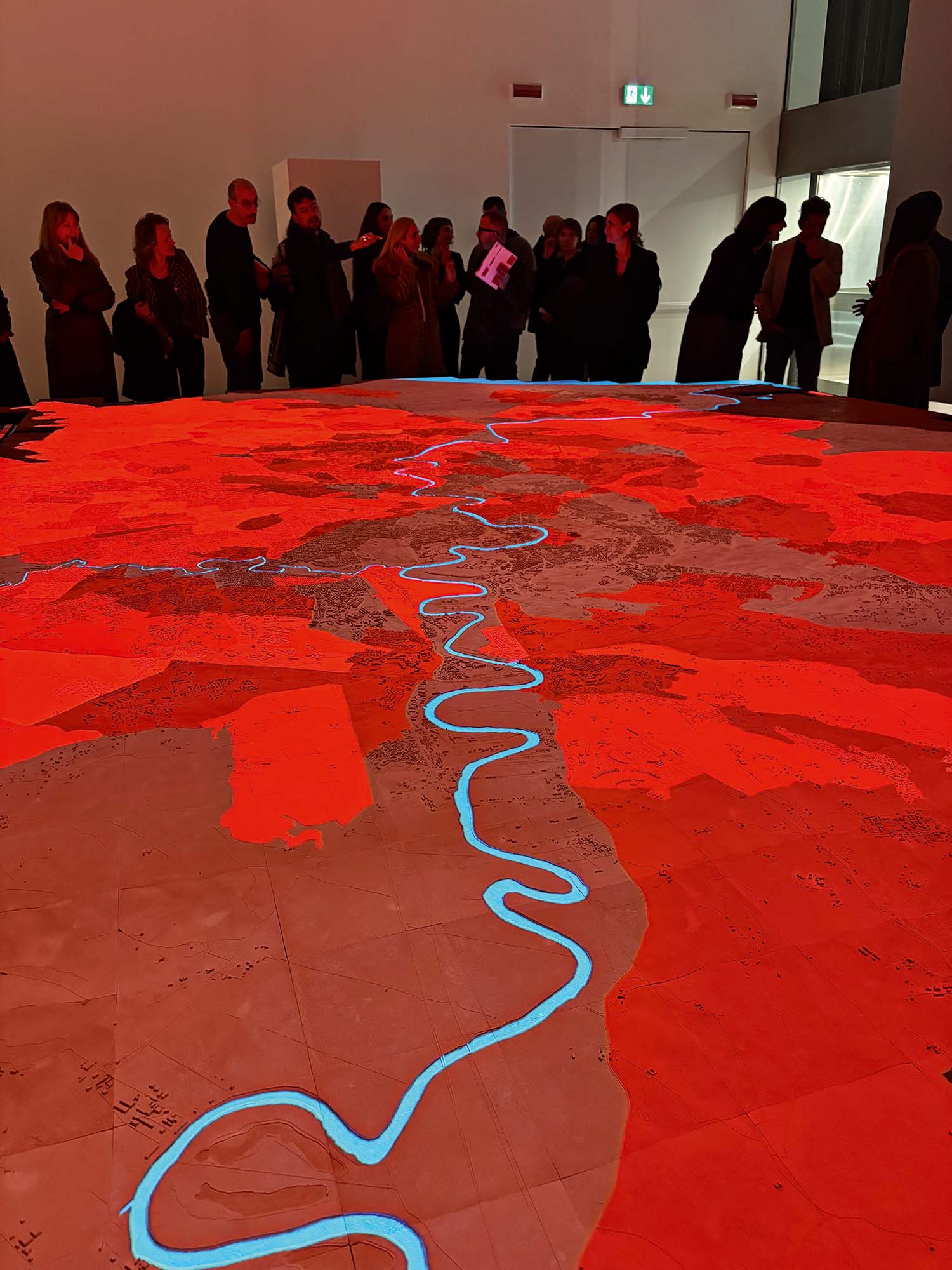
As mentioned, the exhibition was organized into four sections orchestrated into a rhythmic sequence of spatial experiences punctuated by sudden transitions. After the initial rooms dedicated to “global comparisons,” the path bifurcated: to the right, a white wall hosts Marina Caneve’s photographic project on contemporary Rome, accompanied by a critical text by Izabela Anna Moren. In the parallel corridor to the left, an anthracite-gray wall supported “Rome in the World’s Imagination,” a section curated by Paola Viganò and Maria Medushevskaya. This visual atlas compiled documentary evidence of the Eternal City’s extraordinary and kaleidoscopic planetary centrality in fueling the collective imagination. Finally, the visitor entered a dark, immersive, acoustic space dominated by a monumental terracotta model of Rome’s entire municipality. Fabricated at a 1:7,500 scale by Marco Galofaro (Modelab), this tactile artifact served as a projection screen for dynamic thematic maps generated by Keti Lelo’s empirical research.
CITIES AND NUMBERS
To evaluate its state of health and well-being, Rome was compared to other cities across four variables measuring the quality of inhabited spaces and their management, mobility infrastructure, the environment, and social structure. With its 2.7 million inhabitants (compared to London’s nine million), predominantly elderly – the aging index stands at 200, meaning two elderly citizens for every youth, with an average age of 46.8 compared to Istanbul’s 30 – the Municipality of Rome spans an area of 1,287 km² [496 sq. mi.], equivalent to a circle 50 km [31 mi.] in diameter. Despite being the second largest metropolitan area in Europe after London, the city retains balanced proportions between solid and void: its average density within the urban core is ten times lower than that of Paris (1,853 inhabitants/km² [0.39 sq. mi.] versus 18,435) and contains roughly 50% open space. These open spaces, which include nature reserves and productive land, make it the largest agricultural municipal district on the continent. This factor positively impacts environmental sustainability – air quality remains within safe PM2.5 thresholds – and is equally significant for economic self-sufficiency.
While the birth rate ranks among the lowest (1.6 compared to Cairo’s 57.8), statistics confirm that Rome remains one of the premier tourist destinations in Europe and the world, with one Airbnb bed for every four residents within the Aurelian Walls. Over the last decade alone, tourist volume surged from 13 to 22 million: a 70% increase that triggered a spike in the average real estate price per square meter in the historic center, accelerating resident displacement and rendering housing generally unaffordable. In short, we are witnessing the “Venetianization” of Rome,19 the side effect of which is widening social disparity, balanced only by rising revenues and thus a potential increase in transport infrastructure investments. Yet, transport remained the most distressing datum of the investigation. Rome’s public transportation metrics align more closely with Mumbai or Lagos than with Berlin or Paris.
Partly due to its cumbersome subterranean archaeological heritage, the capital lacks a subway and rail network scaled to its geography, operating just 59 km [36.66 mi.] of metro lines and seventy-five stations, compared to Berlin’s 402 km [249.79 mi.] and 272 stations. Meanwhile, Chinese cities have rapidly closed the modernization gap, vastly exceeding Italian provisions, as demonstrated by Beijing, which today boasts a metro network of 879 km [546.19 mi.] and 522 stations. In Rome, where investments in cycling infrastructure have only recently begun, over 60% of all trips rely on private automobiles. From this perspective, there is no virtue to be found: a lack of public transit options yields high car ownership rates (nearly one vehicle per inhabitant), expanding asphalt surfaces, and intensifying urban heat islands – effects mitigated only by the city’s coastal topography and Mediterranean climate.
Despite sharp inequalities between the historic center and the outer peripheries – exacerbated by Rome’s strictly monocentric structure 20 – the capital retains a cohesive morphological layout. Socioeconomic segregation is distributed unevenly across the metropolitan territory, avoiding the stark, hyper-segregated enclaves seen in Mexico City, New York, or Milan. The dynamic maps projected onto the terracotta model illustrated these subtle relationships between neighborhoods, administrative districts [municipi], and socio-spatial boundaries. By mapping historical growth, fabric density, commuter flows, spatial voids, institutional services, and demographics, the exhibition reveals a city defined by moderate systemic imbalances, unfulfilled structural potential, and silent infrastructural crises. This data-driven analysis underscores the value of the Human Development Index (HDI) – introduced by the UNDP in the 1990s to counter generic GDP metrics.21 By measuring resource access, education levels, and life expectancy, the HDI accurately quantifies the precise territorial and socioeconomic disparities across the contemporary city.
IMAGINARIES AND WANDERINGS
To the specific weight and beauty of numbers, the exhibition joined a second documentary apparatus designed to stimulate the senses and the pleasure of erudition, aimed at foregrounding Rome’s extraordinary visual power through the intimate gaze of writers, artists, photographers, and architects. The resulting collection illustrated the tension between love and aversion that defines the world’s relationship with the city – a destiny encoded in its very name: Roma, a palindrome for Amor [love], long mythologized as its secret, sacred, unutterable title.
This archival section demanded a slower, more contemplative pace. It organized historical materials into thematic groups, weaving together Robert Venturi’s collages, Sigmund Freud’s essays, Lord Byron’s notebooks, Rodolfo Lanciani’s maps (1901), and Peter Eisenman’s theoretical projects (Rome: The Political City 1986-1987).
The display included Tim Potter’s documentary photographs of the 1968 student protests at the Faculty of Architecture; observations by Madame de Staël (“Rome, an oasis dropped into a barren wilderness,” 1805) and Charles Dickens (“broken aqueducts, left in the most picturesque and beautiful clusters of arches […] a desert of decay, sombre and desolate beyond all expression,” 1846); verses by Joseph Brodsky (“[…] flooded with light. As only a fragment can dream,” 1982); and Cy Twombly’s expressive canvas Trafitti da una piazza romana (1962). These historical pieces sat alongside contemporary works produced by international fellows at foreign academies, including Tim Davis’ New Antiquity photo series (2009), Thyra Hilden and Pio Diaz’s video installation Coliseum on Fire (2010), and Alex Nogué’s acrylic paintings (2022).
Within this mosaic of cultural remembrance, André Aciman’s reflections on his family’s Roman exile captured the spatial experience of the city: “lunch, walk, vigils. Everywhere you turn you stumble on memories – your own, someone else’s, the city’s.” 22 Marina Caneve structured her photographic project around this tradition of urban drifting, documenting the city’s hidden recesses, decaying infrastructure, and spaces reclaimed by wilderness along the Tiber and Aniene rivers. Her work invoked a long legacy of spatial exploration, from Joel Sternfeld’s iconic Campagna Romana (1992) and Gianfranco Rosi’s documentary Sacro GRA (2013), to the radical walking methodologies developed by the Roman collective, Stalker/Osservatorio Nomade. This bottom-up approach to urbanism received significant attention at the recent 19th Venice Architecture Biennale (2025), curated by Carlo Ratti. In the Austrian Pavilion’s Roma vs Wien display, curators Sabine Pollak, Michael Obrist, and Lorenzo Romito contrasted a highly structured, stable Vienna with a resilient, self-organizing Rome, where grassroots practices of spatial reappropriation and common use of space continuously contest institutional inequalities.23
CURATORIAL DISPLAYS AND ARMATURES
Roma nel Mondo marked an important milestone in the history of exhibitions about Rome, notably due to its experimentation with communicative tools and exhibition armatures. Coming just a few months after Diagrams – the exhibition curated by Rem Koolhaas’ AMO/OMA studio which opened in May 2025 at the Fondazione Prada in Venice 24 – Burdett’s design flipped the relationship between abstract data, legibility, and its physical armature. The diagram, used to synthesize data into transmissive devices, sat at the center of a cross-disciplinary inquiry in both projects. To the two-dimensional nature of the roughly 300 diagrams that Koolhaas sealed in elegant glass vitrines like relics – including rare documents, books, and ordinary photocopies – the object-based system staged at MAXXI counterposes a multi-sensory capture. Three-dimensional graphs, diagrams, and histograms took shape, where the unit of measurement becomes the pixel expanding a surface, the disk elevating a column, or the veil thickening a fabric, assuming different meanings and textures case by case. Here, diagrammatic language activated intuition, triggering a playful, tactile, and visual interaction that allowed everyone, children included, to comprehend and raise questions.
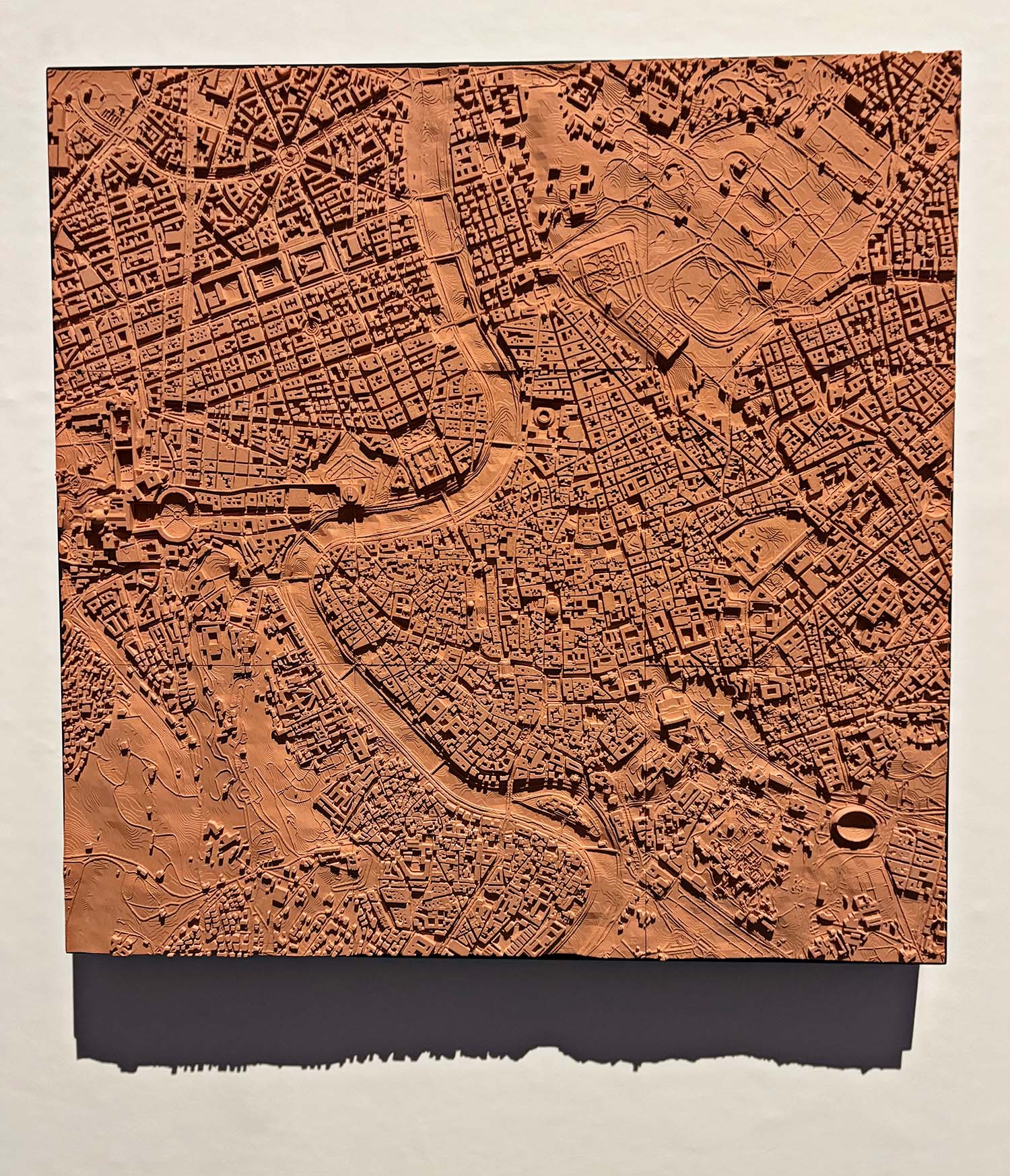
This interactive logic shaped the central terracotta model. Measuring 7.15 × 6.80 m [23.46 × 22.32 ft.], it was assembled from 954 individual 17 × 17 cm [6.69 × 6.69 in.] modular tiles. Here, the pixel unit returned as a design strategy, rendering the massive map modular, open-ended, and evolutionary – allowing future researchers to update, remodel, or replace the city piece by piece over time. In its raw form, clay is a malleable, living medium that holds an alchemical and therapeutic quality, a characteristic that Ettore Sottsass famously integrated into his design poetics. Furthermore, Rome has built itself out of brick since the Republican era; the terracotta model thus stands as a direct homage to the city’s material history, its specific atmospheric textures, and its earthy tones.
The production of this model required an innovative hybrid workflow, combining digital modeling, 3D printing, custom mold-making, and traditional slip casting. Rather than serving as a temporary exhibition prop, the installation will join Caneve’s photographs as a permanent acquisition in the MAXXI architecture collection.
By investing in works that expand an archive that already holds the complete records of Roma Interrotta, the museum reinforces its institutional role as one of the most significant cultural hubs for the modern and contemporary history of the city.
Credits
-
Figures 1–4: photos by © the Author.
Notes
-
Marcello Piacentini, Il volto di Roma e altre immagini (Edizioni della Bussola, 1944).
-
Ludovico Quaroni, Immagine di Roma (Laterza, 1976).
-
Paolo Portoghesi, Roma/amor. Memoria, racconto, speranza (Marsilio, 2019).
-
Fabrizio Toppetti and Vincenzo Moschetti, Mirabilia (Macerata Quodlibet, 2026).
-
Peter Eisenman, “Notation of Affect,” in Pathos, Affekt, Gefühl: Die Emotionen in den Künsten, ed. Klaus Herding and Bernhard Stumpfhaus (Walter de Gruyter, 2004), 44.
-
Robert Venturi, Complexity and Contradiction in Architecture (The Museum of Modern Art, 1966).
-
Giulio Carlo Argan, “Introduzione,” in Roma Interrotta, ed. Piero Sartogo et al. (Officina Edizioni, 1978), 11–12.
-
Christian Norberg-Schulz, “Il genius loci di Roma,” in ibid., 13–27.
-
Ibid., 14.
-
Bruno Zevi, Architettura e storiografia (Libreria Editrice Politecnica Tamburini, 1951).
-
Alberto Clementi and Francesco Perego, eds., La metropoli spontanea. Il caso di Roma 1925–1981 (Edizioni Dedalo, 1983). The publication was the result of a collective academic research coordinated by the authors, alongside the Ministry of Cultural Heritage, the Municipality, and Sapienza University.
-
Italo Insolera, Roma Moderna. Un secolo di storia urbanistica (Einaudi, 1962).
-
Clementi, La metropoli spontanea, 38.
-
Argan, “Introduzione,” 11.
-
Clementi, La metropoli spontanea, 30.
-
Ricky Burdett and Izabela Anna Moren, eds., Roma nel Mondo (Corraini Edizioni, 2026).
-
Ricky Burdett and Sarah Ichioka, eds., Cities, Architecture and Society (Rizzoli, 2006).
-
Keti Lelo, “Il DNA di Roma,” in Roma nel Mondo, ed. Ricky Burdett and Izabela Anna Moren (Corraini Edizioni, 2026), 106.
-
Jack Self, “Rome is Burning: The Eternal City at the End of the World,” in ibid., 98.
-
Lelo, “Il DNA di Roma,” 108.
-
Ibid., 124.
-
André Aciman, Find Me (Faber & Faber, 2019), 9.
-
ARCH+, Wien/Roma – Agency for Better Living (ARCH+, 2025).
-
AMO/OMA, Diagrams exhibition at the Fondazione Prada, Venice, Italy, 10 May–24 November 2025.