
Archive
Category: Criticism
Book Review
Criticism
Open Access
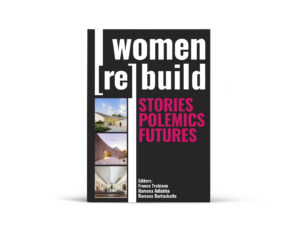
Women [Re]Build: Stories, Polemics, Futures
by Lynnette Widder
pp. 519–523
Women [Re]Build: Stories, Polemics, Futures By Franca Trubiano, Ramona Adlakha, and Ramune Bartuskaite (eds.) Novato CA, USA: Applied Research and Design / Oro Editions, 2019, 2018241 mm x 165 mm144 pagesUS$ 29.95 (paperback)ISBN: 978-1-943532-43-8
Article
Criticism
Subscribers
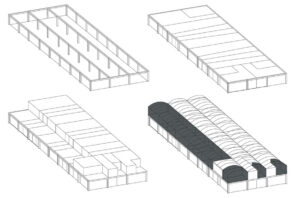
Housing the Multitude: Struggling with Impermanence and Singularities
by Xavier Van Rooyen, Michaël Bianchi
pp. 67–92
This article seeks to trace a history of Team X’s experimentations on the issue of housing for the great number and more specifically around the theoretical background leading to the question of impermanence and indeterminacy in the architectural process. Through the writings of the Smithsons, Oskar Hansen, or John Voelcker, a theoretical framework will be defined and then put into perspective in a contemporary context. Two case studies will be discussed: Lacaton & Vassal, and Elemental. Connections will be made on the issue of indeterminacy and the concepts of “open structure” and “open aesthetics” will be promoted. These concepts presented here offer an alternative for some other possible formal developments around the question of indeterminacy. We will assess whether the pragmatism of these two contemporary architectural offices allow their proposals, beyond responding to specific situations, to claim the status of a reproducible model, such as one imagined during the 1960s.
Buy
Already in your cart -
View cart
Exhibition Review
Criticism
Open Access
“FREESPACE” and the Citizen: Stories of Generosity from the Venice Architecture Biennale 2018
by Carla Brisotto, Cristina Cassandra Murphy, Martha Battaglin Ramos
pp. 237–252
Essay
Criticism
Subscribers
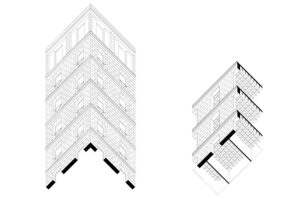
Pouillon’s Practical Theory. A Design Method for Contemporary Architectural Practice
by Emilio Mossa
pp. 47–68
The aim of this paper is to underline the currency and modernity of Fernand Pouillon’s method for contemporary architectural practices. In particular, this dissertation analyzes the theory hidden behind Pouillon’s practice, and the motivation influencing the final quality of his works in order to make this method implementable to the current conditions of architectural design related to the management of complexity, buildability and quality of buildings. This paper explains Pouillon’s design process through the case study of Résidence Les 200 Logements, or dwellings, built in Aix-en-Provence between 1951 and 1955. This work represents the turning point experience in the development of a design methodology that Pouillon will use for the following twenty years of his career. The 200 Logements project demonstrates the absolute effectiveness of this design method to achieve a certain quality in all the production phases. By merging technological and humanistic culture, the buildings designed by Pouillon exemplify the possibility of making theory through practice. Intended as “practical theories,” the models and the approaches proposed by Pouillon represent a design method that can still be used today.
Buy
Already in your cart -
View cart
Exhibition Review
Criticism
Open Access
Little Boxes and Big Boxes. On Donald Judd’s “Obdurate Space”
by Kyle May, Julia van den Hout
pp. 233–240
Exhibition Review
Criticism
Open Access
Make New Critical Stories. A View on the 2017 Chicago Architecture Biennial
by Maurizio Sabini
pp. 219–231
The 2017 edition of the Chicago Architecture Biennial, Make New History, like any other similar event, has caused debate and controversy. Beyond inevitable flaws and shortcomings, the CAB though deserves to be appreciated for the quality of most of the exhibited projects, works or installations, some of which managed also to offer what was missing in this CAB’s main theme: a critical perspective. The theme itself of the CAB is challenged, but the good works of many international architects and artists, well selected by the Artistic Directors Sharon Johnston and Mark Lee, is appreciated for their contributions to a critical discourse in our field, for their “critical stories.” Through a discussion of the curators’ hypothesis and of some of the most interesting works, as well as of some critical contributions included in the exhibition catalog, this review tries to offer a critical assessment for an event that, fortunately, has already acquired an outstanding position within the architecture cultural landscape of our time.
Conference Report
Criticism
Open Access
The Transformative Power of Urbanism. The Urban Age Conference, Venice Biennale (July 2016)
by Brunella Angeli
pp. 119–128
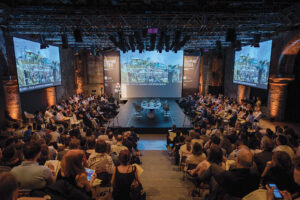
As the world population is increasing at unprecedented rates and wastelands are extending at a variety of new scale and in various spaces organizing the sprawling landscape, the line between formal and informal settings, God’s eye view planning walled off from the outside world and temporary structures seems to intensify. There is an urgency to reverse such inefficient growth with its consequent inhuman conditions and better plan world’s cities by means of urbanization. The Urban Age “Shaping Cities” Conference at the Venice Biennale (July 14-15, 2016) with the exhibition Conflicts of an Urban Age explored the connections among the political, economic and social city with the scale of its physical and urban form. Addressing themes such as expansion, redevelopment, adaption and confronting speakers and urban solutions from different backgrounds, the conference questioned the role of planning in the definition of more inclusive, safe, resilient and sustainable cities. The theme reconnects to Habitat III, the UN global cities summit set for Quito, Ecuador, in October 2016 implementing the New Urban Agenda for the world’s rapidly urbanizing areas.