
Archive
Category: Criticism
Exhibition Review
Criticism
Open Access
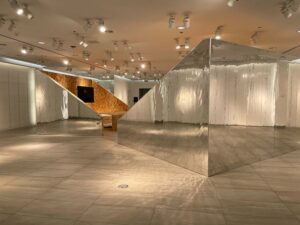
Abstractive Reuse. A Review of SHIFT: Ecologies at the 2025 Chicago Architecture Biennial
by Alex Serbanescu
pp. 241–248
Book Review
Criticism
Open Access
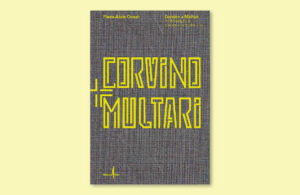
Our First Thirty Years: On Corvino + Multari
by Andrea Canclini
pp. 225–230
Corvino + Multari: Architecture in Dialogue with the CityBy Pierre-Alain CrosetMarsilio Arte, 20256.69 x 0.98 x 9.45 in. [17 x 3.3 x 24.3 cm]336 pages, 86 b/w and 280 color ill.€35 / £28 / $35 (paperback)ISBN: 9791254632932 (ENG)ISBN: 9791254632765 (IT)
Article
Criticism
Subscribers
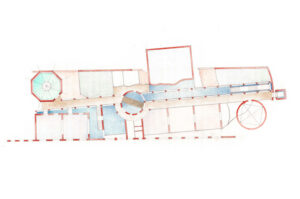
Massimo Carmassi, the Civic Architect of Pisa. Five School Projects
by Cecilia Marcheschi
pp. 119–139
This article examines the work of Massimo Carmassi, a civil servant architect and head of the architecture department of the Municipality of Pisa between 1974 and 1990, focusing on school architecture as a field of civic and urban design experimentation, both in terms of public commitment and authorial research. Developed within the framework of the progressive policies promoted by Pisan administrations during the 1970s and 1980s, Carmassi’s schools are interpreted as urban devices that introduce spatial quality, recognizability, and identity into the city’s peripheral neighborhoods, often marked by anonymity and a lack of collective spaces. The article explores the architect’s language, grounded in the deliberate use of a limited set of recurring devices – such as the wall, elementary formal structures, and the gallery building – alongside a restrained palette of materials, including brick, iron, and glass. What emerges is an understanding of public architecture not as a functional container, but as an active instrument in the construction of the city. This perspective frames Carmassi’s work as a form of architectural practice in which civic responsibility and authorial research are inseparably intertwined.
Exhibition Review
Criticism
Open Access
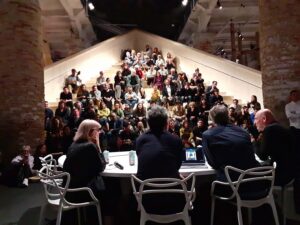
Beyond Exhibiting. Discourse at the 2025 Venice Architecture Biennale
by Maurizio Sabini
pp. 199–204
Essay
Criticism
Subscribers
Seven Charging Stations of the Soul
by Andreas Luescher
pp. 67–88
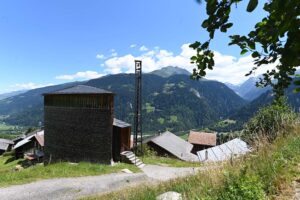
Contemporary alpine chapels have emerged over the past decade driven by the dialogue between the inner world of personal experience and the outer world of the built environment. These chapels are gems located in the pre-alps, where livestock still graze on mountain pastures in the warmer months. The seven alpine chapels discussed in this article take on various forms and purposes, such as a place for prayer, a destination for a pilgrimage, and a place for baptisms and burials. As sacred architecture, chapels were perhaps not seen as epochal creations, but these spaces change the definition and understanding of what a contemporary chapel can be. The seven contemporary award-winning European chapels included in this essay introduce a new architectural vocabulary that challenge the traditional notions of a chapel and its function. The paper articulates a specific relational network (Beziehungsgeflecht) as it explores an analogy between outside nature (physical features) and internal nature (the human organism) that is woven between the human, personal, and emotional experiences one may have while visiting these structures.
Buy
Already in your cart -
View cart

Polemic
Criticism
Open Access
The Monstrous Hybrids in Our Midst. Jane Jacobs and the Dark Age Ahead
by Thomas Fisher
pp. 9–19
We are honored to receive, and proudly publish, Tom Fisher’s acceptance speech for his 2025 AIA/ACSA Topaz Medallion award. [MS]
ABSTRACT - The political and social disruptions that often follow pandemics have accelerated many countries, including the United States, toward what Jane Jacobs described in her last book, entitled Dark Age Ahead (2004). This essay looks at Jacobs’ description of the characteristics of cultures that fall into a dark age and how we can see signs of them arising around the world today. Following that analysis, this essay explores what Jacobs calls the “five pillars” that stand against such cultural collapse and how the architecture and design community can help reinforce those pillars.
Book Review
Criticism
Open Access
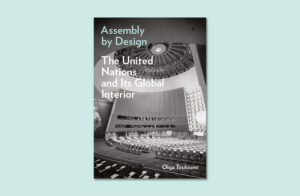
Assembly by Design: The United Nations and Its Global Interior
by Olivia Hamilton
pp. 571–576
Assembly by Design. The United Nations and Its Global Interior By Olga TouloumiMinneapolis MN, USA: University of Minnesota Press, 20247 x 10 in. [17.8 x 25.4 cm] 119 illustrations (106 b/w, 13 color plates)312 pagesUS$140 (hardcover)ISBN: 978-1517913328US$35 (paperback)ISBN: 978-1517913335US$35 (e-book)ISBN: 978-1452971544
Book Review
Criticism
Open Access
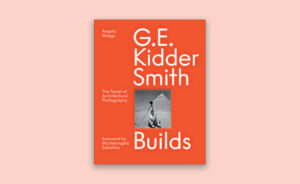
G.E. Kidder Smith Builds: The Travel of Architectural Photography
by Stephen Leet
pp. 303–309
G.E. Kidder Smith Builds: The Travel of Architectural PhotographyBy Angelo MaggiForeword by Michelangelo SabatinoEpilogue by Samuel Pujol SmithNovato CA, USA: ORO Editions, 202281/2 x 1 x 11 in. [21.6 x 2.5 x 28 cm]250 illustrations280 pagesUS$60.00 (hardcover)August 16, 2022ISBN-10: 978-1954081537ISBN-13: 978-1954081536

Article
Criticism
Subscribers
The Japan National Stadium: Between Architectural Bigness and Urban Smallness
by Aya Jazaierly, Andrea Canclini
pp. 57–77
In 2012, Zaha Hadid Architects (ZHA) was announced winner for the competition to design the Japan National Stadium, the main venue for the 2020 Olympics. Over the years, the project faced a range of controversy that ended with the scrapping of ZHA’s proposal in 2015, and the adoption of a non-iconic stadium designed by Kengo Kuma, one that is more integrated with its context. The critique against ZHA’s project involved Japanese architects led by Fumihiko Maki; it stemmed from the urban consequences such an architectural object would have, bringing the protagonists into conflict at the very intersection of their nature as architects and urban planners. This paper aims to analyze the reasons behind this controversy, which lies within the theoretical debate between a phenomenological approach on one hand and the autonomy of design on the other. Despite her established status as an archistar, Hadid’s proposal seemed to suffer the side effects of Koolhaasian “bigness”; the heritage discipline of preserving the built and natural environment of the neighborhood suddenly became a matter such an important structure had to deal with.
Buy
Already in your cart -
View cart
Essay
Criticism
Subscribers
Vernacular Architecture on Display: From Exhibited Artifact to Operative Discourse
by Stamatina Kousidi
pp. 35–56
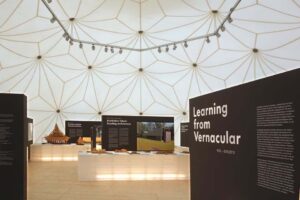
This article sets out to interrogate the exhibition as an essential form of critical discourse in architecture, looking at how it has engendered new conceptual and operative approaches to the vernacular notion. Focusing on the late 20th century, it explores how the exhibition space contributed to the praise of the vernacular as a valid design reference, by creating a platform for its renewed, consistent, and systematic reinterpretation. This praise did not entail the recovery of history but the redefinition of the relation between tradition and concepts of modernity, building and pre-existent context. The exhibition space thus served as a catalyst to the return of the vernacular model; it enabled new connections between project, travel, and theoretical discourse, engaging ever more international audiences. In recent exhibitions such a model manifests itself again through full-scale models, mock-ups, and pavilions that prioritize issues of materiality, construction, and experience. The article, ultimately, explores the vernacular as a cogent theme which may hold the key for a more inclusive, culturally-rooted, and holistic approach to the design of the built environment and its interpretation.
Buy
Already in your cart -
View cart