
Archive
Category: Theory
Essay
Theory
Open Access
The Wall That Articulates: Characteristics and Operability in Space
by Joana Pinheiro
pp. 87–105
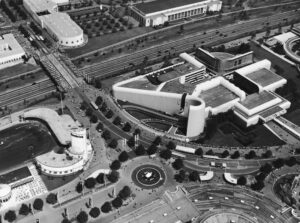
This essay stems from a dissertation that studies the “architectural wall” from a conceptual point of view. The wall acts in space in different ways and can present the purpose of emplacement, reference, articulation, enclosure or of an inhabitable wall. Among the wall types studied in the thesis, the wall that performs as an articulation agent is described in this paper. For that matter, a group of architectural works, that translate in a definite manner the operativity of this theory, is presented. Through the analysis of these case-studies, the definition of the type, by its determining properties, is reached. Besides considering this research as a scientific instrument in the field of architecture to understand the comprehensive element “wall,” which further interacts with man and its environment, it is also regarded as a didactical means. Through the acknowledgement of the properties given in the tables and diagrams of the type, it is possible along the process of design to identify this architectural element within its complex play of variables, and thereby use it in a more scrupulous and consequent manner.

Essay
Theory
Subscribers
The Transparency Trilemma: Interrogating Transparency in Architectural Design
by Matyas Gutai, Simon Richards, Aris Kafantaris
pp. 57–86
In light of emerging dialogues on the negative environmental impact of glass buildings that culminated in the glass building ban proposal in New York City, this paper reinterrogates the meaning and potentials of transparency in architecture. This is done by introducing the concept of the “Transparency Trilemma,” whereby glass envelopes are believed to be unable to provide thermal comfort, environmental sustainability, and optical transparency at the same time. By re-evaluating transparency from technical, spatial, and semantic viewpoints, this paper presents a comprehensive new Transparency Framework for the overall assessment of buildings on these grounds. The use of this framework can facilitate a more holistic evaluation of glass buildings across the full range of their potential meanings and applications, which would support better design and understanding of the role of transparency in contemporary architecture.
Buy
Already in your cart -
View cart
Essay
Theory
Subscribers
Urban Autophagy. A New Imaginary for Twenty-First Century Urban Growth
by Hannibal Newsom
pp. 37–55
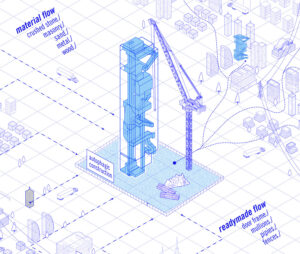
The human, environmental, and political impact of raw material resourcing throughout the global supply chain is a critical facet of any plan to confront accelerating climate change in the twenty-first century. Invoking the work of biologist Dr. Rhonda Patrick on autophagy, a mechanism through which mammalian bodies consume their own dead and dying cells to promote health and longevity, this essay explores the imaginary of Urban Autophagy as a mechanism through which the city can consume itself in order to grow. This essay presents a novel understanding of the limits of our natural resources and proposes a major shift in how we conceive of standard practices for sustainable development. First, this essay defines the model of Urban Autophagy; second, it surveys already-existing practices that support the model of Urban Autophagy; third, it presents a methodology that can be developed and expanded in order to introduce Urban Autophagy into standard practice; and finally, this essay argues for the implications of this approach toward a more ambitious stewardship of the environment and the health and longevity of our cities.
Buy
Already in your cart -
View cart
Conference Report
Theory
Open Access
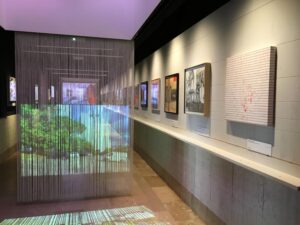
“Carlo Roma 2020”: Architecture, City and Politics in Carlo Aymonino’s Legacy
by Diana Carta
pp. 243–256
Book Review
Theory
Open Access
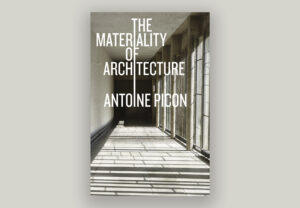
The Materiality of Architecture
by Stamatina Kousidi
pp. 551–562
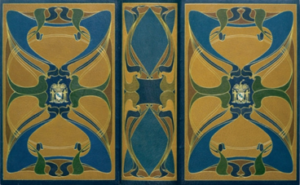
The Materiality of ArchitectureBy Antoine PiconMinneapolis and London: University of Minnesota Press, 20205 ½ in. x 8 ½ in.36 b&w photos192 pages$108.00 cloth ISBN: 978-1-5179-0945-5$27.00 paperback (January 2021) ISBN: 978-1-5179-0948-2
Article
Theory
Subscribers
The Contested Nature of Modernity: “Type and Individuality” in the Deutscher Werkbund
by Bilgen Dündar
pp. 243–262
The purpose of this paper is to contribute an inclusive insight into the debate of type (Typisierung) and individuality in the Deutscher Werkbund. The debate is widely discussed on the dichotomy between art and industry in the historiography of modern architecture. This paper aims to show that both camps of the debate wanted to constitute the synthesis of art and industry, but the methods that they used were different. This paper considers the debate as a referent of the contested nature of modernity. Modernity oscillates between the desire to give the modern world new modes of structure, order, regulation and to accept modernity with all complexities. This article claims that while the notion of type represents the former one, the notion of individuality represents the later one in the realm of architecture. This article unveiled the control mechanisms in the discourses of defenders of Typisierung. It found the concepts norm, organization, system, standardization, which were the reflections of the Enlightenment. On the other hand, it pointed out the reactions of the individualists against these discourses.
Buy
Already in your cart -
View cart
Essay
Theory
Open Access
Musings on Boredom, Midcentury Architecture, and Public Spaces
by Andreea Mihalache
pp. 119–138
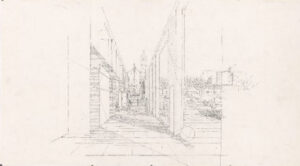
The rejection of “boredom” fueled the midcentury reaction against modernism, but little is known about the complicated presence of this mood in the architectural discourse. Far from being a mere rhetorical tool, the quip “Less is a bore” is part of Robert Venturi’s larger interest in boredom and was influenced by his reading of a book referenced repeatedly in Complexity and Contradiction in Architecture (1966): August Heckscher’s The Public Happiness (1962). A liberal writer and political activist, Heckscher situated boredom at the core of modern humanity’s alienation. While the concern with boredom was explicitly addressed in the humanities, I suggest that it was taking shape in midcentury architectural polemics under the influence of writings from other disciplines, as well as the emerging artistic practices that were deliberately embracing the “aesthetics of boredom.” Specifically, I will examine Venturi’s reading of Heckscher through two of his (unbuilt) civic projects that directly engage the issue of boredom: Three Buildings for a Town in Ohio (1965) and the entry for the Copley Square Competition (1966).
Essay
Theory
Open Access
On the CIAM 7 Grid: From an Ideological to a Critical Tool
by Pierre-Alain Croset, Andrea Canclini
pp. 89–117
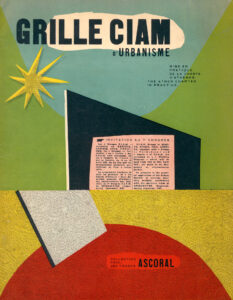
Much historiographical research has been produced on the post-war CIAMs, demonstrating the importance of the CIAM Grid, proposed as a “thinking tool” for representing the town planning projects at the CIAM 7 in Bergamo (1949). This essay proposes a new critical and epistemological examination of the CIAM Grid based on new archival documents and on a rereading of the exact words used by Le Corbusier, who proposed to consider the Grid as an “interlocutor.” Seventy years later, we propose to go beyond the failure of CIAM 7 and to elaborate a “new Grid,” with the name of “Second Life Grid,” as a critical tool for discussing exclusively projects related to the new paradigm of recycling and reusing buildings and urban spaces. Beginning with the question of the critical legacy of the CIAM Grid, our intention was to think of a Grid conceived no longer as an instrument of dogmatic and normative thought, but as an instrument of dialogical criticism which has been tested through an open call for projects and an international conference held in Bergamo in October, 2019.
Essay
Theory
Open Access
American Mirror: the Occupation of the ‘New World’ and the Rise of Architecture as We Know It
by Fernando Luiz Lara
pp. 71–88
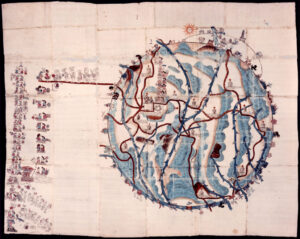
This paper argues that the rise of architecture as a unique discipline and the conquest of the American continent are not just chronological coincidences but interdependent variables of the same process of modernization. Traditional scholarship in architecture has not entertained those parallel developments at all. The field of architectural history and theory still treats the spatial occupation of the Americas as a consequence of the Renaissance and European modernization, despite a few decades of scholarly literature in related disciplines questioning such assumptions. (Fanon 1961; Said 1978; Dussel 1980; Bhabha 1987; Escobar 1994). Such scholarship demonstrates that the encounter of 1492 and the territorial occupation that followed played a central role in the development of Western culture in general, allowing the extrapolation of the same logic to the architectural discipline in particular.
Book Review
Theory
Open Access
Sibyl Moholy-Nagy: Architecture, Modernism and Its Discontents
by Eszter Polonyi
pp. 513–518
Sibyl Moholy-Nagy:Architecture, Modernismand Its Discontents By Hilde HeynenLondon: BloomsburyStudies in Modern Architecture, 2019234 mm x 156 mm 288 pagesUS$ 100.00 (hardback),US$ 31.46 (paperback)ISBN: 978-1-350094-11-6