
Archive
Category: Urbanism
Essay
Urbanism
Subscribers
Reconfronting Sprawl: Still Paved with Good Intentions as Well as Asphalt
by Doug Kelbaugh
pp. 187–199
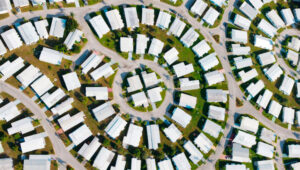
This paper, based on the author’s new book The Urban Fix: Resilient Cities in the War against Climate Change, Heat Islands and Overpopulation (2019), culminates over three decades of researching, teaching, and writing on American sprawl. One of the country’s biggest and most familiar problems, it could be described as a conspiracy of good intentions: short-sighted desires to live in nature; traffic safety engineers’ preference for wide thoroughfares; fire marshals’ desire to turn around hook-and-ladder trucks at the end of every cul-de-sac, etc. Over half of American homes are single-family dwellings – 69 million out of a total of 132 million. The fatal flaw is that these positive intentions quickly led to very high energy/carbon/ecological footprints per suburbanite – a challenge that is difficult because of extensive, indelible infrastructure. Densifying arterial strips, inserting transit, redeveloping a walkable, bikeable, mixed-use, and human-scaled urbanity is as urgent as it is essential in the nation’s effort to combat climate change.
Buy
Already in your cart -
View cart
Project
Urbanism
Open Access
Architecture and Intermodality. Guidelines for the Architecture of the Intermodal Hub at the FVG Airport Ronchi dei Legionari
by Giovanni Fraziano, Thomas Bisiani, Luigi Di Dato, Claudio Meninno, Adriano Venudo, Marko Verri
pp. 85–109
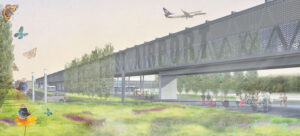
The research addresses the topic of intermodality in terms of technical, typological, and architectural response of infrastructure systems, considering their relationship with the territory and the landscape. The study starts from the hypothesis of the development of a comprehensive intermodal hub in the Ronchi dei Legionari Airport (Friuli-Venezia Giulia, Trieste, Italy), integrated with the network of local public transport and railway infrastructure, considered in a scenario of sustainability over the medium term and updated with respect to the current economic situation. The first phase of the research focused on the definition of the guidelines for the design of the intermodal hub. Subsequently, the study verified the hypothesis by modeling some alternative scenarios, whose results led to the identification of a highly comprehensive set of data, consistent with the financial framework. Lastly, urban verification: the identified scenarios constitute a framework of alternative options corresponding to the minimum, optimal and critical conditions of the system as a whole. The possible alternatives prove the degree of versatility of the proposed layout which provides, as a whole, the possibility of opting for one of the proposed scenarios or for a more complex combination of the proposed solutions.

Essay
Urbanism
Open Access
Urban Hacking. A Nobel Project for the Redundant City
by conrad-bercah
pp. 99–118
In 1963, Constantinos Doxiadis, Buckminster Fuller and Marshall Mc Luhan signed, among others, the little known “Delos Declaration,” which alerted the world that the “problem of expanding urban area may soon outstrip all other problems facing mankind, except that of nuclear war.” In the year 2016, it is clear to most that the “urban meltdown” has indeed outstripped “all other problems facing mankind, ‘including’ the possibility of nuclear war” and the reality of the financial meltdown, of which it is a direct result and from which there is no U-turn. How can we assure that modern cities develop a regenerative relationship to the living world on whose health they ultimately depend?The current scenario is dominated by the Redundant City whose march cannot be stopped ex-ante. Staying clear of Renzo Piano’s misguided (and falsely politically correct) rhetoric of urban mending, through "urban adjustments" we have a shot at trying to restore a sense of urbanity or “cityness” to constantly growing, shapeless conurbations. “Urban Hacking” argues for a new way to organize our urban systems, and for thinking and acting beyond what is considered “sustainable” development. Urban Hacking aims at establishing a healthier relationship between Natur and Kultur. The theory sponsors a new attitude towards urban matter based on little talked about modus operandi like demolition, recycling, multi-scaling and urban hacking.Urban Hacking may eventually lead to a Dörfer-Großstadt (metropolis of villages), namely an adjustable planning concept to counter the various redundancies of our time.

Article
Urbanism
Open Access
China’s Grand Canal. Strategies for Sustainable Urban Development in China
by Andrea Degli Angeli
pp. 73–97
China has had to deal with the huge architectural and urban development challenges created over the past fifty years. China’s economic growth model has been based on accelerated consumption and manufacturing, with inevitable and significant environmental and social consequences. The model discussed in this paper seeks to employ the principles of sustainability in a specific urban development context: the massive Beijing-Hangzhou Canal, the longest artificial waterway in the world. The model simulates a macro strategy for the redevelopment of this ancient water system utilizing and adapting highly successful traditional Chinese planning methods for urban, wetland and rural areas. Elements of this model could serve as the basis for effective future Chinese urban development in similar contexts. China has already begun actualizing policies and strategies to address major concerns about environmental and social issues. The proposed model is intended to contribute to this endeavour and to promote sustainable growth in the most populated country in the world. The project outlined in this paper shows that the planning elements that inspired Marco Polo’s admiration for Chinese cities are still highly relevant in a country increasingly damaged by inappropriate and standardized international urban development approaches.
Essay
Urbanism
Open Access
Form after Urbanism: The Potential of Grossform
by Martin Hättasch
pp. 59–76
Published: 2016-01-28
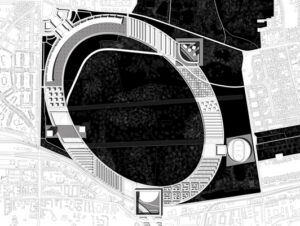
Grossformen im Wohnungsbau is the title of an unassuming pamphlet that German architect O.M. Ungers published in 1966 as part of the Veröffentlichungen zur Architektur series (VzA #5) during his tenure at the TU Berlin in the 1960’s. In it Ungers reimagines the singular architectural intervention at a scale between architecture and urbanism as a counter measure to the rapid urbanization brought about by Europe’s postwar boom. The formal coherence of Grossform (literally meaning “large form” in German) could provide a framework within which the unplannable processes of the contemporary city played out, while acting as stable markers of identity in an expanding urban field of increasing formlessness. Many of the ideas introduced in Grossformen would resurface throughout Ungers’ career, and eventually find their way into the better known Green Archipelago project. But where the morphologically pure islands in the Green Archipelago form a “dialectic city” only as a federation of ideal fragments, the scaleless concept of Grossform equally suggests the possibility of the island itself becoming a “dialectic object,” containing the exacerbated differences of the archipelago within. Faced with an urban environment in which traditional tools of urbanism have come to be swept away irrevocably by a limitless proliferation of building production, this reconsideration of the urban agency at the architectural scale appears highly pertinent today. Reconstituting the conceptual underpinnings of Grossform and outlining the trajectories of the “dialectic city” and “dialectic object” in reference to Ungers’ work, this paper aims to contribute to the (re)emergent debate on the conditions and constitutions of the architectural object: Through the combination of programmatic neutrality and formal specificity, Grossform may serve as the starting point for a contemporary paradigm in which the architectural object carries renewed urban relevance beyond its bounded form.